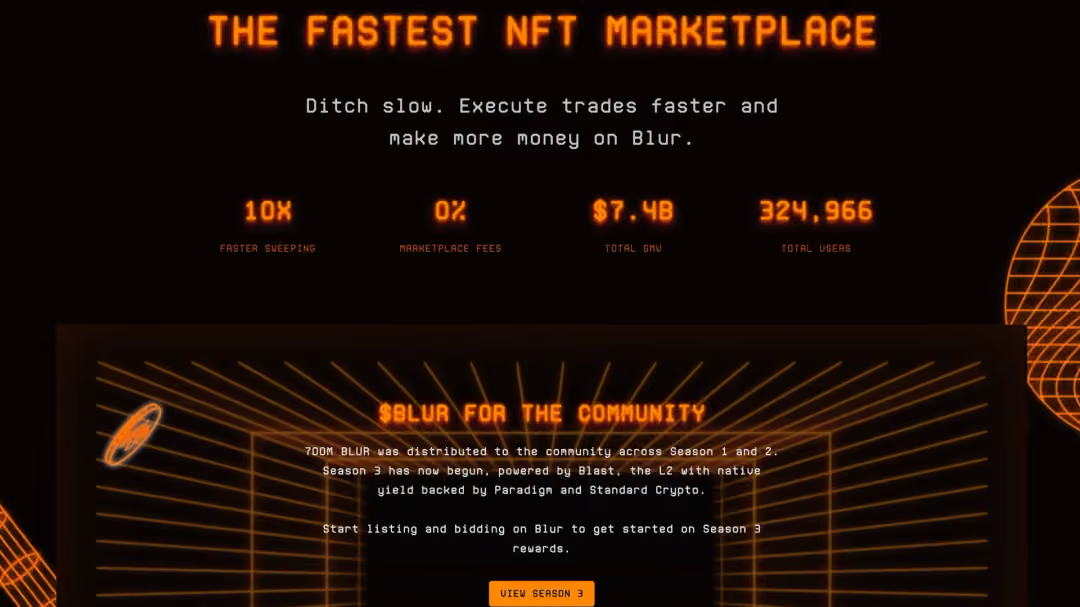
- Blur, which once captured more than 70% of Ethereum NFT trading volume and was the largest marketplace for digital asset trading on the network, is shutting down its website on November 12, 2026. The marketplace announced Monday that users have until that date to settle loans through Blend (Blur’s lending service) or allow them to default. After November 12, borrowers will have access to a separate tool to withdraw their collateral, but the core marketplace will be gone. The smart contracts underlying Blur will remain operational on Ethereum—meaning the blockchain infrastructure won’t disappear, but the user-facing platform will. BLUR tokenholders will retain voting rights over a “fee switch” that could theoretically allow the community to resurrect a marketplace and collect fees, but that’s a last resort for a dead protocol. The numbers tell a brutal story: Blur reached $1.43 billion in monthly trading volume in March 2023, at the peak of the NFT bubble. By March 2026, that monthly volume had collapsed to under $7 million. That’s a 99.5% decline in three years. The platform charged zero marketplace fees for all that trading, generating zero protocol revenue over three years despite facilitating billions in cumulative volume. A business model built on the thesis that incentive tokens would create enough trading velocity to justify the loss of fee revenue never materialized. The token rewards dried up. The speculative traders left. The organic user base evaporated. Blur became a ghost town.
- Blur’s shutdown is the second major retreat in ten days for creator Tieshun Roquerre (known as Pacman). On October 2, Blast—an Ethereum scaling network also created by Roquerre and developed by the Blur team—announced its shutdown. Blast had attracted more than $2 billion in total value locked (TVL) through generous user rewards. By the time of the shutdown announcement, that TVL had collapsed to approximately $32 million. Blast is shutting down because, as the team stated, the network cost more to operate than it generated in revenue. That statement is a damning indictment of the entire Roquerre portfolio: both Blur and Blast were built on a subsidy model. Token rewards. Airdrops. Incentive campaigns. They attracted billions in capital and trading volume while the money lasted. When the capital dried up (or the operators decided to stop spending), the users evaporated. The difference between a sustainable business and a subsidy trap is whether organic activity continues after incentives end. In both Blur and Blast, the answer was no. After incentives stopped, volume collapsed and operating costs became unsustainable.
- Blur’s rise and fall is particularly instructive because it challenges the narrative that “the winner takes most” in NFT markets. In March 2023, Blur captured over 70% of Ethereum NFT trading volume, crushing OpenSea (the previous leader). Validators predicted that Blur would dominate NFT trading indefinitely based on network effects, lower fees, and faster transactions. But the dominance lasted only months. By 2024, as the NFT market matured and speculation faded, trading volume on all platforms (not just Blur) collapsed. The problem wasn’t Blur’s platform design. The problem was that the entire NFT market was built on speculative momentum, not genuine use cases. Blur didn’t cause the NFT market crash. Blur just became a high-profile casualty of it. The critical failure was the business model: zero fees, zero protocol revenue, total dependency on token incentives. That model works only if (a) volume keeps growing, or (b) the team has infinite capital to subsidize operations. Neither proved true. Blur had neither the universe-scale network effects to sustain zero fees indefinitely, nor the capital reserves to keep subsidizing when volume collapsed.
- The BLUR token collapsed on the announcement, falling more than 20% to around $0.015 per token. For token holders, the fee switch (the right to vote on future marketplace fees) has theoretical value but zero practical value if there’s no marketplace to collect fees from. The smart contracts remain live on Ethereum, meaning a community fork or third party could theoretically rebuild Blur on top of the existing infrastructure. But the reputational damage is severe. If Blur is known for failing and shutting down, why would users trust a reboot? The only way the fee switch has value is if someone rebuilds Blur with an actual revenue model and genuine differentiation. That’s possible but unlikely. More likely, the BLUR token slowly approaches zero as the community realizes that voting rights on dead infrastructure are worthless. The Blur shutdown marks the end of an era for Ethereum NFT infrastructure. OpenSea, the original leader, is still operating but in decline. LooksRare, another competitor, is barely trading. Magic Eden exists primarily for Solana, not Ethereum. The Ethereum NFT market, once the hottest vertical in crypto, is now a sleepy backwater. Projects that built billion-dollar valuations on NFT trading infrastructure have discovered that it was all built on sand—sand made of token incentives and speculative momentum, not genuine, sustainable user demand.
What Happened?
Blur, the once-largest Ethereum NFT marketplace by trading volume, announced Monday that it will shut down its website and cease arranging new loans through its Blend lending service on November 12, 2026. The closure follows a catastrophic 99.5% decline in monthly trading volume from its March 2023 peak of approximately $1.43 billion to under $7 million by March 2026. Blur’s marketplace charged zero trading fees and generated zero protocol revenue over three years despite facilitating billions in cumulative NFT trading volume, relying instead on token incentive programs to attract users and trading activity. The website closure marks the second major retreat in ten days for Blur’s creator, Tieshun Roquerre (known as Pacman), following the October 2 shutdown announcement of Blast, an Ethereum scaling network also developed by Roquerre and the Blur team. Blast had attracted more than $2 billion in total value locked through user rewards but declined to approximately $32 million before its shutdown due to unsustainable operating costs. Blur’s smart contracts will remain operational on Ethereum after the website closure, allowing community governance through the BLUR token’s “fee switch” mechanism, which grants token holders voting rights over potential future marketplace fees. Borrowers using Blend have until November 12 to repay loans or allow them to default, with access to a separate asset withdrawal tool provided afterward. The BLUR token fell more than 20% following the shutdown announcement, trading around $0.015 per token.
Why It Matters?
Blur’s shutdown represents the collapse of a subsidy-driven business model that once dominated Ethereum’s NFT infrastructure and captured over 70% of trading volume at its March 2023 peak. The failure demonstrates that market dominance built on token incentive programs, user rewards, and subsidized fees cannot sustain organic trading activity once those incentives disappear. The parallel shutdown of sister project Blast (which faced identical economics—declining TVL from $2 billion to $32 million due to unsustainable operating costs) reinforces the pattern: both Blur and Blast were built on the assumption that either trading volume would grow indefinitely to justify zero fees, or that capital reserves would sustain indefinite subsidies. Neither occurred. The broader implication is that the Ethereum NFT infrastructure market, once the hottest vertical in crypto during the 2021-2023 bull cycle, has collapsed not just in trading activity but in fundamental viability. OpenSea (the original market leader) remains operational but in significant decline. Competitors like LooksRare are barely trading. The market structure reveals that genuine demand for NFT trading infrastructure remains low, and previous valuations and market dominance were entirely dependent on speculative momentum and token incentive programs. For token holders, the BLUR fee switch—voting rights over potential future fees—has theoretical value but no practical utility if there is no functioning marketplace to collect fees from. A community fork or third-party rebuild is theoretically possible but unlikely given reputational damage and lack of perceived competitive advantage.
What’s Next?
Monitor whether Blur’s smart contracts are accessed or utilized by community developers after the November 12 website closure. If a rebuild or fork emerges with genuine revenue model differentiation, it could resurrect value in BLUR tokens and NFT infrastructure. If smart contracts remain dormant, BLUR approaches zero value. Track the broader Ethereum NFT market for stabilization or further collapse. If other major NFT platforms (OpenSea, Magic Eden on Ethereum, others) also announce shutdowns or major layoffs, it confirms that NFT infrastructure as a whole is unsustainable in the current market environment. If trading volumes stabilize across remaining platforms, it suggests the market has found a sustainable floor. Monitor Tieshun Roquerre and his team’s next moves. If they launch new projects with similar subsidy-driven models, investors should treat them with extreme skepticism given the Blur/Blast failure pattern. If they pivot to sustainable business models, it could signal lessons learned. Watch BLUR token price action through November 12. A recovery above $0.02 would suggest some investor conviction in fee switch value or rebuild prospects. A decline toward $0.01 or below would confirm market judgment that the project is dead. Finally, examine whether any major Ethereum NFT traders migrate to alternative ecosystems (Solana, Tezos, newer L2s) or simply exit NFT trading entirely. If traders are exiting the category rather than moving to competitors, it validates the hypothesis that NFT infrastructure is a diminished market.
Affected Tickers and Coins: BLUR | ETH | BLAST
Source: CoinDesk