
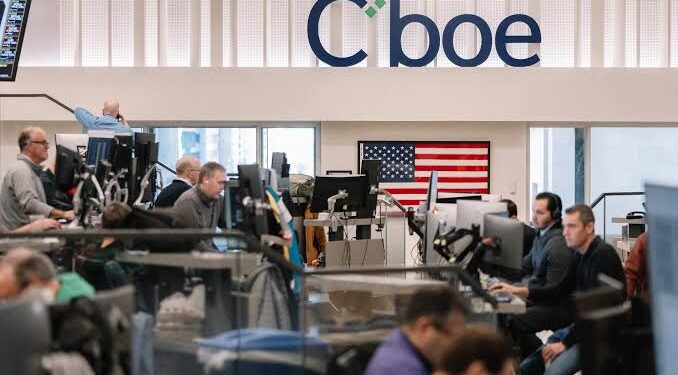
- Cboe is examining perpetual futures on the VIX volatility index, which measures expected S and P 500 volatility over the following 30 days. Rob Hocking, global head of derivatives, said the exchange will explore listing them once there is more regulatory clarity, noting that clients have long asked how to access VIX cash and that no good method exists.
- Existing proxies are expensive. Cboe already lists VIX futures and options, and exchange-traded funds track the index, but because those funds hold derivatives rather than the index itself they are imperfect and can be costly in normal conditions. The ProShares VIX Short-Term Futures ETF has lost 34% in 2026.
- Perpetual futures never expire and use a funding mechanism intended to anchor the contract near spot, with leverage that magnifies gains and losses. Robinhood revealed this week it will offer US clients up to 10 times leverage on Bitcoin and Ether perpetuals, with other crypto perpetuals at up to three times.
- Cboe separately signed a 25-year extension of its exclusive licensing agreement with S and P Dow Jones Indices through 2051, sending shares higher. Its S and P 500 index options trade around $1 trillion of notional value daily.
What Happened?
Hocking, a former equity volatility trader at Goldman Sachs, was speaking at the Bloomberg Intelligence Derivatives Market Structure Conference in New York on September 30. He called for clearer regulatory guidance on how perpetual futures are overseen, saying there is substantial opportunity to innovate but that the rules need to be established first.
Why It Matters?
The 34% loss on the VIX futures ETF explains both the demand for a better instrument and why caution is warranted. That decline is not a market call gone wrong, it is structural: funds holding VIX futures must roll them forward, and in normal conditions the next contract typically costs more than the one expiring, so holders pay a persistent carry. Many retail investors buy these products believing they own portfolio insurance, and instead own a position that bleeds while markets are calm. A perpetual future would track spot more closely, but perpetuals carry their own funding payments that can run against holders for extended periods. The cost is relocated rather than removed, and anyone evaluating a VIX perpetual should ask what the funding rate looks like in quiet markets. Hocking argument against his own prospective product is unusually candid and worth repeating to clients. He points out that options deliver comparable leverage with asymmetric payouts, where gains accelerate as the position moves favourably, and that an option buyer loss is capped at the premium paid. A perpetual future is linear with no such cap. A derivatives head describing the instrument he already sells as structurally better than the one he is exploring is a meaningful caution. The broader pattern is leverage reaching retail quickly. Robinhood offering 10 times leverage on crypto perpetuals to US clients, alongside CFTC exemptions opening prediction markets to consumer applications, means highly geared instruments are becoming widely accessible while the regulatory framework is still being written. The licensing extension is the most valuable item here commercially, securing the franchise behind $1 trillion of daily options notional through 2051.
What Next?
Regulatory clarity on perpetual futures is the gating item Hocking identifies, and no timeline exists. Watch whether the CFTC addresses perpetuals explicitly, given that it has been active on crypto market structure and prediction markets. If VIX perpetuals do launch, the funding rate in calm markets is the number that determines whether they are genuinely cheaper than the existing ETF route. Robinhood rollout of 10 times crypto leverage is the near-term test of retail appetite and of how these products behave in a drawdown. For Cboe shareholders the licensing extension through 2051 matters more than any new listing, since it protects the index options business that generates the bulk of the franchise value.
Affected Tickers and Coins: CBOE, VIXY, HOOD, SPGI, BTC, ETH
Source: Bloomberg


