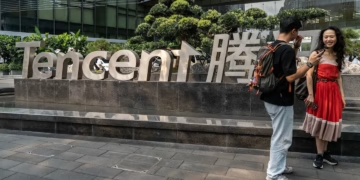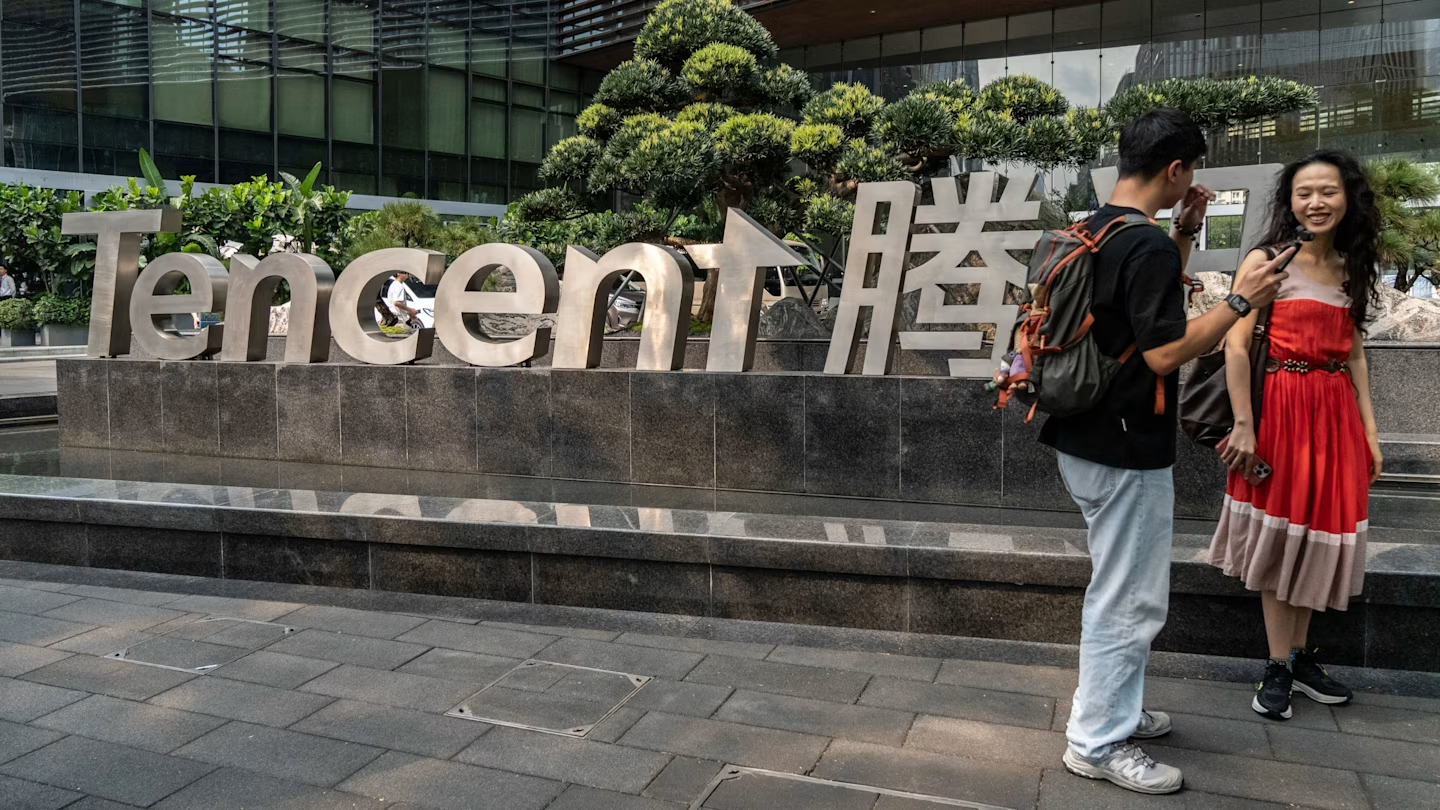
- Tencent is raising $5 billion in bonds to fund AI capital expenditures, joining a massive wave of Chinese and global tech companies borrowing heavily to compete in the AI arms race. The offering includes $1.5 billion to $2 billion in US dollar tranches and 20 billion to 25 billion yuan ($3 billion to $3.7 billion) in offshore yuan notes. Pricing could happen as early as Tuesday. Tencent told investors the bulk of the proceeds would go toward chip purchases, with the rest funding broader AI-related capex. The company also told investors it has no plans to issue shares or convertible bonds, which suggests management is committed to avoiding dilution at all costs. That’s a signal: Tencent would rather borrow at elevated yields than dilute shareholders. That desperation to fund capex without dilution tells you how critical AI spending has become to Chinese tech competition.
- The capex intensity is stunning. In Q2 2026, Tencent spent 52.8 billion yuan on AI and computing infrastructure, a 176% year-over-year increase. That single quarter’s spending triggered a free-cash outflow of 13.8 billion yuan. Annualized, based on Q2 levels, that’s over 200 billion yuan per year. Management told investors to expect capex to remain elevated through the remainder of 2026 and into 2027. So we’re looking at multiple years of 200+ billion yuan annual spending. For context: that’s roughly $28 billion annually at current exchange rates. Tencent is not alone. SoftBank raised $11.1 billion in junk bonds (one of the largest corporate junk-bond offerings ever). Alibaba raised a record $10.2 billion follow-on offering. Z.AI (a Chinese AI model maker) raised $9.6 billion through IPO, placements, and convertibles. The entire sector is in an AI capex arms race, and the capital markets are funding it despite rising scrutiny about whether it will actually generate returns.
- The strategic context is catch-up. Tencent is explicitly trying to catch up to ByteDance and Alibaba in AI. ByteDance is the dominant player in recommendation algorithms (TikTok, Douyin) and has been investing heavily in LLM and multimodal models. Alibaba built a massive cloud infrastructure business and is now pivoting hard into generative AI. Tencent, historically strong in gaming and social messaging, feels behind in the AI narrative. Raising $5 billion in bonds and committing to 200+ billion yuan annual capex is management saying: we are going all-in on AI, and we will spend whatever it takes to catch up. That willingness to borrow and commit capital is a bet that AI will be strategically decisive over the next 3-5 years. If that bet is wrong—if AI models plateau, if competitive advantages aren’t durable, if ROI remains poor—Tencent has saddled itself with years of high debt and depreciation on worthless infrastructure.
- The market is funding this despite ROI skepticism. Investors who bought SoftBank bonds, Alibaba’s follow-on, and now Tencent bonds are essentially betting that the capex will eventually generate returns. But there’s a growing undercurrent of investor concern: is this a boom that will collapse? Are we funding white elephant infrastructure projects? Tencent’s decision to tell investors it has no plans to issue shares is interesting because it suggests management knows that share dilution would face investor skepticism. By borrowing instead, they’re saying: trust us, this will work. But that trust is being tested. The bond market is funding these capex booms, but yields are rising and scrutiny is increasing. If a quarter arrives where Tencent reports disappointing AI progress or signals that capex might need to moderate, the bond and stock markets will both react negatively. The company has made a huge bet on AI mattering strategically in the next 2-3 years.
What Happened?
Tencent Holdings announced plans to raise approximately $5 billion through a bond offering to finance AI-related capital expenditures, with the company expected to price the deal as early as Tuesday. The offering comprises $1.5 billion to $2 billion across US dollar tranches and 20 billion to 25 billion yuan ($3 billion to $3.7 billion) in offshore yuan notes. In investor calls, Tencent indicated that proceeds would be used primarily for general corporate purposes related to AI, with the bulk of AI spending directed toward chip purchases. The company also told investors it has no plans to issue equity or convertible bonds. Tencent’s move follows aggressive capex increases in the second quarter, when the company spent 52.8 billion yuan on AI and computing infrastructure, representing 176 percent year-over-year growth. That quarterly spending triggered a free-cash outflow of 13.8 billion yuan. Management indicated that capex will remain elevated through the remainder of 2026 and into 2027, with annual spending likely to exceed 200 billion yuan based on Q2 levels. Tencent’s bond offering is part of a broader trend of Chinese and global tech companies turning to capital markets to fund AI investments. SoftBank recently raised $11.1 billion through junk bonds, Alibaba raised a record $10.2 billion via follow-on offering, and Z.AI generated $9.6 billion through IPO, placements, and convertible bonds.
Why It Matters?
Tencent’s $5 billion bond offering and commitment to 200+ billion yuan annual capex through 2027 represents a strategic inflection for the company and a stress test for the global capital markets’ faith in AI. The numbers are substantial: Tencent is borrowing $5 billion and committing to roughly $28 billion in annual capex for multiple years—all to compete in an arms race where the winner is not yet determined and returns remain uncertain. The company’s explicit statement that it has no plans to issue shares is particularly telling. It signals that management believes diluting shareholders with equity offerings would be more damaging to stock price than incurring debt. In other words, management thinks the market would judge a massive equity raise as a sign of desperation or dilution, but will accept debt as a vote of confidence. That confidence is being tested. Investors are funding these capex booms through bonds and equity offerings, but the underlying concern is rising: will these investments generate returns? If AI model capabilities plateau, if competitive advantages prove non-durable, or if compute infrastructure becomes commoditized, Tencent will have spent 200+ billion yuan annually on increasingly worthless assets. For global financial markets, the significance is concentration of capital. SoftBank, Alibaba, Z.AI, Tencent, and a handful of US mega-cap tech firms are absorbing capital market funding at unprecedented scale for AI capex. If the capex boom ends or if returns disappoint, the bond market could face simultaneous pressure from issuers needing to refinance or issues from issuers cutting capex. That would create a credit crunch in the tech sector.
What’s Next?
Monitor how the bond prices. If Tencent’s $5 billion offering prices at tight spreads (tight relative to Chinese credit), it signals continued investor confidence in the capex story. If spreads are wide or if demand is weak, it signals skepticism. Track quarterly capex guidance in upcoming earnings. If Tencent continues to guide for 200+ billion yuan annual capex through 2027, management is committed. If guidance moderates, it means management is seeing pushback from either investors or internal ROI concerns. Watch for commentary on AI progress and monetization. Tencent needs to show that its capex is actually translating into better AI models, products, and revenue. If earnings season passes without clear evidence that AI capex is generating returns, stock and bond prices could both suffer. Monitor competitor capex signals. If Alibaba or ByteDance moderate their capex guidance despite leading positions, it signals the sector is hitting saturation or returns are disappointing. If they continue escalating capex, it validates Tencent’s commitment. Track broader tech bond market conditions. If 10-year Treasury yields spike above 5.5% or credit spreads widen broadly, Tencent and other tech issuers will face higher refinancing costs. That could force capex moderation across the sector. Finally, watch for any commentary from Chinese policymakers on tech capex or debt levels. If regulators begin expressing concern about the scale of debt financing for AI, it could constrain refinancing access and force capex cuts across the sector. The current environment is heavily supportive of capex funding, but that can change quickly if policy shifts or financial conditions tighten.
Affected Tickers and Coins: TCEHY | BABA | SFTBY
Source: Bloomberg