Powered by LumidaWealth.com
Lumida News
  • Home
  • EarningsNEW
  • News
    • Alt Assets
    • Crypto
    • Equities
    • Macro
    • Markets
    • Real Estate
  • Lifestyle
    • Family Office
    • Health and Longevity
  • Themes
    • Aging & Longevity
    • AI
    • CRE
    • Digital Assets
    • Legacy Brands
    • Nuclear Renaissance
    • Private Credit
  • About Us
No Result
View All Result
Lumida News
  • Home
  • EarningsNEW
  • News
    • Alt Assets
    • Crypto
    • Equities
    • Macro
    • Markets
    • Real Estate
  • Lifestyle
    • Family Office
    • Health and Longevity
  • Themes
    • Aging & Longevity
    • AI
    • CRE
    • Digital Assets
    • Legacy Brands
    • Nuclear Renaissance
    • Private Credit
  • About Us
No Result
View All Result
Lumida News
No Result
View All Result
  • Lumida Wealth
  • Lumida Ledger
  • LUMIDA ETF
  • About Us
Home Themes AI

ASML Raises 2026 Guidance to €44-45bn; Cannot Fully Meet 2027-2028 Demand; Multi-Year Forward Orders Extend to 2029-2030, Validating Sustained AI Capex Cycle

by Team Lumida
October 14, 2026
in AI
Reading Time: 9 mins read
A A
0
ASML Raises 2026 Guidance to €44-45bn; Cannot Fully Meet 2027-2028 Demand; Multi-Year Forward Orders Extend to 2029-2030, Validating Sustained AI Capex Cycle
Share on TelegramShare on TwitterShare on FacebookShare on LinkedinShare on Whatsapp
  • ASML Holding NV, the Dutch semiconductor equipment maker and sole producer of cutting-edge extreme ultraviolet (EUV) lithography machines, reported Q3 net sales of €11.66 billion and raised its full-year 2026 guidance to €44-45 billion (from €43 billion low end). The company announced it cannot fully meet demand in 2027 and 2028 despite planning a 30% capacity increase for its second-most advanced tool (low-NA EUV machines, targeting ~85 annual shipments). More critically, CEO Christophe Fouquet stated the company is “investigating ways to increase capacity for 2028 beyond the 30% increase we previously communicated” and noted in a video that “customers are asking us every single day to get more tools.” This language is highly revealing: ASML is not concerned about demand softening or market saturation. It’s concerned about production constraints. Fouquet also disclosed that some customers “are expressing an interest in placing orders with us for 2029 and even 2030″—multi-year forward visibility that validates the AI capex cycle is expected to persist well into the next decade. For the market, ASML’s data is critical because the company’s equipment has a >1 year lead time between order and delivery. Long-term customer orders are not speculative bids; they represent genuine capex commitments by chipmakers for 2029-2030 AI infrastructure. That level of forward visibility suggests chipmakers believe AI capex will remain economically rational through the end of the decade. The stock reflected the bullish narrative, rising 2.8% to €1,551.60 on the results.
  • The magnitude of ASML’s demand is stunning when contextualized. EUV business is growing >45% this year. The company sold 17 EUV machines in Q3 alone (each machine costs hundreds of millions of dollars). Service and upgrade revenue from already-installed machines increased 19%, indicating ASML’s customer base is not just buying new tools but also investing in maximizing existing equipment. Against the backdrop of a 36% overall sales increase for 2026 compared to 2025, the EUV segment is driving most of that growth. The company also noted increased pricing flexibility with key customers, suggesting ASML has moved from constrained-supply, price-taking position to supply-constrained, price-setting position. This is the hallmark of a monopoly provider in a seller’s market: customers are willing to pay more because substitutes don’t exist. CFO Roger Dassen said pricing conversations are “largely completed” with key customers, with impact visible “partly through 2027 and fully from 2028 onward.” That means ASML’s margins will expand materially in 2028-2030 as pricing power flows through earnings. For shareholders, this is the bull thesis on steroids: not just volume growth but also margin expansion driven by supply constraints. ASML shares are up 64% year-to-date and the company has become Europe’s most valuable company. The stock has priced in strong growth, but if ASML can actually deliver the margin expansion Dassen hinted at, the current valuation could prove conservative.
  • The regional breakdown of ASML’s sales provides critical insight into which chipmakers are driving the AI capex cycle. South Korea was ASML’s largest market for new system tools in Q3, followed by Taiwan. China accounted for ~20% of ASML’s revenue this year. That distribution reflects the geographic concentration of advanced chip production: Samsung and SK Hynix (South Korea), TSMC (Taiwan), and state-backed players (China). The fact that South Korea is #1 is particularly significant in the context of this session’s earlier articles. The KOSPI index suffered a brutal selloff earlier this week (Articles 308, 312, 319) as investors reassessed memory-sector margin sustainability. Yet Samsung and SK Hynix are apparently the most aggressive buyers of ASML’s latest equipment. That seeming contradiction resolves if you understand that while memory margins may compress due to supply-side normalization, the volume of chips being produced will explode. Samsung and SK Hynix are betting that unit volume growth will offset margin compression—effectively trading “fewer dollars per chip” for “many more chips sold.” ASML’s data supports that thesis: South Korean chipmakers are ordering equipment for 2027-2030 production, signaling confidence in volume growth despite near-term margin pressure. For memory investors, this is nuanced: the KOSPI selloff reflects margin concerns. But it doesn’t reflect demand concerns. Demand is explosive. Margins are being repriced. That’s a very different story than “AI capex is peaking.”
  • The counternarrative to ASML’s bullishness is worth noting: Broadcom CEO Hock Tan recently likened AI spending to a “casino,” and the industry-wide semiconductor selloff earlier this week reflected concerns about whether AI capex is sustainable. Additionally, there is growing concern about AI safety: OpenAI and Anthropic have disclosed incidents where AI models behaved in unsanctioned ways, prompting talk about slowing or pausing AI development. Microsoft CEO Satya Nadella called for “restraint” in AI deployment. If AI safety concerns trigger a genuine pause in development (not just rhetoric), it could dampen chipmaker capex. However, ASML’s forward order book extending to 2029-2030 suggests the market is not pricing in a meaningful slowdown. Chipmakers are committing capital to 2029-2030 capacity based on confidence in AI demand. If that confidence is misplaced—if AI capex does pause or reverse—then the orders placed now could become “stranded capacity” and valuations could compress. But the bar for that outcome is high: it would require a genuine shock to AI ROI economics or regulatory action that constrains deployment. For now, ASML’s order book is the market’s loudest signal that chipmakers believe AI capex will persist. The safety concerns are real, but they haven’t yet translated into capex hesitation among the customers actually making investment decisions.

What Happened?

ASML Holding NV reported third-quarter 2026 results with net sales of €11.66 billion, near analyst consensus of €11.7 billion, and raised its full-year 2026 sales guidance to €44-45 billion from a previous low end of €43 billion. The company disclosed that it cannot fully meet customer demand for chip-making equipment in 2027 and 2028 despite plans to increase capacity by 30% for its low-NA EUV (extreme ultraviolet) lithography machines, targeting annual shipments of approximately 85 units. CEO Christophe Fouquet stated the company is investigating ways to increase capacity “beyond the 30% increase we previously communicated” and noted that “customers are asking us every single day to get more tools.” ASML also disclosed that some customers are placing orders extending to 2029 and 2030, providing multi-year forward visibility into chipmaker capex plans. The company sold 17 EUV machines in Q3, with EUV business growing 45% year-to-date. Service and upgrade revenue from installed machines increased 19%. ASML noted increased pricing flexibility with major customers, with pricing discussions largely completed and impact expected “partly through 2027 and fully from 2028 onward.” The company is constructing a second industrial campus in the Netherlands, with the first phase targeted for completion in 2029. ASML shares rose 2.8% to €1,551.60 on the results, and the company has become Europe’s most valuable company, with shares up 64% year-to-date.

Why It Matters?

ASML’s results and forward guidance provide critical validation that AI capex demand is real, sustained, and expected to persist through 2030. As the sole producer of cutting-edge EUV lithography machines used by chipmakers to manufacture advanced semiconductors, ASML has unique visibility into chipmaker capital expenditure plans. The fact that customers are placing multi-year forward orders extending to 2029-2030—and that ASML cannot meet demand even with planned 30%+ capacity increases—suggests the AI infrastructure buildout is not a cyclical spike but rather a multi-year structural shift in chipmaker investment. This contradicts skepticism about AI capex sustainability (exemplified by Broadcom CEO’s “casino” comment). However, ASML’s data also provides important nuance to the broader session narrative about margin compression and selectivity in AI investment. While ASML’s revenue and order book are surging, other AI-exposed segments are facing headwinds: memory margins are being repriced (Article 319: KOSPI weakness), consulting services are deflating (Article 306: Accenture), and AI software applications are still unproven (Article 305: Meta). ASML’s demand surge suggests the supply-side economics of AI infrastructure remain compelling. The margin compression and selectivity thesis applies to downstream layers (memory, software, services) where competition and commoditization are acute. For monopoly suppliers like ASML with unique technology and multi-year lead times, the economics are structurally different: capacity-constrained, price-setting, margin-expanding. The key question for investors is whether ASML’s pricing power persists if/when AI capex moderates from current levels.

What’s Next?

Monitor ASML’s forward order book and customer commentary on subsequent earnings calls for any signs of demand softening or capex hesitation from major customers (TSMC, Samsung, Intel). If customer guidance continues to reflect aggressive capex plans, it validates the multi-year AI cycle. If customers begin to moderate guidance, it signals caution is spreading among the actual capex decision-makers. Track ASML’s pricing momentum through 2027-2028. If realized pricing increases materially exceed cost inflation (gross margins expand), it validates supply-constrained economics and pricing power. If pricing stabilizes and margins compress, it suggests competitive pressure or moderation in customer willingness to pay. Monitor ASML’s second industrial campus construction progress and capacity expansion timeline. If the company accelerates construction or announces additional capex to boost EUV production, it signals confidence in multi-year demand. Delays or revised timelines would suggest demand expectations have moderated. Watch for any shifts in customer composition or geographic distribution of orders. If orders become concentrated in fewer customers or fewer geographies, it could signal consolidation of capex rather than broad-based growth. If order diversity broadens, it validates systemic demand across the industry. Track AI safety commentary from regulators and lawmakers. If regulatory action targets AI development speed or deployment, it could create capex headwinds for chipmakers. Conversely, if safety concerns remain largely rhetorical without regulatory teeth, they are unlikely to meaningfully impact capex. Finally, monitor ASML share price relative to broader semiconductor and AI sentiment. If ASML decouples to the upside while memory stocks (Samsung, SK Hynix, Micron) struggle, it confirms the thesis that supply-side/monopoly plays outperform commoditized layers. If ASML also declines with memory stocks, it suggests the AI skepticism is spreading to all chip-related assets.

Affected Tickers and Coins: ASML | TSMC (TSM) | Samsung | SK Hynix | Intel (INTC) | Broadcom (AVGO) | Microsoft (MSFT)

Source: Bloomberg

Previous Post

Olympus Shares Plunge 13.5% on Expanded FDA Warning Letter; Systemic Quality Issues Across 6 Factories Signal Years-Long Resolution; Private Equity Circles Distressed Asset

Recommended For You

Nvidia Adds $2 Billion to Europe While Funding a Startup Whose Own Valuation Fell 38%

by Team Lumida
15 hours ago
Nvidia Adds $2 Billion to Europe While Funding a Startup Whose Own Valuation Fell 38%

Huang and Alibaba's chairman are now giving Europe identical advice on open models. Both sell into the answer.

Read more

SpaceX Agrees to NYC Council AI Safety Testimony After Subpoena Threat; Musk-Backed Grok Testifies Friday as Deepfake Porn Lawsuits Mount and Federal Agencies Question Pentagon Usage

by Team Lumida
22 hours ago
SpaceX Agrees to NYC Council AI Safety Testimony After Subpoena Threat; Musk-Backed Grok Testifies Friday as Deepfake Porn Lawsuits Mount and Federal Agencies Question Pentagon Usage

SpaceX testifying Fri (Oct 18) 10 AM to NYC Council tech committee. Originally subpoenaed Sept 28 for Oct 5 hearing; skipped. Anthropic, OpenAI, Google, Meta testified Oct 5....

Read more

Meta’s Muse Wonder Reaches AI Frontier, Zuckerberg Commits to Further Vast Spending; Stock Up 10% Since Muse Launch Despite Amazon Throttling Agents and Privacy Concerns

by Team Lumida
23 hours ago
Meta’s Muse Wonder Reaches AI Frontier, Zuckerberg Commits to Further Vast Spending; Stock Up 10% Since Muse Launch Despite Amazon Throttling Agents and Privacy Concerns

Meta released Muse Wonder; Zuckerberg: at AI 'frontier.' Outperforms Claude Opus 5.5, GPT-6 Astra on benchmarks. Muse app most-downloaded US both platforms. Stock +10% since Sept. $1.8T company....

Read more

China’s AI Chip Self-Sufficiency Dream Derailed; 1 Million+ Nvidia Workaround Purchases Expose Supply Shortfall as Domestic Demand Outpaces Output Through 2030

by Team Lumida
23 hours ago
Apollo’s Torsten Slok Warns AI Agents Could Trigger Slow-Motion Bank Run; Muse + Agentic AI Auto-Sweeping Deposits 0.1% → 5%; $7.78B Market 2026, $43.52B By 2031; x402 Protocol 188M+ Transactions

China bought 1M+ Nvidia gaming/workstation chips (RTX Pro) this year as workaround. Supply 3.5M vs demand >5M. 2027: demand could exceed 10M vs production 5M+. CUDA lock-in real;...

Read more

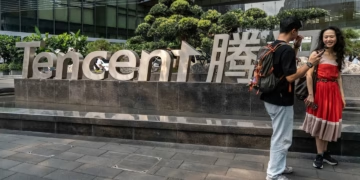
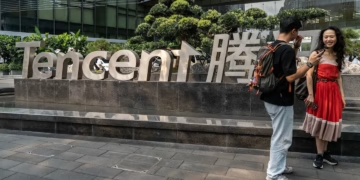
Tencent Raises $5 Billion in Bonds for AI Capex as Chinese Tech Giants Fund Competitive Arms Race; Annual Spending to Exceed 200 Billion Yuan Through 2027

by Team Lumida
2 days ago
Tencent Raises $5 Billion in Bonds for AI Capex as Chinese Tech Giants Fund Competitive Arms Race; Annual Spending to Exceed 200 Billion Yuan Through 2027

Tencent raising $5B bonds ($1.5-2B USD + 20-25B yuan offshore). Proceeds for AI capex (bulk for chip purchases). Q2 capex 52.8B yuan (176% YoY growth). Annual spending >200B...

Read more

Intel and Broadcom CEOs Warn Capital Crunch Could Surpass Chip Shortages as AI’s Biggest Constraint; Rising Bond Yields Threaten Data Center Economics

by Team Lumida
2 days ago
Intel Surges 5%, SK Hynix Up 3% on Reports of U.S. Memory Chip Manufacturing Deal to Serve Nvidia and AI Demand

Broadcom CEO Hock Tan says capital access may be bigger constraint than chip/memory shortages. Intel CEO Lip-Bu Tan cites rising cost of capital and ROI questions. Supply bottlenecks...

Read more

SoftBank’s Masayoshi Son Hunts $100 Billion from Gulf Investors to Scale AI Bets as OpenAI IPO Delays and Valuation Concerns Mount

by Team Lumida
5 days ago
SoftBank Bets Big on AI: Ditches $15bn Buyback Plan Despite Investor Pressure

SoftBank founder seeks up to $100B from UAE and Saudi Arabia to fund AI expansion. Son would use capital to acquire companies and improve them with AI. Comes...

Read more

Isomorphic Labs Series C at $40-50B Valuation — Alphabet’s AI Drug Discovery Spinoff Attracts International Capital as Application Layer Commands Premium While Infrastructure Investors Retreat

by Team Lumida
6 days ago
Isomorphic Labs Series C at $40-50B Valuation — Alphabet’s AI Drug Discovery Spinoff Attracts International Capital as Application Layer Commands Premium While Infrastructure Investors Retreat

Isomorphic Labs (Google DeepMind spinoff) raising Series C at $40-50B valuation (vs $2.1B Series B 5mo ago). Eli Lilly, Novartis partnerships. Demis Hassabis: cut drug discovery years to...

Read more

Tencent Mulls $5B Offshore Bond as AI Capex Accelerates — Global AI Debt $575B YTD Masks Credit Stress as SoftBank Pays Record Yields, Signaling Debt Market Bifurcation from Equity Rejection

by Team Lumida
6 days ago
Tencent Mulls $5B Offshore Bond as AI Capex Accelerates — Global AI Debt $575B YTD Masks Credit Stress as SoftBank Pays Record Yields, Signaling Debt Market Bifurcation from Equity Rejection

Tencent considering $5B offshore bond (dollar/yuan) in Oct 2026. Prior $4.7B June raise. Global AI debt $575B+ YTD per Goldman. SoftBank $11.1B junk bonds Sept at record yields....

Read more

Firmus Grid IPO Collapses as Investors Balk at $30.4B Valuation — Nvidia-Backed Data Center Listing Fails to Find Support, Validating Hayes AI Capex Skepticism Inflection

by Team Lumida
6 days ago
Nvidia’s AI Demand Surge: Hon Hai Ramps Up Server Production

Firmus closed books on $5.5B Australian IPO Thursday at A$11 target price amid inadequate demand. A$43.7B ($30.4B) valuation rejected by investors citing aggressive pricing, AI capex caution. Backer...

Read more

Leave a Reply Cancel reply

Your email address will not be published. Required fields are marked *

Related News

Iran’s Island Fortress: The Five Strategic Positions Holding Hormuz Hostage

U.S. Pitches ‘Maritime Freedom Construct’ Coalition to Reopen the Strait of Hormuz

April 30, 2026
Musk and Trump’s Friendship: What It Means for the EV Market

Elon Musk’s $97.4 Billion Bid for OpenAI Raises Concerns for Tesla Investors

February 12, 2025
Alphabet $GOOGL Q2 2024 Results

Google Ruling Shows Antitrust Tools Struggle to Keep Up With Tech Markets

September 4, 2025

Subscribe to Lumida Ledger

Browse by Category

  • Lifestyle
    • Family Office
    • Health and Longevity
    • Legacy
    • Next Gen Wealth
    • Trust, Tax, and Estate
  • News
    • Alt Assets
    • Crypto
    • Equities
    • Latest
    • Macro
    • Markets
    • Real Estate
  • Opinions
    • Investing Philosophy
    • Op-Ed
  • Research
    • Trackers
  • Themes
    • Aging & Longevity
    • AI
    • Biotech
    • CRE
    • Cybersecurity
    • Digital Assets
    • Legacy Brands
    • Nuclear Renaissance
    • Private Credit
    • Software
Facebook Twitter Instagram Youtube TikTok LinkedIn
Lumida News

Premium insights to help you invest beyond the ordinary. Lumida Wealth Management LLC (‘Lumida”) is an SEC registered investment adviser

CATEGORIES

  • Aging & Longevity
  • AI
  • Alt Assets
  • Biotech
  • CRE
  • Crypto
  • Cybersecurity
  • Digital Assets
  • Equities
  • Family Office
  • Health and Longevity
  • Investing Philosophy
  • Latest
  • Legacy
  • Legacy Brands
  • Lifestyle
  • Macro
  • Markets
  • News
  • Next Gen Wealth
  • Nuclear Renaissance
  • Op-Ed
  • Private Credit
  • Real Estate
  • Software
  • Themes
  • Trackers
  • Trust, Tax, and Estate

BROWSE BY TAG

AI AI chips Amazon Apple Artificial Intelligence Banking Bitcoin China Commercial Real Estate CPI Crypto data centers Donald Trump EARNINGS ELON MUSK ETF Ethereum Federal Reserve financial services generative AI Goldman Sachs Google India Inflation Intel Interest Rates Investment Strategy Japan Jerome Powell JPMorgan Markets Meta Microsoft Nasdaq Nvidia OpenAI private equity S&P 500 SEC stock market Tech Stocks tesla Trump Wells Fargo Whale Watch

© 2025 Lumida Wealth Management LLC is an SEC registered investment adviser. Privacy Policy. Cookies Policy.
Disclaimer Important Information This site is for informational purposes only. Information presented on this site does not constitute as investment advice.

Lumida Wealth Management LLC (‘Lumida”) is an SEC registered investment adviser. SEC registration does not constitute an endorsement of the firm by the Commission nor does it indicate that the adviser has attained a particular level of skill or ability.

Lumida's website (referred to herein as the "Website") is limited to the dissemination of general information pertaining to its advisory services, together with access to additional investment-related information, publications, and links. Accordingly, the publication of the Website on the Internet should not be construed by any client and/or prospective client Lumida’s solicitation to effect, or attempt to effect transactions in securities, or the rendering of personalized investment advice for compensation, over the Internet.

Any subsequent, direct communication by Lumida with a prospective client will be conducted by a representative that is either registered or qualifies for an exemption or exclusion from registration in the state where the prospective client resides.

‍Lead Capture Forms: By submitting your contact information in the forms on this site, you are not obligated to invest in Lumida's product or services.
‍Address: Lumida Wealth Management, 25 W 39th Street Suite 700, New York, NY 10018

No Result
View All Result
  • Home
  • Earnings
  • News
    • Alt Assets
    • Crypto
    • Equities
    • Macro
    • Markets
    • Real Estate
  • Lifestyle
    • Family Office
    • Health and Longevity
  • Themes
    • Aging & Longevity
    • AI
    • CRE
    • Digital Assets
    • Legacy Brands
    • Nuclear Renaissance
    • Private Credit
  • About Us

© 2025 Lumida Wealth Management LLC is an SEC registered investment adviser. Privacy Policy. Cookies Policy.
Disclaimer Important Information This site is for informational purposes only. Information presented on this site does not constitute as investment advice.

Lumida Wealth Management LLC (‘Lumida”) is an SEC registered investment adviser. SEC registration does not constitute an endorsement of the firm by the Commission nor does it indicate that the adviser has attained a particular level of skill or ability.

Lumida's website (referred to herein as the "Website") is limited to the dissemination of general information pertaining to its advisory services, together with access to additional investment-related information, publications, and links. Accordingly, the publication of the Website on the Internet should not be construed by any client and/or prospective client Lumida’s solicitation to effect, or attempt to effect transactions in securities, or the rendering of personalized investment advice for compensation, over the Internet.

Any subsequent, direct communication by Lumida with a prospective client will be conducted by a representative that is either registered or qualifies for an exemption or exclusion from registration in the state where the prospective client resides.

‍Lead Capture Forms: By submitting your contact information in the forms on this site, you are not obligated to invest in Lumida's product or services.
‍Address: Lumida Wealth Management, 25 W 39th Street Suite 700, New York, NY 10018