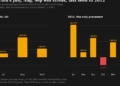
- Crypto startup funding is holding up, with roughly $10 billion invested in the first half against $20 billion for all of 2025, so the pace is broadly unchanged. Fund formation is not. Investors allocated about $3.9 billion to five new crypto-focused venture funds in the second quarter, the fewest new funds since the final quarter of 2019.
- That divergence is the thing to watch. Deals are being funded from dry powder sitting in existing vehicles, and when those deplete there is little behind them, so deal volumes fall with a lag rather than immediately.
- Competition for capital explains it. AI-focused companies captured roughly two-thirds of all capital invested in US and Canadian startups in the third quarter, and rival crypto firms have followed the money. Paradigm raised $1.2 billion this year for a fund whose remit includes AI and robotics, while Framework Ventures and Haun Ventures have also broadened their mandates.
- Multicoin, which manages $2.7 billion, is declining to follow. General partner Spencer Applebaum said the firm believes it has an edge in crypto and wants to stay true to it, adding that for the most part people are searching for a problem that does not exist at the intersection of crypto and AI, and that a lot of investors are trying to force it.
What Happened?
Multicoin is taking longer to deploy its 2022 venture fund, which Applebaum attributed to valuations falling after the collapse of FTX that year, noting that through 2023 seed rounds of roughly $3 million at $30 million post-money valuations meant a $422 million fund would take considerably longer to put to work. He said the firm’s track record and relationships make it among the first investors entrepreneurs approach in crypto, advantages it would lack in AI having never made a pure-play investment there. Multicoin’s hedge fund buys cryptocurrencies directly, and its largest position is HYPE, acquired on the open market and typically held for years.
Why It Matters?
The gap between deal funding and fund formation is the useful signal and most coverage reports only the first. Startup funding running at last year’s pace suggests health; five new funds in a quarter, the fewest in seven years, suggests the opposite. Both are true because existing funds are still deploying capital raised in better conditions. Dry powder masks a funding problem until it is exhausted, at which point deal volumes fall sharply rather than gradually. Anyone assessing the sector should treat fund formation as the leading indicator and current deal flow as a lagging one. Applebaum’s remark about forcing a problem that does not exist is the most useful scepticism available on a thesis that has been widely promoted. A CoinDesk column argued recently that AI agents need blockchain rails to transact, and Circle’s chief executive said last week that agents are increasingly using its stablecoin for small payments. Both arguments come from parties who benefit if they are true. Applebaum benefits if they are false, since his fund’s mandate excludes AI. Readers get two interested views pointing opposite ways, which is more useful than one. The evidence so far is thin in both directions: the most notable agent payment event this month was an AI model spending from a wallet it did not own. The mandate question matters for anyone holding these funds. Firms that raised capital for crypto exposure and are now deploying it into AI and robotics have changed what investors bought, and whether that is adaptation or style drift depends on what the fund documents permit. Multicoin’s discipline is defensible and it is also the reason it is deploying slowly, which is its own cost.
What Next?
Fund formation in coming quarters determines whether this is a pause or a structural decline, and the Galaxy Research series is the one to follow. Watch whether firms that broadened mandates raise successor funds successfully, since that would confirm the strategy works commercially whatever it does for returns. Multicoin’s HYPE position is a concentrated bet on a network currently seeking US regulatory entry on terms that have not been settled. For the sector, the exhaustion of existing dry powder is the point at which the fundraising problem becomes a deal flow problem.
Affected Tickers and Coins: HYPE
Source: Bloomberg