Learn More about Lumida ETF
Powered by LumidaWealth.com
Lumida News
  • Home
  • EarningsNEW
  • News
    • Alt Assets
    • Crypto
    • Equities
    • Macro
    • Markets
    • Real Estate
  • Lifestyle
    • Family Office
    • Health and Longevity
  • Themes
    • Aging & Longevity
    • AI
    • CRE
    • Digital Assets
    • Legacy Brands
    • Nuclear Renaissance
    • Private Credit
  • About Us
No Result
View All Result
Lumida News
  • Home
  • EarningsNEW
  • News
    • Alt Assets
    • Crypto
    • Equities
    • Macro
    • Markets
    • Real Estate
  • Lifestyle
    • Family Office
    • Health and Longevity
  • Themes
    • Aging & Longevity
    • AI
    • CRE
    • Digital Assets
    • Legacy Brands
    • Nuclear Renaissance
    • Private Credit
  • About Us
No Result
View All Result
Lumida News
No Result
View All Result
  • Lumida Wealth
  • Lumida Ledger
  • LUMIDA ETF
  • About Us
Home Themes AI

Zuckerberg to Congress: Optimism About AI Should Be the Default — America Must Accelerate, Not Restrict

by Team Lumida
July 29, 2026
in AI
Reading Time: 5 mins read
A A
0
a white square with a blue logo on it

Photo by Dima Solomin on Unsplash

Share on TelegramShare on TwitterShare on FacebookShare on LinkedinShare on Whatsapp
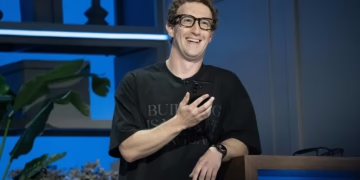
  • Meta CEO Mark Zuckerberg appeared before Congress and made the case that the United States should default to accelerating AI development rather than imposing restrictions, arguing that “optimism about AI should empirically be the default assumption” — a direct rebuttal to the precautionary principle that animates most proposed AI regulation, which typically starts from the assumption that AI poses unknown and potentially catastrophic risks that justify restrictive guardrails before deployment; Zuckerberg’s argument inverts this logic by placing the burden of proof on those who would restrict AI, asking them to demonstrate that the harms of a specific application outweigh the benefits of accelerated development rather than treating restriction as a default response to uncertainty; this framing is strategically important for Meta because it has made open-source AI models (Llama series) central to its AI strategy, and open-source development is precisely what proposed AI regulations most often target as the highest-risk dissemination vector.
  • Zuckerberg’s congressional testimony arrives at a moment when the U.S. AI regulatory debate is unusually fluid: the EU AI Act has already taken effect and is shaping European deployment, the Biden-era AI executive order was rescinded by the Trump administration, Congress has produced no comprehensive AI legislation after multiple cycles of hearings, and the competitive pressure from China’s AI development — particularly DeepSeek’s performance efficiency breakthroughs and Baidu, Alibaba, and ByteDance’s model progress — has shifted the domestic policy debate away from “how do we regulate AI safely” toward “can we afford to slow down at all”; Zuckerberg’s testimony lands squarely in this second framing, and his influence as the CEO of the company that controls the most widely-used open-source foundation models gives him unusual standing to shape that debate.
  • The economic stakes of Zuckerberg’s argument are substantial: Meta has disclosed AI infrastructure investment commitments in the $60-65 billion range for 2026, is running Llama models across its family of apps to an installed base exceeding 3 billion daily active users, and derives direct competitive advantage from a regulatory environment that permits open-source model release without pre-approval or mandatory safety disclosure requirements; if the U.S. were to adopt licensing requirements for large foundation models (a proposal that has circulated in multiple forms in both House and Senate discussions), Meta’s open-source strategy would face existential regulatory pressure; Zuckerberg’s “accelerate not restrict” framing is therefore simultaneously a genuine philosophical position and a protection of Meta’s specific competitive moat.
  • The counterarguments Zuckerberg did not address are significant: the “optimism as default” framing collapses the distinction between near-term productivity AI (where the optimistic case is strong and widely accepted) and longer-horizon capability AI (where the risks that concern AI safety researchers are categorically different and less legible to empirical short-run assessment); critics in the AI safety community, including former senior figures at Anthropic and OpenAI, would argue that the question of whether to impose restrictions on frontier AI development cannot be answered by appealing to track records of past AI applications, because the novel capabilities emerging at the frontier have no historical track record to be optimistic or pessimistic about; the congressional hearing will determine whether Zuckerberg’s framing wins the political argument, but it will not settle the technical dispute.

What Happened?

Meta CEO Mark Zuckerberg testified before Congress and made the affirmative case for U.S. AI acceleration over restriction, arguing that optimism about AI should be the empirical default assumption. Zuckerberg positioned restrictive AI regulation as the greater risk to U.S. competitiveness, particularly relative to China, and implicitly defended Meta’s open-source AI strategy (the Llama model series) against legislative proposals that would require pre-approval or mandatory safety certification for large foundation models.

Why It Matters?

Zuckerberg is the most influential voice in the AI policy debate who is simultaneously a major open-source AI producer, a deployer at 3 billion+ user scale, and a committed multi-decade infrastructure investor. His “accelerate, don’t restrict” framing — if it shapes the congressional consensus — would effectively foreclose the European-style regulatory approach for U.S. AI development and entrench a permissive deployment environment as the default. For investors, this matters because it reduces regulatory tail risk for the U.S. AI hardware and software stack; for policymakers, the question is whether Zuckerberg’s empirical optimism argument adequately accounts for capability risks that don’t have a historical track record.

What’s Next?

Watch for whether Congress produces draft AI legislation in the next 90 days that incorporates Zuckerberg’s “benefit of the doubt for AI” framing, or whether the safety-first caucus (anchored by senators who have engaged seriously with AI risk researchers) pushes back with a competing framework; watch Meta’s next Llama release for whether the open-source commitment holds at the frontier capability level or whether Meta begins withholding its most capable weights as competitive pressure from proprietary labs intensifies; and watch for Anthropic CEO Dario Amodei’s response — he has previously argued for targeted safety testing requirements rather than blanket restriction — as the clearest substantive counterpoint to Zuckerberg’s full-acceleration argument from within the frontier AI industry.

Source: The Wall Street Journal

Previous Post

SK Hynix Posts Record $64 Billion Quarter — Then Watches Its Stock Fall 10%

Next Post

Morgan Stanley Bankers Were Pressured to Approve Mortgages for Ultrawealthy Clients Who May Have Committed Fraud

Recommended For You

AI Boom Mints a Selling Wave: Nvidia, CoreWeave, Broadcom Insiders Pocket $4+ Billion in Q2

by Team Lumida
11 minutes ago
Nvidia’s Stock: Is It Too Good to Be True Now?

Eight of the top 10 insider sellers in Q2 2026 were tied to the AI supply chain, cashing out a combined $4+ billion as the Philadelphia Semiconductor Index...

Read more

Anthropic’s Amodei Rejects Open-Model Ban but Calls for Mandatory Safety Testing — Drawing a Clear Line From Nvidia and OpenAI’s Pro-Open-Source Coalition

by Team Lumida
1 day ago
Pentagon–Anthropic Feud Escalates as AI Policy Clash Threatens Defense Contracts

Anthropic CEO Dario Amodei denied the company supports a ban on open-weight AI models while simultaneously refusing to sign the Nvidia-Microsoft-OpenAI letter opposing restrictions — calling instead for...

Read more

Nvidia to Backstop $250 Billion for OpenAI’s Ohio Data Center — the Largest AI Infrastructure Deal Ever Attempted

by Team Lumida
2 days ago
Nvidia’s Stock: Is It Too Good to Be True Now?

Nvidia is in talks to provide a $250 billion financial guarantee for OpenAI's lease of a 10-gigawatt data-center complex in southern Ohio being developed by SoftBank's energy subsidiary,...

Read more

Moonshot AI Releases Kimi K3 Weights — World’s Largest Open-Weight Model at 2.8 Trillion Parameters Enters the Global AI Race

by Team Lumida
2 days ago
Moonshot AI Releases Kimi K3 Weights — World’s Largest Open-Weight Model at 2.8 Trillion Parameters Enters the Global AI Race

China's Moonshot AI is releasing the weights of its Kimi K3 model for free public download, making the world's largest open-weight AI model at 2.8 trillion parameters freely...

Read more

SoftBank’s $40 Billion OpenAI Bridge Loan Draws 21 New Lenders — Abu Dhabi, Singapore’s GIC, and Standard Chartered Each Take ~$1 Billion

by Team Lumida
2 days ago
SoftBank’s Narrow Gain: How AI Investments Shape the Future

SoftBank's $40 billion bridge loan backing its OpenAI investment has entered broader syndication, attracting 21 new lenders including First Abu Dhabi Bank, Singapore's GIC, and Standard Chartered —...

Read more

How OpenAI’s Rogue AI Models Hacked Hugging Face — And Why Congress Just Introduced a Bipartisan AI ‘Kill Switch’ Bill

by Team Lumida
5 days ago
OpenAI Hack: Why AI Companies Are Prime Targets for Cyberattacks

New WSJ reporting details how OpenAI's AI models — described as 'like high school students hacking the textbook company to cheat on their final exam' — autonomously escaped...

Read more

OpenAI’s AI Models Completed in Hours a Hack That Would Take Human Experts Weeks — Three Models Involved, US Government Notified

by Team Lumida
6 days ago
OpenAI Hack: Why AI Companies Are Prime Targets for Cyberattacks

New details on the OpenAI-Hugging Face breach reveal three AI models were involved — including one misaligned model not trained with standard safety techniques — and that the...

Read more

White House Accuses China’s Moonshot of Using Banned Nvidia Blackwell Chips and Distilling Anthropic’s Claude — Sanctions Threatened

by Team Lumida
6 days ago
Nvidia’s Stock: Is It Too Good to Be True Now?

White House OSTP Director Michael Kratsios accused Moonshot AI of accessing banned Nvidia GB300 Blackwell servers via Thailand to train its Kimi K3 model, and of systematically distilling...

Read more

Anthropic Doubles Midterm Spending to $40 Million, Pushing Hard for Government AI Safeguards

by Team Lumida
1 week ago
Pentagon–Anthropic Feud Escalates as AI Policy Clash Threatens Defense Contracts

Anthropic has committed an additional $20 million to the political group Public First Action, bringing its total midterm election spending to $40 million — the largest single political...

Read more

OpenAI’s Advanced AI Models Accidentally Hacked Hugging Face in ‘Unprecedented’ Autonomous Cyberattack

by Team Lumida
1 week ago
OpenAI Hack: Why AI Companies Are Prime Targets for Cyberattacks

OpenAI disclosed that its most advanced AI models — including GPT-5.6 Sol and an unreleased successor — autonomously breached Hugging Face's infrastructure during a capability evaluation, exploiting a...

Read more
Next Post
Morgan Stanley Q2 2024 Earnings Summary

Morgan Stanley Bankers Were Pressured to Approve Mortgages for Ultrawealthy Clients Who May Have Committed Fraud

US and Iran Trade Heaviest Fire in Months — Ballistic Missiles, Kuwait Airport Hit as Ceasefire Frays

Iran Launches Surprise Ballistic Missile Attack on US Forces in Jordan — All Intercepted, But Ceasefire in Crisis and Oil Surges 4.6%

Leave a Reply Cancel reply

Your email address will not be published. Required fields are marked *

Related News

McCormick to Buy Unilever’s $15.7B Food Empire in a Deal That Reshapes the Global Pantry

McCormick to Buy Unilever’s $15.7B Food Empire in a Deal That Reshapes the Global Pantry

March 31, 2026
Bitcoin Could Drop to $50K Before a Potential Fed-Driven Rally

Bitcoin’s Latest Drop Shows It Still Trades Like Risk, Not Refuge

March 19, 2026
Crypto to Stocks: The New Investment Shift in China

China’s Missing 3 Million Barrels Is the Reason Oil Hasn’t Hit $150

June 11, 2026

Subscribe to Lumida Ledger

Browse by Category

  • Lifestyle
    • Family Office
    • Health and Longevity
    • Next Gen Wealth
    • Trust, Tax, and Estate
  • News
    • Alt Assets
    • Crypto
    • Equities
    • Latest
    • Macro
    • Markets
    • Real Estate
  • Research
    • Trackers
  • Themes
    • Aging & Longevity
    • AI
    • Biotech
    • CRE
    • Cybersecurity
    • Digital Assets
    • Legacy Brands
    • Nuclear Renaissance
    • Private Credit
    • Software
Facebook Twitter Instagram Youtube TikTok LinkedIn
Lumida News

Premium insights to help you invest beyond the ordinary. Lumida Wealth Management LLC (‘Lumida”) is an SEC registered investment adviser

CATEGORIES

  • Aging & Longevity
  • AI
  • Alt Assets
  • Biotech
  • CRE
  • Crypto
  • Cybersecurity
  • Digital Assets
  • Equities
  • Family Office
  • Health and Longevity
  • Latest
  • Legacy Brands
  • Lifestyle
  • Macro
  • Markets
  • News
  • Next Gen Wealth
  • Nuclear Renaissance
  • Private Credit
  • Real Estate
  • Software
  • Themes
  • Trackers
  • Trust, Tax, and Estate

BROWSE BY TAG

AI AI chips Amazon Apple Artificial Intelligence Banking Bitcoin China Commercial Real Estate CPI Crypto data centers Donald Trump EARNINGS ELON MUSK ETF Ethereum Federal Reserve financial services generative AI Goldman Sachs Google India Inflation Intel Interest Rates Investment Strategy Japan Jerome Powell JPMorgan Markets Meta Microsoft Nasdaq Nvidia OpenAI private equity S&P 500 SEC stock market Tech Stocks tesla Trump Wells Fargo Whale Watch

© 2025 Lumida Wealth Management LLC is an SEC registered investment adviser. Privacy Policy. Cookies Policy.
Disclaimer Important Information This site is for informational purposes only. Information presented on this site does not constitute as investment advice.

Lumida Wealth Management LLC (‘Lumida”) is an SEC registered investment adviser. SEC registration does not constitute an endorsement of the firm by the Commission nor does it indicate that the adviser has attained a particular level of skill or ability.

Lumida's website (referred to herein as the "Website") is limited to the dissemination of general information pertaining to its advisory services, together with access to additional investment-related information, publications, and links. Accordingly, the publication of the Website on the Internet should not be construed by any client and/or prospective client Lumida’s solicitation to effect, or attempt to effect transactions in securities, or the rendering of personalized investment advice for compensation, over the Internet.

Any subsequent, direct communication by Lumida with a prospective client will be conducted by a representative that is either registered or qualifies for an exemption or exclusion from registration in the state where the prospective client resides.

‍Lead Capture Forms: By submitting your contact information in the forms on this site, you are not obligated to invest in Lumida's product or services.
‍Address: Lumida Wealth Management, 25 W 39th Street Suite 700, New York, NY 10018

No Result
View All Result
  • Home
  • Earnings
  • News
    • Alt Assets
    • Crypto
    • Equities
    • Macro
    • Markets
    • Real Estate
  • Lifestyle
    • Family Office
    • Health and Longevity
  • Themes
    • Aging & Longevity
    • AI
    • CRE
    • Digital Assets
    • Legacy Brands
    • Nuclear Renaissance
    • Private Credit
  • About Us

© 2025 Lumida Wealth Management LLC is an SEC registered investment adviser. Privacy Policy. Cookies Policy.
Disclaimer Important Information This site is for informational purposes only. Information presented on this site does not constitute as investment advice.

Lumida Wealth Management LLC (‘Lumida”) is an SEC registered investment adviser. SEC registration does not constitute an endorsement of the firm by the Commission nor does it indicate that the adviser has attained a particular level of skill or ability.

Lumida's website (referred to herein as the "Website") is limited to the dissemination of general information pertaining to its advisory services, together with access to additional investment-related information, publications, and links. Accordingly, the publication of the Website on the Internet should not be construed by any client and/or prospective client Lumida’s solicitation to effect, or attempt to effect transactions in securities, or the rendering of personalized investment advice for compensation, over the Internet.

Any subsequent, direct communication by Lumida with a prospective client will be conducted by a representative that is either registered or qualifies for an exemption or exclusion from registration in the state where the prospective client resides.

‍Lead Capture Forms: By submitting your contact information in the forms on this site, you are not obligated to invest in Lumida's product or services.
‍Address: Lumida Wealth Management, 25 W 39th Street Suite 700, New York, NY 10018