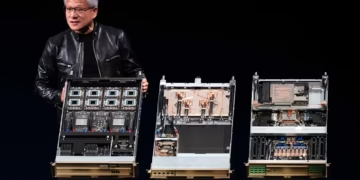
- SK Hynix reported approximately $64 billion in quarterly revenue — the highest quarterly result in the history of the DRAM/NAND memory industry — powered almost entirely by explosive demand for High Bandwidth Memory (HBM) chips that are the critical interconnect layer in AI accelerator systems; HBM is the memory component that sits directly on top of the GPU die in systems like Nvidia’s H100 and H200, allowing the processor to access vastly more memory bandwidth than conventional DRAM architectures permit, and SK Hynix has maintained a meaningful lead over Samsung and Micron in HBM3E (the current generation) yield and volume, with Nvidia qualifying its HBM3E chips well ahead of Samsung’s competing product; the record revenue was therefore a direct consequence of Hynix’s position as the primary supplier to the most capital-intensive AI infrastructure buildout in corporate history — and yet the market’s reaction was to sell.
- The ~10% stock decline on record results is a textbook example of the “sell the news” dynamic when expectations have been set by an extended period of upward earnings revisions driven by AI infrastructure optimism: investors had priced into SK Hynix’s share price an extended runway of above-consensus results, and a result that is merely “record” rather than “record and materially better than the already elevated consensus estimate” triggers profit-taking from investors who bought the AI infrastructure theme early and have accrued significant gains; the market is also forward-pricing the risk that HBM demand will eventually normalize as AI training cluster buildouts plateau and inference workloads (which are less HBM-intensive than training) become the dominant compute use case; the question is not whether Hynix had a good quarter — it clearly did — but whether the next four quarters will be incrementally better, and the market appears to have concluded that the answer is uncertain enough to sell.
- The competitive dynamics in HBM are worth watching closely: Samsung has been investing heavily to close the yield and qualification gap with Hynix on HBM3E, and Micron has been more aggressive than expected in ramping its own HBM capacity for Nvidia and other customers; if Samsung achieves broad HBM3E qualification at Nvidia in the next two quarters, the effective oligopoly that Hynix has enjoyed as the primary HBM supplier would loosen, compressing HBM ASPs (average selling prices) and limiting Hynix’s ability to maintain the gross margin profile that drove the record quarter; the bear case for Hynix is not that AI chip demand disappears, but that competition normalizes HBM pricing faster than revenue growth from volume can offset the margin compression, a dynamic the market appeared to be pricing in with the post-earnings selloff.
- The broader read-through for the AI semiconductor investment thesis is that the market has entered a phase where the quality of results is being evaluated against an increasingly ambitious bar set by prior upside surprises; Nvidia, TSMC, ASML, and now SK Hynix have all delivered historically exceptional quarters in the past four quarters, and the cumulative effect of those results is that the consensus model for AI infrastructure suppliers is now priced for sustained outperformance rather than merely strong results; in this environment, “record quarter” without material guidance raise or accelerating order visibility is increasingly insufficient to drive stock appreciation — a dynamic that will affect every AI hardware name reporting in the next earnings cycle and that should prompt investors to re-examine whether AI infrastructure valuations reflect cyclical risk adequately.
What Happened?
SK Hynix reported approximately $64 billion in quarterly revenue — a record for the global memory semiconductor industry — driven by surging demand for High Bandwidth Memory chips used in AI accelerators, where Hynix has maintained supply leadership over Samsung and Micron. Despite the historic result, SK Hynix stock fell approximately 10% on the earnings, as the result failed to materially exceed the elevated consensus expectations that AI optimism had already baked into the share price.
Why It Matters?
The SK Hynix “record results, stock falls” dynamic is a canary for the broader AI infrastructure investment cycle: when even historically exceptional quarters disappoint the market, it signals that AI hardware valuations have priced in a level of sustained outperformance that leaves little room for error, supply normalization, or demand plateaus. The HBM competitive picture — Samsung racing to close the qualification gap, Micron ramping aggressively — creates a credible scenario where pricing power in the highest-margin AI memory segment erodes faster than volume growth compensates, compressing the margin profile that made this quarter exceptional.
What’s Next?
Watch Samsung’s HBM3E qualification timeline at Nvidia — any announcement of broad supply approval would immediately reprice Hynix’s competitive moat; watch Micron’s next earnings for HBM volume and pricing data that would triangulate the supply/demand balance in AI memory; watch Hynix’s guidance for next quarter specifically on HBM ASP trajectory, which will tell you whether the premium pricing environment is holding or beginning to normalize; and watch the next Nvidia data center revenue print for whether AI training cluster demand is still accelerating or beginning to shift toward a higher inference-to-training ratio that would structurally reduce HBM intensity per GPU dollar deployed.
Source: The Wall Street Journal