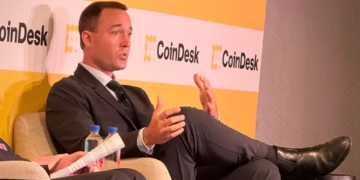
- Qivalis, an independent euro-pegged stablecoin builder with a growing number of banks as shareholders, has onboarded 37 European banks in the past year. It has grown from a single employee to roughly 40 staff and is close to securing an Electronic Money Institution licence in the Netherlands, aiming to go live with a regulated euro stablecoin by the end of this year.
- Chief executive Jan-Oliver Sell said trade finance funds that provide instruments and buy commodities are shifting their entire supply chain into stablecoins, increasingly without converting back to fiat. He cited a supplier in East Africa trading with a counterparty in Kazakhstan entirely in stablecoins with no off-ramp.
- The consequence Sell identifies is speed of collateral turnover, describing collateral rotating in minutes rather than days and the business model changing as a result. He said the focus has grown in Asia, Latin America and Africa.
- The market remains dominated by dollar-pegged tokens from Tether and Circle. Sell argues Europeans, Japanese and Koreans will not operate in dollars and that the market will end up multi-stablecoin, with flows resembling those in fiat currencies.
What Happened?
Sell said earlier enterprise blockchain efforts from firms such as R3 and Hyperledger worked on digitising paper instruments like letters of credit but lacked the cash leg, and that stablecoins with real liquidity have supplied the missing payment side. He argued that continued delay to the Clarity Act in the United States extends the opportunity for Europe, where the Markets in Crypto Assets framework at least gives institutions clarity about their position, and suggested recently formed US bank-led stablecoin consortia are some way behind, noting it took Qivalis three and a half years to reach this point.
Why It Matters?
The collateral velocity point is the substantive economic claim and it cuts in a direction the article does not follow. Trade finance returns depend heavily on how many times capital turns over in a year, so if collateral rotates in minutes rather than days, the same pool supports far more transactions. That expands volume and simultaneously compresses the spread earned on each one, because faster settlement removes the risk that the spread compensates for. Investors in trade finance funds should expect the asset class to become higher volume and lower margin rather than simply more profitable, which matters for anyone underwriting these strategies at current yields. The no-off-ramp example deserves equal weight. Value circulating between East Africa and Kazakhstan without ever touching fiat means settlement occurring entirely outside the correspondent banking system and outside any single jurisdiction payment supervision. That is the efficiency gain and the compliance problem stated in one sentence, and it sits directly against reporting that entities under sanctions received 694% more crypto during 2025. The same rail serves both uses. Readers should also weigh what this interview is. Qivalis has no licence yet, no live product, and Sell offers no figures for actual trade finance stablecoin volume, only descriptions of conversations. A pre-launch chief executive describing his sector as transformed is making a commercial pitch as well as an observation. His multi-stablecoin thesis also runs against network effects, which have so far concentrated liquidity in dollar tokens precisely because fragmented currencies fragment liquidity.
What Next?
The Dutch Electronic Money Institution licence is the gating item, and the year-end go-live target gives a dated test of whether Qivalis delivers. Watch how many of the 37 onboarded banks actually transact once the token launches, since onboarding and usage are very different measures. The ECB push to ban stablecoin yields and ESMA making tokenization a supervisory priority from 2027 are the European constraints that will shape what this product can offer. On the competitive side, track whether US bank consortia announce firm launch dates, which would test Sell claim that they are years behind. The measure that would substantiate the whole thesis is published trade finance stablecoin settlement volume, which nobody currently reports, and its absence is the main reason to treat these claims as directional rather than proven.
Affected Tickers and Coins: CRCL, USDT, HSBC, V
Source: CoinDesk