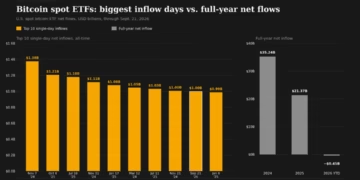
- The 13 US-listed spot Bitcoin ETFs drew a combined net $1.92 billion in inflows last week — the most since early October 2025 — including a single-day record of $606.3 million on August 20, as Bitcoin surged approximately 23% over the week to trade near $76,900 on Monday morning in London, its largest weekly percentage gain in more than three years and a dramatic reversal from the prior week’s $390 million in net ETF outflows.
- BlackRock’s iShares Bitcoin Trust (IBIT) dominated the inflow picture, accounting for $1.3 billion of the week’s total $1.92 billion — cementing its position as the primary institutional on-ramp for Bitcoin exposure and reflecting the degree to which the spot ETF structure has become the preferred vehicle for mainstream investors seeking Bitcoin allocation rather than direct custody.
- Bitcoin’s rally was initially catalyzed by Treasury Secretary Bessent’s announcement of expanded debt buybacks for long-dated bonds — a move that traders interpreted as fiscal-dominance signaling and a potential debasement of long-term dollar purchasing power, triggering the “debasement trade” in Bitcoin and gold simultaneously — before being amplified into a more dramatic squeeze as short sellers were forced to close bearish positions, with Bloomberg reporting $2.7 billion in crypto short liquidations during the week.
- Despite the spectacular weekly performance, critical uncertainties remain about whether the rally represents durable institutional re-engagement or a technically driven surge: some $2.9 billion has been drained from Bitcoin ETFs year-to-date even after last week’s inflows, Bitcoin’s all-time high above $126,000 reached in October 2025 remains far above current levels, and QCP Group senior sales trader Jayke Kyndrede warned that “after such a rapid move, some consolidation or retracement would be unsurprising.”
What Happened?
Spot Bitcoin ETFs in the United States recorded their strongest week of net inflows in ten months, pulling in $1.92 billion across the 13 US-listed funds as Bitcoin posted a 23% weekly gain — its largest in more than three years. The surge began when Treasury Secretary Bessent announced expanded buybacks of long-dated Treasury bonds, a move that traders interpreted as a signal of fiscal stress and potential dollar debasement, triggering buying in “hard assets” including Bitcoin and gold. The rally was subsequently amplified by a violent short squeeze: traders who had built bearish bets on Bitcoin were forced to close their positions as prices rose, accelerating the move. Bloomberg reported that the week saw approximately $2.7 billion in total crypto short liquidations, one of the largest such events on record. Bitcoin was trading around $76,900 on Monday morning, approaching but still below the psychologically significant $80,000 level.
Why It Matters?
The scale and composition of last week’s Bitcoin ETF inflows offer several meaningful signals about the current state of crypto markets and institutional appetite. The dominance of BlackRock’s IBIT — accounting for 68% of total weekly inflows — confirms that the institutional Bitcoin ETF market has consolidated around a small number of large, brand-name products rather than dispersing across the full competitive field. The fact that inflows occurred on every trading day of the week, as OKX SG CEO Gracie Lin noted, suggests the buying was not concentrated in a single speculative burst but reflected broader participation across multiple investor types. Most importantly, the macro trigger for the rally — fiscal concerns about US debt sustainability and the debasement implications of Treasury yield management — suggests that Bitcoin is increasingly trading on the same inputs as gold, positioning it less as a speculative technology asset and more as a macro hedge in institutional portfolio construction.
What’s Next?
The durability of Bitcoin’s rally from here depends on whether the macro conditions that triggered it — fiscal stress signals, Treasury yield volatility, and debasement trade dynamics — persist or resolve. If Warsh’s Jackson Hole speech Friday delivers a hawkish signal that strengthens the dollar and compresses inflation expectations, the debasement narrative underpinning Bitcoin’s move weakens. Conversely, if the bond market continues to price in fiscal deterioration and the Fed remains on hold while inflation stays elevated, the macro case for Bitcoin as a debasement hedge remains intact. Near-term, profit-taking after a 23% weekly move is the most likely technical outcome — Lin’s observation that “some profit-taking wouldn’t be surprising” reflects a consensus view that the pace of the move has outrun short-term fundamentals. The question is whether any pullback attracts renewed institutional buying through the ETF channel or reveals the rally as primarily technically driven.
Source: Bloomberg