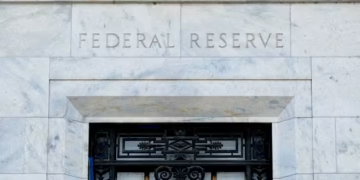
- Richmond Fed President Tom Barkin issued one of the most direct fiscal warnings from a Fed official in recent months, saying that rising US debt — which recently crossed $40 trillion — will eventually produce a “reckoning,” adding: “No one can tell you when. We’re a global currency, rule of law — all the reasons people keep buying the debt. But, you know, at some point, people stop buying your debt and that’s the risk out there.”
- Barkin described the Fed’s July rate decision — which held rates steady for the fifth consecutive meeting, despite three dissents in favor of a hike — as a “close call,” a characterization that suggests the Fed is closer to its next move than the consecutive holds might imply, and that the September 15-16 meeting is live in a way that markets may be underpricing.
- Two more months of economic data will arrive before the September FOMC meeting, making Wednesday’s PCE print and the August employment and inflation data that follow the most consequential near-term inputs to the Fed’s decision — and giving Warsh’s Jackson Hole speech on Friday an important interpretive function: investors will be parsing his remarks for clues about how the Fed is weighting the data it already has.
- Barkin flagged the Canada tariff situation as an ongoing source of uncertainty: “I don’t take the Canadian situation by itself as being any big change in the US posture, but I do think the broad question of whether we kind of know where the tariff rates are going to land or we don’t — that’s the bigger issue” — a framing that situates tariff uncertainty as a persistent inflation wildcard that makes the Fed’s already difficult job harder to execute with precision.
What Happened?
Federal Reserve Bank of Richmond President Tom Barkin spoke at an event in Charlotte, North Carolina on Tuesday, commenting on US fiscal dynamics, the Fed’s rate outlook, and trade policy uncertainty. On fiscal policy, Barkin was direct: with US public debt now exceeding $40 trillion, an eventual market “reckoning” is coming even if its timing is unknowable. He noted that the US benefits from structural advantages — reserve currency status, rule of law — that have extended its borrowing capacity far beyond what would be available to other sovereigns, but that those advantages are not infinite. On rates, he called July’s hold a “close call” and said the Fed will receive two full sets of economic data before deciding what to do at the September 15-16 meeting. He is not a voter this year but his public framing carries weight as a signal of where the broader institution is thinking.
Why It Matters?
Barkin’s “reckoning” comment is significant precisely because it comes from inside the Fed — not from a critic of monetary policy or a hedge fund investor with an interest in talking up gold. A sitting Fed president publicly warning that the US is on a fiscally unsustainable path, and that the mechanism of adjustment will be investors eventually refusing to buy Treasury debt, is the explicit articulation of the tail risk that Bessent’s buyback program is designed to forestall. The irony is that Bessent’s intervention — buying long-dated Treasuries to suppress yields — is itself a form of the monetization that tends to accelerate the timeline of the reckoning Barkin is warning about. The “close call” framing on July’s rate decision is separately important: five consecutive holds can read as a policy direction; a “close call” characterization resets that expectation and puts September back in play.
What’s Next?
Warsh’s Jackson Hole speech Friday is the most immediate catalyst, and Barkin’s comments set the stage: the market wants to know whether Warsh agrees with Barkin’s fiscal risk assessment, whether he sees inflation as sufficiently under control to justify holding rates, and whether the September meeting is a live decision or a foregone hold. Wednesday’s PCE data is the next hard input. Watch also for whether other Fed officials make similar fiscal-risk comments ahead of Jackson Hole — a coordinated shift in rhetoric would signal that the Fed is beginning to view fiscal dominance as a formal policy constraint rather than a background risk.
Source: Bloomberg