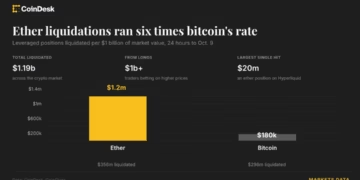
- Exactly one year ago, crypto experienced a cataclysm. On October 10, 2025, the market experienced a single-day liquidation cascade that wiped out $19 billion in leveraged bets. It was a record for a single day. That crash exposed something terrifying: when volatility spiked, liquidity didn’t just decline—it vanished. Traders who thought they could exit positions found themselves unable to do so. The market structure was fragile, and everyone knew it after that day. Bitcoin remains more than 30% below its all-time record high even after recent rallies back above $80,000. Open interest in Bitcoin perpetual futures halved in the six months after the crash, falling from $45 billion to roughly $22.5 billion. A year later, that leverage hasn’t fully returned. Traders learned their lesson: rebuilding leveraged positions slowly is safer than crashing spectacularly.
- But systemic risk didn’t disappear—it just migrated. Here’s the dangerous part: perpetual futures (leveraged contracts that let traders place bets without expiration dates) have exploded as a product class for real-world assets. Twelve months ago, open interest in perpetual futures for stocks, commodities, bonds, and other traditional assets stood at virtually zero. Today, it exceeds $17 billion. Almost all of that growth happened in the last six months. Who’s driving it? Hyperliquid, an offshore crypto exchange that was an early mover in offering perps on stocks and commodities. The implicit trade: if you want 24/7 trading, instant settlement, and no closing time, you go to Hyperliquid or similar venues. You trade perps on Apple, gold, oil, Treasury bonds. And you use leverage. The same machinery that created the $19 billion crash in crypto is now being deployed on traditional financial assets. That should concern regulators.
- The market has become more sophisticated and more institutional, but also more dangerous in new ways. Banks and major trading firms are now experimenting with digital assets, stablecoins, and tokenization. The Fed is moving ahead with plans to strengthen trading with guidelines on collateral and margin usage, despite failed crypto regulation in September. But here’s the trap: regulators are building rules for crypto and traditional finance separately. If a major crash in offshore perp markets (Hyperliquid trades on stocks/commodities) cascades back into traditional securities markets, regulators won’t have coordinated playbooks. The never-ending quest for yield is pushing traders toward instruments and venues that aren’t yet fully integrated into the regulatory framework. That’s how you create the next crisis.
- Crypto itself is now integrated with Wall Street rather than opposing it. The industry was born as a rebellion against financial institutions. Today, it’s becoming another corner of Wall Street. Prediction markets are drawing crowds (another leveraged betting mechanism). Sports betting venues are experimenting with crypto. The structural case for Bitcoin remains intact (limited supply, narrative about inflation hedge, institutional adoption). But the industry has stopped asking whether crypto will disrupt finance. Instead, it’s asking how to integrate it. Lucas Tcheyan from Galaxy Digital summed it up: “The market that crashed on 10/10 doesn’t really exist anymore. The one that replaced it is just starting to get priced in.” That new market is simultaneously more resilient (lower leverage, better exchange safeguards, less correlation) and more dangerous (leverage migrated to unregulated offshore venues offering perps on real-world assets, systemic integration with traditional finance).
What Happened?
On October 10, 2025, cryptocurrency markets experienced a historic liquidation cascade that wiped out $19 billion in leveraged bets in a single day, exposing structural fragility and sparking an industry-wide retrenchment. One year later, Bitcoin remains approximately 30 percent below its all-time high despite a recent rally above $80,000. Total open interest in Bitcoin perpetual futures halved in the six months following the crash, from approximately $45 billion to roughly $22.5 billion, and remains well below its prior peak. Traders have been slow to rebuild leveraged positions. However, the crypto market has undergone a fundamental structural transformation. The most significant new development is the rapid expansion of perpetual futures contracts for real-world assets—stocks, commodities, bonds, and currencies. Open interest in perpetual futures for traditional assets stood at virtually zero one year ago and now exceeds $17 billion, driven primarily by offshore crypto exchanges like Hyperliquid that offer 24/7 trading with instant settlement. The shift reflects migration of the speculative and leverage-dependent market infrastructure from purely crypto assets to real-world financial assets. Meanwhile, banks and major trading firms are accelerating experimentation with digital assets, stablecoins, and blockchain-based financial infrastructure. Federal regulators, despite failed comprehensive crypto regulation in September, are moving forward with guidelines on collateral usage and margin requirements for digital asset trading.
Why It Matters?
The October 2025 crash served a pedagogical function: traders and market participants learned that leverage in fragmented, 24/7 markets can evaporate liquidity faster than in regulated traditional exchanges. The response—reducing leverage in crypto perpetual futures—appears rational. But the broader shift toward perpetual futures for real-world assets exposes a dangerous regulatory gap. If traders can access 24/7 leveraged bets on Apple, gold, oil, and Treasury yields through offshore venues, they are trading instruments that are functionally identical to their crypto counterparts but outside traditional regulatory frameworks. The risk profile is identical: when volatility spikes and liquidity disappears, traders face cascading liquidations. The difference is that these positions are now linked to traditional financial assets. If a flash crash in offshore perp markets cascades into stock markets, commodity markets, and fixed income markets, the fallout will be systemic. The Fed is building margin and collateral rules, but those rules are being designed for crypto assets and traditional finance separately. Coordinated execution will be difficult. Additionally, the observation that crypto is becoming integrated with Wall Street rather than disrupting it is strategically significant. The early narrative was that blockchain and crypto would displace traditional finance. The reality is that Wall Street has absorbed the technological and structural innovations while maintaining its dominance. Perps, tokenization, stablecoins, and 24/7 settlement are now just new tools within the traditional financial system. That integration provides stability but also means that crypto volatility and leverage cycles now directly affect traditional markets.
What’s Next?
Monitor open interest in real-world asset perpetual futures, particularly on Hyperliquid and similar venues. If that $17 billion grows to $50 billion or $100 billion, it represents significant leverage concentrated in instruments outside traditional regulatory oversight. A volatility spike that cascades through those markets could create forced deleveraging that reverberates into stock and commodity exchanges. Watch for regulatory coordination between the Fed, SEC, and CFTC on perpetual futures for traditional assets. If regulators create margin and collateral rules for crypto perps but not for real-world asset perps, the arbitrage becomes obvious: traders migrate to real-world asset perps to avoid regulation. That would be dangerous. Track Bitcoin and crypto volatility regimes closely. QCP Capital forecast Bitcoin in a $80,000–$90,000 range for Q4 2026. If Bitcoin breaks above $90,000, it could reignite retail interest and leverage rebuilding in crypto. If Bitcoin falls below $80,000, it tests whether the market has genuinely rebuilt confidence or just consolidated at lower leverage levels. Monitor prediction market growth. Prediction markets are another leveraged betting mechanism that could concentrate tail risk. If prediction markets on political events or economic outcomes grow to systemic scale, they become another liquidity risk vector. Finally, watch bank and Wall Street commentary on stablecoins and tokenization. If major banks begin rolling out stablecoin platforms and tokenized securities trading, that accelerates integration between crypto infrastructure and traditional finance—which provides stability but also means contagion runs in both directions.
Affected Tickers and Coins: BTC | ETH | GLXY
Source: Bloomberg