- The Bitcoin Volmex Implied Volatility Index fell to 36.11 — its lowest since September and near its lowest since 2023 — reflecting subdued trading and a marked decline in demand for options protection as Bitcoin consolidates around $77,000, still down ~40% from its October record above $126,000.
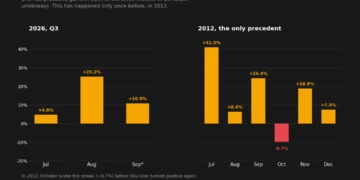
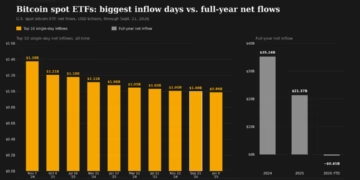
- US spot-Bitcoin ETFs have recorded net outflows of approximately $1 billion so far in May, reversing two consecutive months of net inflows — a concrete signal that institutional and retail demand has cooled meaningfully since the post-election surge.
- Speculative capital has rotated away from crypto and into AI and semiconductor stocks, where US equities, South Korea’s Kospi, and Taiwan’s market have all recently touched record highs on AI demand — leaving Bitcoin increasingly sidelined in the current risk rally.
- Volatility selling has become a structural feature of this cycle: long-term holders, miners, and sovereign investors are systematically selling options premium to generate income from Bitcoin positions, repeatedly suppressing implied volatility spikes and making sustained price breakouts harder to achieve.
What Happened?
Bitcoin’s implied volatility has compressed to levels not seen in nine months, with the Volmex index hitting 36.11 as trading activity slows and the market finds itself in a narrow range around $77,000. The broader context is striking: global equity markets are rallying to record highs on AI and Iran deal optimism, yet Bitcoin is sitting 40% below its October peak and seeing ETF outflows. “Retail interest is understandably going elsewhere to take advantage of other trading opportunities, as also seen from ETF outflows data,” said Caroline Mauron of Orbit Markets. The divergence between buoyant risk appetite in equities and flat-to-declining crypto demand is one of the more notable market dynamics of 2026.
Why It Matters?
Low implied volatility in Bitcoin means options are cheap — which is either an opportunity or a warning sign, depending on one’s view of where price is heading. The structural driver of the low-vol regime is important: investors are selling volatility as a yield substitute, since Bitcoin itself generates no income. As Rajiv Sawhney of Wave Digital Assets put it, “for long-term holders, miners, sovereign investors and larger funds, selling volatility has become a way to generate income from their holdings.” This is a maturing-market behavior — but it also means the market is systematically pricing out the kind of explosive moves that defined earlier Bitcoin cycles. The rotation of speculative capital into AI stocks is the other key variable: as long as Nvidia, semiconductor, and AI infrastructure names are generating the outsized returns that crypto once monopolized, the “hot money” that powers Bitcoin breakouts has a better place to be.
What’s Next?
The setup is one where a catalyst — a Hormuz deal, a macro shift, or a regulatory development in the US crypto bill space — could rapidly reprice implied volatility higher if it triggers a directional move. Until then, the vol-selling regime is self-reinforcing: every spike gets sold, keeping premiums low and breakouts unsustained. Watch for whether spot-Bitcoin ETF flows reverse in June as Iran deal optimism potentially boosts broad risk appetite, and whether the passage of US crypto legislation — which has been advancing through Congress — provides a fresh fundamental catalyst. The Bitcoin-AI divergence is the defining intra-risk-asset story of mid-2026, and it will resolve one way or the other before year-end.
Source: Bloomberg