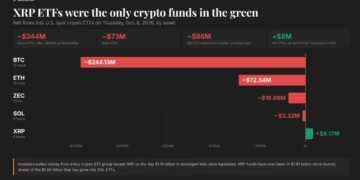
- The 13 US-listed spot Bitcoin ETFs attracted $75.7 million in net inflows last week, adding to the $197.4 million secured the prior week — the first two consecutive weeks of positive flows after nearly two months of sustained capital flight from the funds; the back-to-back positive weeks are notable because they came despite investors draining $424.7 million from Bitcoin ETFs on a single Monday last week following renewed US-Iran military conflict, meaning the weekly net was positive only because inflows on other days of the week decisively offset that single-day outflow; Richard Galvin, executive chairman at crypto investment firm DACM, said “I think it is a sign of bottoming — given their size and breadth, the ETFs have become a good read on general sentiment to Bitcoin and the sector, so an about-face after eight straight weeks, now confirmed across a fortnight, is positive.”
- Bitcoin has reclaimed a technically significant level: the token moved back above its 200-week moving average, which stands at approximately $63,300 and is widely watched by technical analysts as a critical demarcation line between a prolonged bearish and bullish market cycle; Bitcoin briefly rose above $65,000 in Asian trading on Monday despite fresh US airstrikes on Iran, showing resilience that analysts interpreted as indicative of strong underlying support; for several weeks Bitcoin had been largely range-bound between $60,000 and $65,000 amid macro uncertainty — a $65,000 breakout and hold above the 200-week moving average would be a constructive signal that the correction from October’s $126,000 high may be approaching exhaustion.
- Bitcoin is down roughly 50% from its October 2025 high of $126,000, with a significant portion of the decline attributed to Strategy Inc.’s reversal of its “never sell” Bitcoin accumulation strategy; founder Michael Saylor built Strategy’s entire identity around continuously buying Bitcoin with equity proceeds and holding indefinitely, but with Bitcoin near half its October peak it became increasingly difficult for the company to meet dividend obligations; Strategy sold $2.5 million of Bitcoin in early June — the first sale since 2022 — and then disclosed a substantially larger $216 million sale on July 6, with Saylor signaling greater willingness to sell when necessary; the psychological and structural significance of Strategy moving from accumulator to seller was substantial for market sentiment, as the company had become one of the largest single Bitcoin holders and its buying had been seen as a market-supportive force.
- Two macro variables are most closely watched for the next leg of Bitcoin’s price action: first, the Federal Reserve’s rate path — the prospect of rate hikes, driven partly by Iran conflict-related energy inflation passing through to consumer prices, could delay the return of institutional capital that typically needs declining rates to justify risk asset allocation; second, passage of the Clarity Act, a US crypto market-structure bill that has been pending in Congress, which would provide regulatory certainty that institutional investors have cited as a precondition for meaningful new Bitcoin allocation; Damien Loh, CIO at Ericsenz Capital, noted that Clarity Act passage before Congress’s August recess “could provide a catalyst for Bitcoin to move higher” — making the next two to three weeks a potentially pivotal window for crypto legislative progress.
What Happened?
US spot Bitcoin ETFs recorded their second consecutive week of net inflows — $75.7 million last week following $197.4 million the week before — after nearly two months of sustained capital outflows. Bitcoin simultaneously reclaimed its 200-week moving average at approximately $63,300, a technically significant support level, and briefly crossed $65,000 in Asian trading despite fresh US strikes on Iran. The two-week inflow streak ends an eight-week outflow run that tracked Bitcoin’s decline from its October 2025 high of $126,000 to roughly $60,000-65,000.
Why It Matters?
Bitcoin ETFs — which launched in early 2024 and quickly became among the most successful ETF launches in history — have emerged as the primary real-time gauge of institutional and sophisticated retail sentiment toward Bitcoin. Two consecutive positive weeks after an eight-week rout, combined with a reclaim of the 200-week moving average, is the most constructive technical setup Bitcoin has had since the correction began. If the ETF inflow trend continues — particularly if the Clarity Act passes before the August recess — it would signal that the correction from $126,000 is maturing and that institutional re-entry is underway, which historically has been associated with the next leg of a bull cycle.
What’s Next?
Watch the weekly ETF flow data closely over the next two to three weeks — a third consecutive week of inflows would strongly validate the “bottoming” narrative and likely bring additional momentum buyers into the market; watch the Clarity Act’s progress through Congress as the August recess approaches, as passage would remove a key institutional barrier to new Bitcoin allocation; watch the Fed’s communication around the rate path, given that Iran conflict-driven oil price increases above $90 a barrel are adding upward pressure to inflation at exactly the wrong time for rate-cut expectations; and watch Strategy Inc.’s Bitcoin position disclosures, as any further large sales would likely pressure prices and undermine the bottoming narrative.
Source: Bloomberg