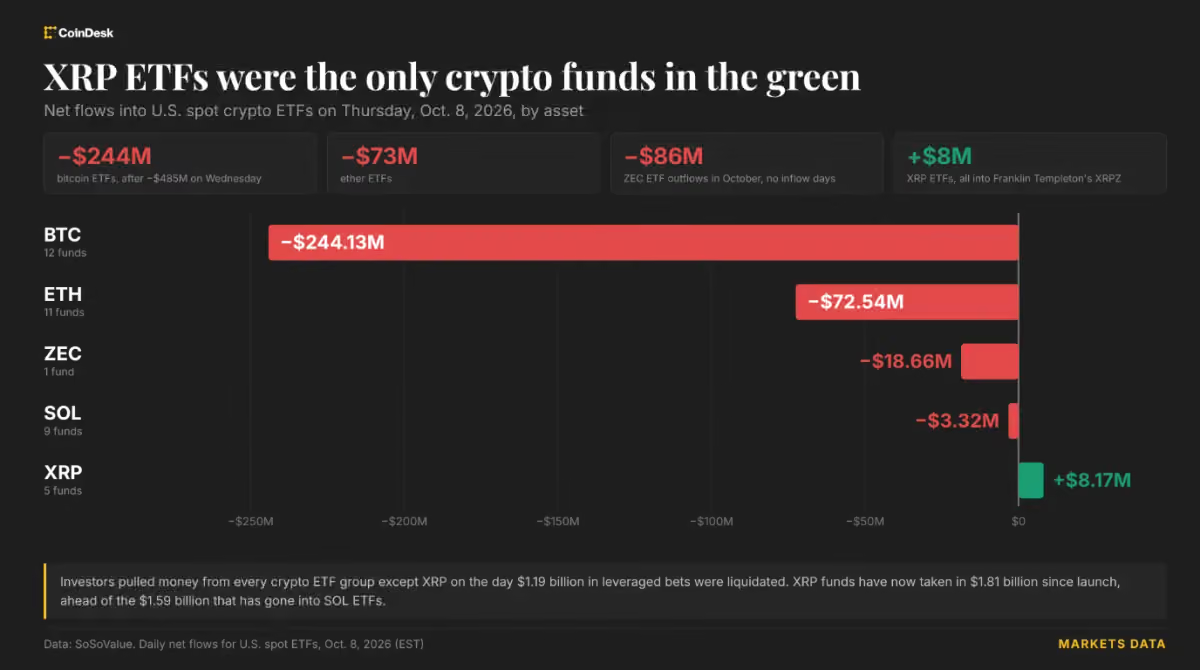
- XRP ETFs only cryptocurrency funds posting inflows Thursday while Bitcoin ETFs shed $244 million and Ethereum, Zcash funds extend October capital flight, validating selective bifurcation within crypto asset class. Bitcoin price near $82,000 after $1 billion liquidation cascade, confirming technical support deterioration. Pattern: institutional crypto capital rotating OUT of Bitcoin, Ethereum, Zcash but INTO XRP, suggesting differentiated risk assessment by asset. XRP Ripple positioning (payment networks, financial partnerships, less energy-intensive consensus) attracting capital despite broader crypto skepticism. Contrast validates Hayes thesis at crypto layer: if BTC/ETH represent infrastructure-like plays (compute-intensive, capex-hungry), XRP represents application/utility play (payment rails, financial rails). Capital rotation from infrastructure-like (BTC, ETH) to application-like (XRP) mirrors macro bifurcation between infrastructure and applications (Articles 272-276). BTC liquidation cascade suggests retail/leveraged positions capitulating, pushing technical support breakdown.
- $244M Bitcoin ETF outflows + $1B liquidation cascade validates technical breakdown and risk-off mood in crypto. Bitcoin resistance at $82K-83K level breaching on single liquidation day suggests weak support structure and leveraged long liquidation acceleration. October pattern: persistent outflows from BTC ETFs (suggesting institutional capital flight, not margin call liquidation), contrasts with single $1B liquidation spike (retail/levered positions). Bifurcation: institutional capital exiting BTC via ETF redemptions; retail/levered positions being forcibly liquidated at $82K support. Zcash (ZEC) fund outflows extend October pattern = privacy-coin skepticism (regulatory, use-case concerns). Ethereum ETF outflows (implied in article) validate application-layer skepticism extending beyond infrastructure into smart contract platforms. Only XRP ETFs in green suggests rotation into payment/rails specifically, away from broad crypto infrastructure and privacy plays.
- XRP capital inflow validation signals payment-network positioning advantage amid institutional skepticism. Ripple XRP positioning centered on payment networks, financial partnerships (MoneyGram historical, central bank digital currency exploration), financial institution adoption. Contrast to Bitcoin (infrastructure/store of value narrative challenged by capex skepticism) and Ethereum (smart contract platform facing competition from Solana, Sui, Base). XRP narrative: utility in financial system rather than speculative infrastructure. Capital rotation into XRP despite BTC/ETH/ZEC outflows suggests institutional capital rotating to “use case clarity” narrative over “infrastructure/upside” narrative. Risk: if Ripple fails to deliver on financial partnership/CBDC adoption timelines, XRP capital inflows could reverse sharply. But current bifurcation validates selective crypto capital allocation independent of broader market skepticism.
- Crypto liquidation cascade validates leverage cycle compression and validates Hayes dual inflection at currency layer. $1B Bitcoin liquidation single day suggests excessive leverage in crypto futures/margin markets. If leverage:spot ratio = 3-5x typical for BTC (per CME, Bybit data), $1B liquidation implies $200-300M spot positions sold into cascading margin calls. Pattern mirrors prime brokerage leverage cycle highlighted in Article 267 (Hayes/FT systemic risk article): when volatility spikes, leverage unwinds rapidly, creating cascade. October timing validates capital flight timing: ETF outflows (institutional decision) + liquidation cascade (leverage unwinding) converging = dual risk-off reinforcement. BTC support breakdown at $82K (vs $83K prior support, $80K November target if continues) positions for further cascade. Crypto leverage cycle validates broader systemic risk compression 2026-2027 predicted by Hayes.
What Happened?
Bitcoin exchange-traded funds posted $244 million in outflows Thursday, and Ethereum and Zcash funds extended their pattern of October capital flight, while XRP ETFs emerged as the only cryptocurrency funds in green during the session. Bitcoin price remained near $82,000 following a $1 billion liquidation cascade, indicating technical support deterioration. Zcash (ZEC) funds extended a multi-week run of October outflows, and implied Ethereum ETF outflows suggested broader institutional capital rotation away from major cryptocurrency infrastructure assets. XRP ETFs, representing the Ripple network’s native asset, attracted inflows despite the broader capital flight from Bitcoin, Ethereum, and privacy-focused cryptocurrency funds. The bifurcated capital flows within the cryptocurrency asset class reflect differentiated investor assessment of various digital assets and use cases.
Why It Matters?
The selective capital rotation within cryptocurrency markets—with institutional investors exiting Bitcoin, Ethereum, and Zcash ETFs while funding XRP positions—validates a bifurcated risk assessment that parallels broader artificial intelligence market dynamics. Bitcoin and Ethereum have served as proxies for cryptocurrency infrastructure and computational buildout, positioning them as correlated to AI infrastructure capex cycles and data center demand. The persistent outflows from these assets suggest institutional capital is repositioning away from cryptocurrency infrastructure narratives at precisely the moment infrastructure capex cycles peak. Conversely, XRP’s inflow pattern reflects investor positioning in assets with clearer utility narratives and financial partnerships, independent of computational infrastructure demands. The $1 billion Bitcoin liquidation cascade on a single day indicates excessive leverage in cryptocurrency derivatives markets, validating systemic risk concerns highlighted in earlier reporting about prime brokerage concentration and hedge fund leverage. The technical breakdown in Bitcoin support levels—with $82,000 as the critical support now under pressure—positions the asset for further downside if liquidation cascades accelerate. The October pattern of persistent cryptocurrency fund outflows suggests institutional capital flight from leveraged positions into less volatile asset classes ahead of what may become a significant volatility event in late 2026 or early 2027.
What’s Next?
Monitor Bitcoin support at $82,000: if breaks decisively (closes below $81,500), validates $80,000 November target and signals continued leverage unwinding; if holds, suggests institutional buyers entering on dip. Watch Bitcoin ETF flows: if outflows continue or accelerate (validates capital flight), suggests institutional repositioning; if inflows resume (validates support bounce), signals stabilization. Track XRP inflow trajectory: if XRP ETF inflows persist while BTC/ETH decline (validates payment-network rotation), supports differentiated risk positioning; if XRP reverses, suggests rotation broad-based rather than selective. Monitor cryptocurrency leverage ratios: if open interest in BTC futures contracts declines sharply (validates deleveraging), supports bottoming narrative; if remains elevated, suggests additional liquidation cascade risk. Watch Ethereum technical support: if ETH breaks technical levels similar to BTC deterioration, signals indiscriminate altcoin pressure; if ETH holds better than BTC, validates selective infrastructure skepticism. Finally, track Ripple partnership announcements: if Ripple announces major financial institution CBDC or payment network partnerships (validates XRP use-case narrative), supports inflow momentum; if no announcements, XRP inflows could reverse if seen as technical rotation rather than fundamental shift. October crypto capital flight validates broader institutional risk-off positioning entering final quarter 2026.
Affected Tickers and Coins: BTC | ETH | XRP | ZEC
Source: CoinDesk