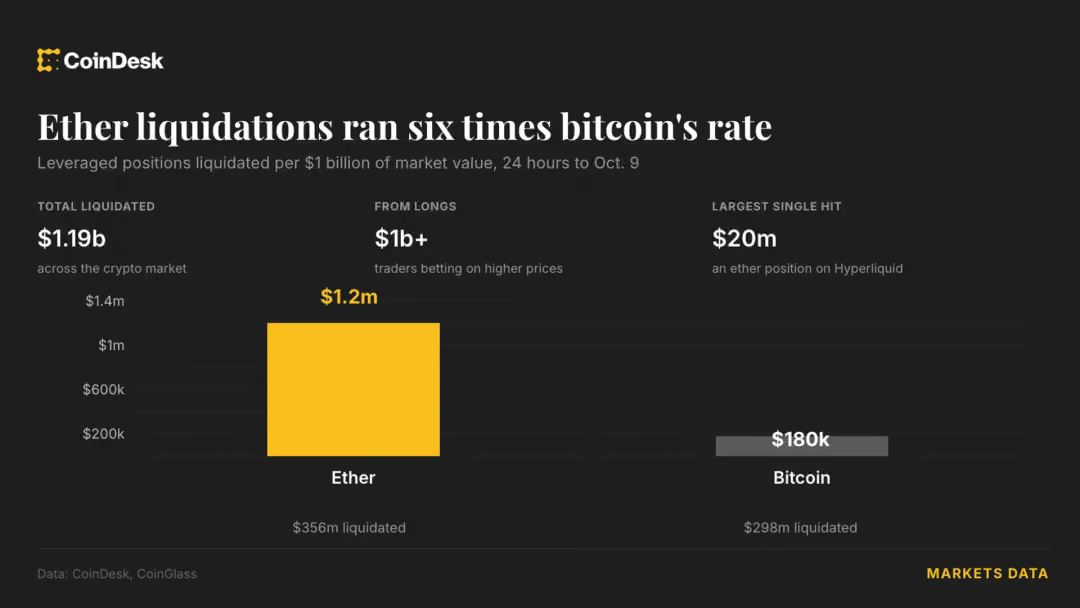
- Ether took the hardest hit Thursday in crypto’s $1.19 billion liquidation cascade. About $356 million in ETH positions were wiped out in 24 hours—more absolute damage than Bitcoin’s $298 million, even though Ether’s total market value is less than one-fifth as large. That concentration matters: Ether liquidations ran at $1.2 million per $1 billion of market cap, compared to Bitcoin’s $180,000. The Hyperliquid decentralized exchange saw a single $20 million Ether position erased. Ether fell 3% to roughly $2,490 while Bitcoin lost about 1%, but the leverage concentration meant Ether traders paid the steeper price for the same market moves.
- The trigger was a perfect storm: Federal Reserve minutes released Thursday showing most officials expected another rate hike before year-end spooked risk appetite. A Pentagon report that the U.S. was preparing for renewed combat in Iran pushed oil higher and added geopolitical anxiety. On top of that, Ethereum researcher Justin Drake warned that artificial intelligence could break the cryptography securing crypto wallets faster than expected—adding technical fear to market fear. Bitcoin had bounced between $83,000 and $87,000 all week, and traders had piled on leverage betting the range would hold. When Bitcoin slid from $83,200 through support to $80,400, those bets started getting liquidated, and falling prices forced more liquidations.
- The liquidation mechanics created a cascade. When a trader’s collateral gets eaten by losses, the exchange closes the position automatically—usually by market-selling into an already falling market. That selling pushes prices down further, triggering the next trader’s liquidation. Across all crypto, $1.19 billion was liquidated in 24 hours, with over $1 billion of it from longs—traders betting on higher prices. Solana accounted for $71 million in liquidations, XRP for $34 million, and NEAR for $25 million. But Ether’s ratio of leverage to market size made it the worst-hit.
- The bounce is now squeezing traders who bet on further declines. After Trump said the U.S. would not strike Iran before the midterms, Bitcoin recovered to $82,200. About 78% of liquidations in the past four hours came from short positions—traders who had bet on falling prices and got caught on the wrong side of the recovery. In the past hour alone, shorts made up nearly $12 million of roughly $13 million in liquidations. Tomorrow marks the anniversary of October 10, 2025, when $19 billion was liquidated in a single day, and that historical echo is keeping traders on edge.
What Happened?
Crypto markets suffered a $1.19 billion liquidation flush on October 9, 2026, with Ether traders taking disproportionate losses. About $356 million in Ether positions were liquidated over 24 hours, compared to $298 million in Bitcoin positions despite Bitcoin’s much larger market cap. Bitcoin fell from roughly $83,200 to as low as $80,400 before recovering to $82,200 by morning. Ether dropped about 3% to $2,490. The cascade was triggered by Federal Reserve minutes showing expectations for another rate hike before year-end, a Pentagon report that the U.S. was preparing for renewed combat in Iran, and a technical warning from Ethereum researcher Justin Drake that AI could compromise crypto security sooner than expected. Traders had accumulated heavy leverage during Bitcoin’s $83,000-$87,000 range earlier in the week. Once support at $83,200 broke, automated liquidations forced positions closed, pushing prices lower and triggering more liquidations. The decentralized exchange Hyperliquid saw a single $20 million Ether position liquidated.
Why It Matters?
Ether’s extreme leverage concentration—$1.2 million in liquidations per $1 billion of market cap versus Bitcoin’s $180,000—shows that smaller-cap assets attract disproportionate leverage from traders chasing higher returns. When markets reverse, those positions unwind fastest and most violently. The cascade also illustrates how Fed policy and geopolitical risk still move crypto: despite crypto’s claims to independence, interest rate expectations and international tensions drive real capital flows. The timing matters too. Tomorrow is the anniversary of October 10, 2025, when $19 billion was liquidated in a single day—a record that makes traders nervous about similar cascades this year. Traders are already positioned defensively, which means any new trigger could cause sharp reversals. Bitcoin’s recovery and the short squeeze that followed shows how fast the psychology can flip, but it also shows how thin the recovery is: Bitcoin is still roughly $800 below the $83,000 level where selling started.
What’s Next?
Watch leverage levels across exchanges over the next 24 hours. If traders are spooked by tomorrow’s anniversary and reduce positions, that’s bullish—less leverage means fewer forced liquidations if markets move again. If leverage starts rebuilding, that’s a warning sign. Monitor the Fed next steps: any signal of pause in rate hikes could flip sentiment quickly. Track geopolitical headlines around Iran, particularly anything Trump says or does before the midterms. If the Pentagon report was overblown, risk appetite could return. Watch Ether specifically: if its liquidation ratio normalizes, that signals traders are being more careful with leverage on smaller assets. If another incident wipes out $300+ million in positions again, that validates a pattern of concentrated leverage among Ether traders. And finally, keep an eye on Bitcoin’s actual support levels. If it can’t hold $82,000, the next target is $80,000, which could trigger another cascade ahead of the October 10 anniversary.
Affected Tickers and Coins: ETH | BTC | SOL | XRP
Source: CoinDesk