- XRP Ledger just gave banks what they’ve been asking for: a way to split payment and compliance work without sharing master keys. The PermissionDelegationV1_1 feature, which activated Wednesday after 80% of the network’s 35 node operators approved it, lets stablecoin issuers, banks, and tokenized fund managers authorize helper accounts to approve customers or process payments while keeping main keys offline. Each helper account gets up to 10 granular permissions tied to specific jobs, not spending limits. For institutions holding $4.26 billion in tokenized assets on the ledger, this solves a real problem: signing keys need to be available during business hours, but keeping them on internet-connected computers creates security risk. Now they can lock down the vault while delegating day-to-day operations.
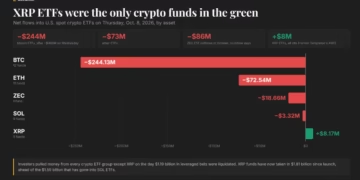
- The rollout comes as XRP infrastructure is quietly accumulating serious institutional adoption. Evernorth, which tracks XRP Ledger activity, reports the network held $3.72 billion in tokenized assets and $539 million in Ripple’s RLUSD stablecoin in Q2 2026—$4.26 billion combined in real institutional capital. That’s not speculation; that’s banks and corporations actually using the ledger for operations. The same day Bitcoin crashed through $82,000 support on leverage liquidations and Ethereum saw institutional capital flee, XRP ETFs attracted fresh inflows. The bifurcation is striking: infrastructure assets investors bet on performance are getting rejected, while infrastructure assets solving specific financial problems are getting adopted.
- But Wednesday’s activation masked emerging technical problems that could undermine institutional confidence. A bug in the PaymentBurn permission accidentally allows helpers to create tokens instead of just destroying them. The fix needs 29 operator votes to advance; as of Friday it only had 27. Separately, some network nodes miscalculate voting percentages when operators rotate security keys, making amendments appear closer to passing than they actually are. Both issues point to a deeper problem: as the protocol handles more institutional assets, operational complexity is mounting faster than the governance system can manage.
- Network operators are now facing a governance bottleneck. The PaymentBurn fix has stalled at 77% support—below the 80% threshold needed to start the two-week activation process. If critical security patches can’t get consensus, the delegation feature will stay under warning indefinitely, exactly when institutions are starting to rely on it. Some operators prioritize speed; others want tighter security. That friction slows everything down. The governance challenge facing XRP Ledger mirrors what’s happening across all infrastructure layers in crypto right now: maturation requires coordinating ever-larger coalitions, and consensus breaks when incentives diverge.
What Happened?
The XRP Ledger activated PermissionDelegationV1_1 on October 8, 2026, a long-awaited upgrade that took weeks longer than expected because operator support slipped below 80% in September and had to be rebuilt. The feature allows account owners to authorize other accounts to perform specific tasks—approving customers, processing payments, managing compliance—without handing over the keys that control their main holdings. Each delegated account can perform only the actions it’s been granted, and the owner can revoke permissions anytime. The XRP Ledger currently hosts $4.26 billion in institutional assets, including Ripple’s RLUSD stablecoin. However, the rollout has exposed two technical bugs: a PaymentBurn delegation permission that unintentionally allows helpers to create tokens, and a voting bug where some nodes miscalculate network consensus percentages. The PaymentBurn fix is stalled at 27 of 35 operator votes, one short of the 29 needed to advance.
Why It Matters?
Permission delegation addresses a critical constraint for banks moving to blockchain infrastructure: they need to operate accounts daily while keeping master keys offline for security. This feature lets them implement the same role-based separation banks use internally—compliance teams approve customers, operations teams execute payments, treasury holds the vault keys. With $4.26 billion in assets already on the ledger, that’s real operational demand, not theoretical. The timing is telling. While Bitcoin crashed below $82,000 on a $1 billion liquidation cascade and institutional investors fled Ethereum exposure, XRP attracted fresh capital. The divergence suggests institutional capital is discriminating between assets: those that promise infrastructure performance (Bitcoin, Ethereum data center plays) versus those solving concrete financial workflow problems (XRP payment networks, stablecoins). But the governance bottleneck—a critical security fix stalled because operators can’t agree—shows the other side of maturation: protocols reaching institutional scale face complexity they weren’t built to manage.
What’s Next?
Watch the PaymentBurn fix. If it hits 29 votes and passes, expect rapid institutional deployment of delegation features across banks and stablecoin issuers. If it stalls, the feature stays under security warning, and institutional confidence in the upgrade erodes. Track Q4 asset growth: if XRP Ledger reaches $6-8 billion in tokenized assets, that signals delegation is working and institutions are adding exposure. If it flatlines, technical issues or governance concerns are holding them back. Monitor whether other chains launch similar features—Ethereum, Solana, and others will build role-based permissions eventually, increasing competition. And pay attention to operator governance dynamics. If voting fragmentation spreads to other upgrades, the protocol slows down precisely when institutions need fast, reliable infrastructure. The XRP Ledger has built something institutional, but now it has to prove it can govern at scale.
Affected Tickers and Coins: XRP | BTC | ETH
Source: CoinDesk