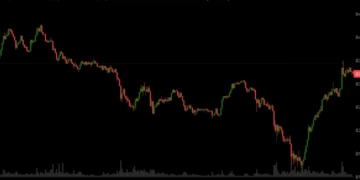
- Bitcoin has fallen approximately 50% from its October 2025 peak and now trades at around $66,000 — a price level below where it stood on the night of Trump’s November 2024 election victory, erasing the entire “Trump premium” that had been priced into crypto markets; the decline has been driven by Bitcoin’s shift from behaving like “digital gold” (an uncorrelated reserve asset) to behaving like a high-beta tech stock — rising and falling broadly in line with risk sentiment — with the divergence from stocks having widened significantly since October; the collapse happened against a backdrop where old-fashioned gold staged a rally to new all-time highs in January, directly breaking the “digital gold” narrative that had underpinned institutional crypto adoption and the MicroStrategy/crypto treasury investment thesis.
- The crypto treasury sector — companies that raise public market capital to accumulate Bitcoin or other tokens, pioneered by Michael Saylor’s Strategy Inc. — has been devastated: assets under management across all crypto treasury companies peaked at over $120 billion in October and have fallen to $75 billion, according to Artemis Analytics data, representing a $45 billion decline; unrealized losses “run into the tens of billions,” Artemis figures show; the sector’s core investment proposition — that crypto treasury companies trade at a premium to net asset value because of their leveraged exposure to crypto upside — collapses when the underlying assets decline sharply, as the leverage that produced outsize gains on the way up amplifies losses on the way down; Strategy itself, which holds more than $50 billion in Bitcoin (approximately 4% of the total 21 million Bitcoin supply), sold $216 million of Bitcoin in recent weeks — the first significant Bitcoin sale the company has made in years, reversing Saylor’s famously absolute “never sell” posture.
- The SPAC route to public markets — which dozens of crypto treasury companies had used or attempted to use — is now effectively broken: Adam Back’s BSTR Holdings scrapped its planned SPAC merger with a Cantor Fitzgerald affiliate, saying they needed to revise terms “to better reflect current market conditions”; a $1 billion crypto treasury vehicle backed by former Commerce Secretary Wilbur Ross was scrapped entirely; a $1.5 billion deal for Ether Machine was cancelled after the co-founder told investors “current market conditions make it impractical to move forward”; Avalanche Treasury Corp., which completed its SPAC listing on June 11, has fallen more than 70% since going public; the SPAC pipeline that had been described as the hottest trade in crypto a year ago has essentially collapsed, with companies that are only now completing deals they announced a year ago facing a market that has fundamentally repriced their asset class.
- The structural question the crash raises is whether crypto treasury companies can ever justify trading at a premium to their NAV — the fundamental arbitrage the entire sector was built on; Adam Back articulated the bull case as recently as August 2025: “the arbitrage between the mispricing of Bitcoin today and its potential future size is so enormous that it can absorb a lot of capital year on year for decades”; that thesis requires Bitcoin to eventually re-rate to a level so high that the current price looks like a permanent discount — a conviction that seems more difficult to hold after a 50% decline that has taken Bitcoin below its pre-Trump-election price; Pantera Capital, which invested in more than 20 crypto treasury deals at peak enthusiasm (led by a $125 million Solana treasury investment in April 2025), says it has made money on standout performers like BitMine Immersion and Hyperliquid Strategies — but acknowledges that investors who came later “have been left holding the bag.”
What Happened?
Bitcoin has fallen 50% from its October 2025 peak and trades near $66,000 — below its November 2024 election-night price — devastating the crypto treasury sector that had amassed $120 billion in assets. That figure has collapsed to $75 billion with tens of billions in unrealized losses. SPAC mergers are being scrapped across the sector, Avalanche Treasury Corp. is down over 70% since going public, and Strategy sold Bitcoin for the first time in years. Adam Back’s BSTR Holdings — whose founder was identified by the New York Times as the possible Satoshi Nakamoto — pulled its SPAC deal with Cantor Fitzgerald.
Why It Matters?
The crypto treasury crash is a stress test of one of the most aggressive financial engineering strategies Wall Street has adopted in recent years: raising public equity capital specifically to leverage up exposure to crypto. When Bitcoin rises, the model produces extraordinary returns; when it falls 50%, it produces catastrophic losses for late investors and an existential crisis for the sector’s business model. The collapse of the “digital gold” narrative — with actual gold at new highs while Bitcoin is below its election-night price — removes the core institutional justification for Bitcoin as a portfolio diversifier uncorrelated with equities, which was the main argument that made Bitcoin ETFs and crypto treasury companies credible to institutional allocators.
What’s Next?
Watch Strategy’s Bitcoin sales for any further acceleration — if Saylor continues selling, it signals genuine financial stress and could become a self-reinforcing negative catalyst; watch the remaining SPAC pipeline for additional collapses or emergency term revisions; watch Bitcoin ETF flows from BlackRock and Fidelity (which hold approximately $72 billion in Bitcoin) for any institutional redemption pressure; watch for potential restructurings or bankruptcies among smaller crypto treasury companies that used leverage to acquire tokens at October peak prices; and watch whether the US crypto legislative bill that was already hitting turbulence in the Senate gets further complicated by the sector’s distress — a weakened crypto industry lobby may have less political capital to push the bill across the finish line.
Source: Bloomberg Businessweek