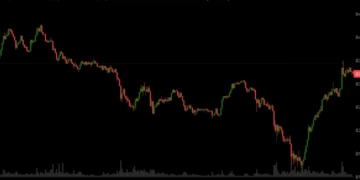
- Bitcoin tumbled more than 3% to below $62,000 after President Trump declared the US-Iran ceasefire over following renewed Iranian attacks on commercial ships in the Strait of Hormuz and subsequent US strikes on Iran — a geopolitical shock that triggered immediate risk-off selling across crypto, equities, and risk assets broadly, with Brent crude surging more than 5% and the MSCI Asia Pacific Index dropping as much as 1%.
- The crypto market’s reaction reflects Bitcoin’s evolving sensitivity to macro risk: the market is “fretting about further fuel-linked inflation and potential rate hikes to counter it,” in the words of Orbit Markets co-founder Caroline Mauron, who sees technical support around $61,500 but warned that the market is likely to remain volatile as geopolitical and macro situations develop — a view that captures how oil price spikes from Hormuz disruptions now feed directly into Bitcoin’s rate-risk calculus.
- The selloff interrupted what had been building as a solid July recovery: Bitcoin had been up approximately 5.5% month-to-date before Wednesday’s drop, partially recovering from a nearly 18% decline in June — its worst monthly performance in four years — and spot Bitcoin ETFs had attracted more than $500 million in inflows over three consecutive trading days, a sharp reversal from the $4.5 billion in June outflows that marked the ETF funds’ worst month since their January 2024 launch.
- Strategy’s $216 million Bitcoin sale disclosed earlier this week barely moved the market — a stark contrast to last month, when Strategy’s disclosure of its first Bitcoin sale since 2022 precipitated a significant selloff — indicating that the market had substantially absorbed the news and that the renewed selling on Wednesday was purely geopolitical, not supply-driven; Strategy remains the largest corporate holder of Bitcoin and the market’s continued tolerance for its sales signals maturing institutional depth.
What Happened?
Bitcoin fell sharply on Wednesday after President Trump declared the ceasefire with Iran over, following renewed Iranian attacks on ships in the Strait of Hormuz and subsequent US strikes on Iranian targets. The cryptocurrency dropped more than 3% to below $62,000 in early London trading, with Ether and Solana also falling. Oil futures surged simultaneously — Brent rose more than 5% — as markets priced in a higher probability of sustained Hormuz disruption. The Iran-related risk-off hit a crypto market that had been in the early stages of recovering from June’s 18% selloff, the worst monthly performance in four years. Both sides accused the other of violating the ceasefire terms.
Why It Matters?
The Bitcoin-Iran reaction illustrates two important dynamics simultaneously. First, Bitcoin remains highly sensitive to macro risk-off events despite its “digital gold” narrative — when geopolitical shocks trigger inflation fears and rate-hike expectations, crypto sells alongside equities rather than acting as a safe haven. The market’s concern is that Hormuz disruptions spike oil prices, which feeds into inflation, which revives Fed rate-hike expectations, which pressure all risk assets including Bitcoin. Second, the contrast between the market’s non-reaction to Strategy’s $216 million Bitcoin sale and the sharp selloff on geopolitical news suggests the market has absorbed institutional supply dynamics but remains acutely sensitive to macro shocks. The three consecutive days of $500M+ ETF inflows before Wednesday’s event were building a positive technical picture that has now been interrupted.
What’s Next?
Watch whether Iran-US tensions escalate further or de-escalate quickly — the crypto market’s recovery trajectory depends heavily on whether this represents a brief flare-up that markets price through or the beginning of a sustained conflict that keeps risk assets under pressure and oil prices elevated. Orbit Markets’ support level of $61,500 is the near-term technical line to watch; a break below that level would signal broader selling momentum. The ETF flow data will also be informative — if institutional inflows resume quickly despite the geopolitical uncertainty, it would suggest underlying institutional demand remains firm. For longer-term observers, the June low after the 18% selloff established the key support range for Bitcoin’s 2026 trajectory.
Source: Bloomberg