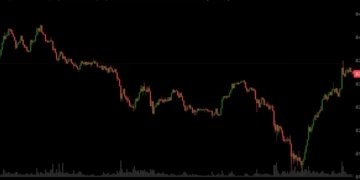
- Strategy’s mNAV metric — which measures enterprise value as a multiple of bitcoin holdings and was the engine of its bitcoin acquisition machine — fell below 1 last month, signaling the market was valuing the company at a discount to its bitcoin; Strategy’s stock is down 75% over the past year, and the company responded by authorizing the sale of up to $1.25 billion of bitcoin to buy back shares and cover interest payments — abandoning its core “never sell bitcoin” philosophy after just three years.
- The mNAV metric has a critical flaw that makes the situation worse than reported: Strategy calculates enterprise value using the par/face value of its $6.75 billion in debt and $15.46 billion in preferred stock, not their market values; at the time mNAV was reported at just under 0.99 on June 26, Strategy’s debt was trading at a 7% discount and preferred shares were trading at a 28% combined discount — meaning the true market-value mNAV was approximately 0.89, not 0.99, a significantly worse position.
- To stabilize its preferred stock prices (which it doesn’t count in mNAV but clearly cares about), Strategy on June 29 raised the dividend on its largest preferred series “STRC” or “Stretch” to 12% — a costly move that reveals the company is deeply concerned about the market value of securities it officially excludes from its key metric; the company estimates its $2.55 billion cash buffer provides approximately 17 months of runway to pay interest and preferred dividends without touching bitcoin, but that window shrinks with every rate adjustment.
- Strategy holds 4% of all bitcoin that will ever exist, and even small sales move markets: a test sale of just 32 bitcoins for $2.5 million in May pushed bitcoin prices lower; if the mNAV falls and stays below 1, Strategy’s own logic demands it sell bitcoin to buy back its deeply discounted securities — but doing so at scale could trigger a self-reinforcing spiral where bitcoin sales push bitcoin prices lower, depressing NAV further and widening the discount that prompted the sales.
What Happened?
Strategy, the bitcoin-hoarding company led by Chairman Michael Saylor, is caught in a mathematical trap of its own design. The company built an acquisition machine based on a simple premise: so long as markets valued Strategy’s stock at a premium to its bitcoin holdings (as measured by its bespoke mNAV metric), it could issue overvalued stock and debt to buy bitcoin, then use the bitcoin appreciation to justify further issuance. That flywheel required mNAV to stay above 1. It fell below 1 last month. The company’s stock is down 75% over the past year, its preferred shares are trading at a 28% discount to par, and its debt is at a 7% discount. Strategy has now authorized the sale of up to $1.25 billion of bitcoin to buy back securities — directly inverting the logic that built its empire. A WSJ analysis finds the company’s own metric understates the severity of its position by using face value rather than market value for its liabilities.
Why It Matters?
Strategy is not a small actor in the bitcoin market. Its holdings represent approximately 4% of all bitcoin that will ever exist — a concentration large enough that even modest sales can move the global bitcoin price. The company’s predicament illustrates the structural fragility of the leveraged bitcoin-accumulation model: it works brilliantly when mNAV is high and rising, allowing cheap capital to buy an appreciating asset; it works catastrophically in reverse, where falling mNAV requires selling the asset whose price decline caused the mNAV to fall. The 17-month cash runway is a real constraint: if bitcoin doesn’t recover sufficiently before the cash runs out, Strategy faces an involuntary liquidation scenario where it must sell bitcoin at whatever price the market offers. For bitcoin investors broadly, Strategy’s position represents a significant and price-sensitive overhang — the question isn’t whether they’ll sell, but under what conditions.
What’s Next?
Watch the mNAV weekly. If it recovers above 1.2 or so sustainably, Strategy’s distress recedes and the authorized bitcoin sales may never fully materialize. If it stays near 1 or dips below again, the 17-month cash clock becomes the dominant variable — and the authorized $1.25 billion bitcoin sale authorization signals management’s intention to act before the clock expires. The STRC preferred dividend hike to 12% is a near-term cost that will accelerate cash burn, making the runway shorter than the 17-month estimate. The deeper strategic question is whether any version of the bitcoin-accumulation roll-up model is viable at current bitcoin prices and market sentiment — or whether Strategy’s trajectory represents the inevitable endgame of a capital structure that required perpetually rising confidence to sustain itself.
Source: The Wall Street Journal