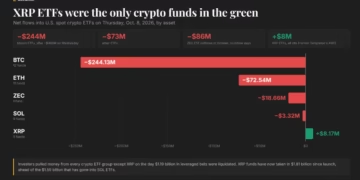
- US-listed Bitcoin ETFs are on pace for their worst month since launching in January 2024, with investors pulling $4.1 billion across 13 funds in June — BlackRock’s IBIT alone accounting for $3 billion of those withdrawals, per Bloomberg data.
- Bitcoin is down 18%+ this month and hovering around $60,000, on track for its worst monthly performance since June 2022 when crypto bankruptcies culminated in the collapse of Sam Bankman-Fried’s FTX; the token is down more than 50% from its October peak.
- Unlike previous Bitcoin corrections where ETF investors bought the dip, Glassnode analysts say traditional investors are now “choosing to reduce exposure” — a bearish behavioral shift that removes a structural support the market had come to rely on.
- Strategy’s preferred stock STRC fell 24.67% last week to $74.57 on fears the company may need to sell Bitcoin to meet upcoming convertible note maturities and dividend obligations — adding pressure on an asset whose largest corporate buyer is now itself under financial strain.
What Happened?
June has been Bitcoin’s worst month in four years: the token is down more than 18%, hovering around $60,000 after falling through that level last week, and is now more than 50% below its October peak. US-listed Bitcoin ETFs have seen $4.1 billion in net outflows this month — the highest since the products launched in January 2024 — with BlackRock’s IBIT alone accounting for $3 billion of the withdrawals. Strategy (formerly MicroStrategy) sparked the latest leg of selling when it disclosed a $2.5 million Bitcoin sale — small against its ~$50 billion in holdings, but symbolically devastating for a company whose founder had pledged never to sell. Strategy’s preferred stock STRC then fell 24.67% last week to $74.57, on analyst concerns that the company may need to liquidate Bitcoin to meet upcoming convertible note maturities and dividend obligations.
Why It Matters?
Bitcoin ETFs were supposed to bring in patient, long-term institutional capital that would dampen volatility and buy corrections. June has exposed the opposite dynamic: when the downturn is deep and prolonged enough, institutional ETF holders become sellers, not buyers. That behavioral shift — documented by Glassnode — removes what markets had come to treat as a structural support. Meanwhile, Strategy’s financial architecture, designed to lever Bitcoin’s price appreciation into perpetual accumulation, is beginning to buckle. If Strategy becomes a forced seller rather than a consistent buyer, one of Bitcoin’s most important demand anchors disappears precisely when institutional ETF demand is contracting.
What’s Next?
Bitcoin is hovering at $60,000 with no obvious near-term catalyst to reverse the trend. Key watch items: whether Strategy can service its convertible note obligations without liquidating more Bitcoin, whether IBIT outflows stabilize or accelerate, and whether ETF investors shift back to dip-buying behavior. A sustained break below $60,000 could trigger the next wave of systematic selling. Glassnode’s observation that “previous Bitcoin corrections attracted ETF buying” but this one has not is the central bearish signal in the current market structure.
Source: Bloomberg