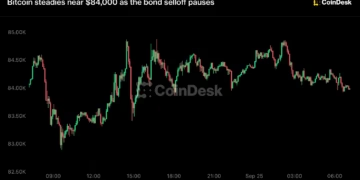
- Bitcoin fell as much as 2.9% to $63,018 in Tuesday Asia trading — its lowest level in 11 days — with Ether down 3.3%, as Citadel Securities publicly projected that Fed Chairman Kevin Warsh will deliver a surprise quarter-point rate hike at Wednesday’s FOMC meeting, arguing the move would strengthen Warsh’s inflation-fighting credibility; interest-rate swaps are pricing approximately 40% odds of a hike — an unusually high level of genuine uncertainty this close to a Fed decision by recent historical standards, and a direct transmission mechanism into crypto markets given that rising borrowing costs drive investors away from risk assets; Caroline Mauron of Orbit Markets framed the downside levels to watch: “$62,000 is the next support level, with strong support expected around $60,000.”
- Bitcoin ETF outflows extended to a third consecutive day on Monday, with investors pulling $11.6 million from US-listed spot Bitcoin ETFs — bringing total outflows from Thursday through Monday to $476.9 million; this continues the pattern that began with the seven-session inflow streak snap last week, and suggests that the institutional re-engagement with Bitcoin that produced three consecutive weeks of net inflows is now reversing under the combined pressure of Fed rate anxiety and Clarity Act legislative uncertainty; the $476.9 million four-day outflow figure approaches the $465 million two-day outflow figure from Thursday-Friday alone, indicating that Monday’s outflow was more modest but that the trend remains directionally negative heading into the Fed decision.
- The technical picture has deteriorated: IG Australia analyst Tony Sycamore noted that “a sustained break and close above the 200-day moving average (currently at $72,001) is still needed to negate medium-term downside risks” — a level that is now nearly 14% above the current price; Bitcoin has been attempting to build a floor after crashing approximately 50% from its October record of $126,000, a decline that has taken the price from all-time-high territory to a level where the 200-day moving average now sits more than $9,000 above spot; the macro-driven nature of the current selldown (Fed rates, AI credit risk concerns) rather than crypto-specific factors means Bitcoin’s recovery timeline is now largely dependent on the Fed’s policy path rather than on crypto market dynamics.
- The dual headwinds of Fed rate hike risk and Clarity Act stagnation create a difficult near-term setup: a Wednesday rate hike would immediately pressure Bitcoin lower and likely extend ETF outflows; a hold with hawkish guidance (which Warsh’s communication style makes more probable than definitive dovish reassurance) could stabilize the market but is unlikely to reignite the inflow trend without a clear signal that tightening is done; the Clarity Act’s ethics impasse — with Democrats demanding tougher language around Trump’s $1.4 billion crypto windfall before they will vote for the bill — shows no sign of resolution before the August recess, removing the regulatory-clarity tailwind that had been supporting sentiment through late July.
What Happened?
Bitcoin fell 2.9% to $63,018 on Tuesday — its lowest in 11 days — as Citadel Securities forecast a surprise Fed rate hike Wednesday and rate swap markets priced ~40% hike odds. Ether dropped 3.3%. Bitcoin ETF outflows extended to a third straight session, with $11.6 million exiting on Monday, bringing the four-day total to $476.9 million. The price has now fallen roughly 50% from its October $126,000 record, and the 200-day moving average at $72,001 remains a distant ceiling that technical analysts say must be reclaimed to signal a durable recovery.
Why It Matters?
Bitcoin’s behavior ahead of the Fed decision is providing a real-time illustration of how thoroughly the “digital gold” and “inflation hedge” narratives have been displaced by crypto’s actual trading behavior as a high-beta risk asset tightly coupled to interest rate expectations. At ~40% hike odds, the market has not priced in a hike but has not dismissed it either — creating maximum ambiguity heading into Wednesday’s decision. The ETF outflow continuation (three days in a row, $477M total) signals that institutional investors who briefly returned in July are now reducing exposure rather than adding at lower prices.
What’s Next?
Wednesday’s Fed decision is the immediate binary: a hike would likely push Bitcoin toward the $60,000 support Mauron identified, while a hold could stabilize prices but may not restore the inflow trend without explicitly dovish guidance that Warsh’s communication style makes unlikely. Watch the post-decision ETF flow data (Thursday morning) as the clearest signal of institutional reaction. The $60,000 level is the next structural support; a break below it would technically negate the modest recovery since the June lows and likely accelerate redemptions from the ETF complex.
Source: Bloomberg