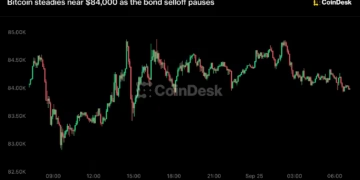
- Bitcoin rose 0.75% to approximately $64,328 ahead of the Federal Reserve’s interest-rate decision, partially recovering from a volatile 48-hour window that saw BTC spike to $66,700 before crashing to $62,400 in the wake of South Korea’s chip stock rout and the geopolitical disruption from the Iran missile attack on U.S. forces in Jordan; the current price action reflects a market in genuine suspension — neither sellers pressing the recent lows nor buyers committing fresh capital — with derivatives data confirming the stasis: the taker long-short volume ratio is nearly perfectly balanced, open interest has held steady near $113 billion over 24 hours while volume ticked up 10% to $205 billion, a combination that points to higher churn from existing participants rather than new positioning entering the market ahead of the Fed decision.
- The Federal Reserve decision arriving Wednesday carries unusual weight for crypto markets because it may be the first rate increase in approximately three years: with U.S. CPI running at 4.1%, the “higher for longer” dynamic that crypto markets had priced as an extended plateau is now a live question of whether rates go even higher, and the 35% probability the market assigns to a hike (per analyst references in the CoinDesk report) is anomalously high given that markets typically converge to near-certainty in the hours before Fed announcements — the persistent 35% hike probability signals genuine uncertainty, not just hedging noise, and explains why Bitcoin implied volatility (30-day) remains near recent lows even as analysts express unease about the outcome; traders are not pricing jitter, they are pricing irresolution.
- The derivatives positioning breakdown reveals important structural divergences within the crypto market: BTC open interest remains steady near 750K BTC despite spot price gains exceeding 1% in 24 hours, and ETH OI has dropped for four consecutive days to 14.14 million ETH — both indicating that spot buyers are not yet triggering futures participation, a dynamic that historically precedes either a directional resolution when futures catch up to spot, or a spot reversal when the spot move proves unsustainable without derivatives confirmation; UNI is the notable exception, with OI rising to its highest since July 13 following BlackRock’s decision to bring its tokenized Treasury fund to Uniswap’s decentralized exchange — a direct catalyst that is distinctly different from the broader market’s macro-uncertainty stasis and illustrates how individual protocol-level news can decouple single assets from the macro holding pattern.
- The options flow adds another layer of complexity: BTC puts at strikes $62,000, $60,000, and $54,000 dominate Deribit 24-hour volume rankings, while ETH options volume is led by calls — a divergence that suggests BTC traders are buying insurance against downside while ETH traders are positioning for upside, possibly reflecting the different sensitivity of each asset to a Fed rate hike (BTC, increasingly correlated with risk assets and macro rate expectations, may face more pressure from a hike than ETH, which has its own protocol-level catalysts including the Pectra upgrade tailwinds); the Monero (XMR) outperformance (+1.82%) in the privacy coin sector, going largely unnoticed, is worth flagging as a potential signal of capital rotating into assets perceived as less correlated with traditional macro outcomes ahead of a binary event.
What Happened?
Bitcoin added 0.75% to recover to ~$64,328 ahead of the Federal Reserve’s Wednesday rate decision, which could mark the first rate hike in three years as U.S. inflation runs at 4.1%. The CoinDesk 20 Index added 0.41% with a mixed 10-up/10-down split. Derivatives positioning shows near-perfect long-short balance, steady open interest at $113B, 30-day implied volatility near recent lows, and put-dominated BTC options flow — the full picture of a market waiting, not acting.
Why It Matters?
A Fed rate hike at Wednesday’s meeting would be the first in three years and would test the degree to which crypto has re-correlated with rate-sensitive risk assets after two years of treating “higher for longer” as a known, priced condition. The market’s failure to converge to a clear Fed consensus by decision day — the 35% hike probability is unusually undecided — means the announcement itself will likely trigger sharp directional movement in both BTC and ETH regardless of which way the Fed goes. “Anything remotely dovish could be good for bitcoin,” per analyst commentary in the piece; anything hawkish would test the $62,400 recent low.
What’s Next?
The Fed decision itself is the immediate catalyst — watch BTC’s reaction in the 15 minutes following the 2 p.m. ET announcement for the initial directional read; watch ETH’s reaction relative to BTC as a signal of whether the macro risk-off / risk-on dynamic is dominating or whether ETH’s protocol-specific tailwinds are providing relative insulation; watch UNI’s open interest and price action as the clearest real-time indicator of whether the tokenized Treasury / DeFi integration theme can sustain momentum independent of macro; and watch the $62,400 support level — the recent low set during the South Korean chip crash and geopolitical spike — as the key downside reference if the Fed hikes and crypto sells.
Source: CoinDesk