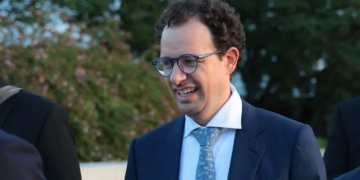
- Trump is expected to name Director of National Intelligence Jay Clayton as his next artificial intelligence czar, possibly as soon as Friday, according to a person familiar with the matter. Clayton has held the intelligence role since July and previously served as US attorney for the Southern District of New York, where he handled cases including the one against former Venezuelan President Nicolas Maduro.
- A Quinnipiac University poll released Wednesday found 72% of those surveyed would oppose a new data center in their community, up from 65% when the question was asked in March. A large majority also said they would favour requiring AI firms to meet independent safety benchmarks even if that slowed development.
- The appointment follows a White House lunch with nearly two dozen Silicon Valley executives. Trump subsequently dismissed new AI rules and released a one-page pledge signed by Jensen Huang of Nvidia, Dario Amodei of Anthropic, Elon Musk, OpenAI president Greg Brockman, Mark Zuckerberg and Sundar Pichai.
- AI now ranks as a key issue in races that will decide control of both chambers of Congress, with voter concern focused on data centers raising power prices and on workforce disruption, alongside newer fears about catastrophic risk after a series of security breaches involving autonomous agents.
What Happened?
Trump has embraced AI as an economic driver since returning to office and has rejected calls from lawmakers and parts of the industry for greater oversight, citing the need to maintain a US lead over China. He has described the safety fears raised by Amodei and others as a hoax, and his allies argue existing liability law provides sufficient protection. Amodei accelerated the debate with a 3,800-word essay on September 12 calling for paced development and more government regulation. Clayton would inherit a role vacated by David Sacks, the first AI czar, who stepped down in March when his term as a special government employee expired. Sacks has remained in contact with Trump, argues AI should be left largely unregulated, and has criticised Amodei position as an attempt to make it harder for smaller companies to challenge larger ones.
Why It Matters?
The polling number is the most consequential item and it has little to do with existential risk. Seventy-two percent opposing a data center locally, up seven points in six months, means AI infrastructure has become unpopular where it is actually built, and siting decisions are made by states and municipalities rather than by Washington. A federal administration enthusiastic about construction cannot deliver permits, which is why roughly $68 billion of projects were blocked or delayed by local opposition in a single quarter and 30 statehouses have taken up siting rules. For investors in data centre developers and the power supply chain, local politics is the binding constraint and it is moving against them regardless of federal posture. The choice of Clayton tells you how the role is being conceived. A former prosecutor and sitting intelligence director is not an industrial policy appointment, and the background suggests national security and enforcement framing rather than development promotion, which sits oddly beside a mandate described as spurring the technology forward. There is also a straightforward political tension worth stating plainly. The administration rejects safety rules while a large majority of voters say they would accept slower development in exchange for independent safety benchmarks, and AI is now a significant midterm issue. Sacks counterargument deserves fair hearing: calls for regulation from an established lab can raise compliance barriers that entrench incumbents, and that critique applies regardless of whether the underlying safety concerns are valid. Both things can be true, which is why the policy question is genuinely difficult rather than simply a matter of who is right about risk.
What Next?
The formal announcement may come within days, and whether Clayton holds both the intelligence and AI roles simultaneously will indicate how much capacity the position actually receives. Watch whether the voluntary audit framework produces named auditors and published assessments, since that is the only mechanism currently on offer. The November midterms are the near-term political test, and data centre siting is likely to feature in state and local races given the polling. For the industry, the measure that matters is whether local opposition translates into more project cancellations, which would show up in capital expenditure guidance before it shows up in policy. Any further movement in the Quinnipiac numbers would indicate whether this is hardening or has peaked.
Affected Tickers and Coins: NVDA, META, GOOGL, SPCX, MSFT
Source: Bloomberg