- Manus AI raised over $500 million in first independent funding round after Beijing forced Meta to abandon $2 billion acquisition, validating investor appetite for AI agent startups despite unprecedented regulatory intervention. Round led by private equity Boyu Capital and VC IDG Capital; follow-on from existing shareholders Tencent, HSG, ZhenFund. Post-funding valuation estimated ~$4 billion (per Bloomberg September report), making Manus China’s most valuable AI agent maker. National Development and Reform Commission blocked Meta’s acquisition citing “technology export control violations,” forcing separation after Meta had begun integrating Manus engineering and product. Manus has since relaunched as independent company with new in-house execution system (Cascade), deployed Manus 2.0, and launched Cue standalone personal-agent app (each agent has email, phone, mobile wallet). Investor participation suggests “short-term fallout of Meta case has been contained” per Eurasia Group’s Dan Wang. Signals renewed confidence in AI agent commercial potential despite rapid foundation model improvements and price competition intensifying.
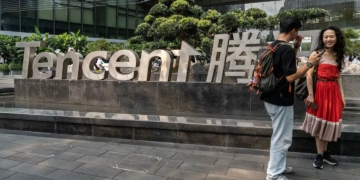
- Beijing’s “technology export ban” blocks foreign AI M&A but incentivizes domestic consolidation and VC participation. NDRC formally prohibited Meta acquisition on basis that Manus technology constitutes foreign investment in AI agent export platform—unprecedented move signaling Xi administration treating AI agent layer as strategic national asset. Result: foreign tech acquirers blocked, but domestic capital (Tencent, Boyu, IDG) backing independent Manus validates Beijing preference for Chinese-controlled ownership. Tencent participation particularly notable: validates Tencent hedging bets across AI ecosystem (also backs Moonshot, has stakes in ByteDance, DeepSeek). Boyu Capital focus on tech/biotech suggests institutional VC believes Manus can achieve standalone profitability despite Meta separation. This pattern mirrors forced breakup of Bytedance/TikTok dynamics: governments prefer domestic-controlled AI agents to foreign acquisition. Net result: China AI agent market consolidating around Tencent/Alibaba/ByteDance + independent VC-backed players (Manus, Moonshot) rather than foreign tech integrations.
- Meta’s knowledge transfer problem validates durability of separated Manus technology despite forced split. Matthias Hendrichs (Singapore AI adviser): “Close integration with Manus does not disappear when transaction reversed. You can separate companies but cannot make engineers forget what they learned.” Meta had integrated Manus engineers and tech before split, meaning Meta retains knowledge of Manus architecture, scaling approaches, and product roadmap. But Manus also launched new systems (Cascade execution engine) suggesting differentiated technology post-separation. Competitive dynamic: Meta launched its own personal AI agent (Muse) in September based on open-source OpenClaw, directly competing with Manus’ Cue standalone agent app. Knowledge transfer gives Meta advantage but also validates Manus’ differentiation strategy post-breakup. Longer-term risk: if Meta’s Muse gains market traction, Manus could face margin pressure despite capital raise.
- Regulatory clarity requirement positions Manus for either IPO or strategic acquisition by Chinese tech giant. Han Lin (Asia Group): “Immediate task for Manus is proving scale, profitability and regulatory alignment.” Company must demonstrate: (1) independent profitability path, (2) zero US technology dependencies, (3) alignment with Xi’s AI agent strategic objectives. Path forward unclear: company “could ultimately aim for public listing” but timing/venue (Shanghai, HK, US unlikely given NDRC precedent) uncertain. Alternatively, acquisition by Tencent/Alibaba/Bytedance validates domestic consolidation thesis. $4B valuation suggests either IPO path at 2027 target or strategic exit at premium to founders. Risk: if Muse gains traction or other agents scale (Moonshot, DeepSeek agents), Manus’ $4B valuation could face compression pressure. This $500M raise buys runway to 2027 inflection point when AI agent layer standardizes and consolidates.
What Happened?
Manus AI, the Chinese artificial intelligence startup forced to separate from Meta after Beijing blocked a $2 billion acquisition, has raised more than $500 million in its first independent funding round. Butterfly Effect, Manus’ parent company, announced Thursday that the round was led by private equity firm Boyu Capital and venture investor IDG Capital, with follow-on investment from existing shareholders including Tencent, HSG, and ZhenFund. The company did not formally disclose its post-funding valuation, but Bloomberg reported in September that Manus was expected to double its valuation to approximately $4 billion in this financing round, positioning it as China’s most valuable artificial intelligence agent maker. The National Development and Reform Commission formally blocked Meta’s acquisition in early 2026, citing technology export control violations. Meta had already begun integrating Manus’ engineering team and technology into its systems when authorities intervened. Since the forced separation, Manus has launched Manus 2.0 incorporating a new in-house execution system called Cascade and unveiled Cue, a standalone personal-agent application in which each agent has its own email address, phone number, and mobile wallet. Meanwhile, Meta has proceeded with development of its own personal AI agent, launching Muse in early September, modeled on the open-source AI agent framework OpenClaw.
Why It Matters?
The fundraising demonstrates that Beijing’s unprecedented regulatory intervention—formally prohibiting foreign investment in Chinese AI agent technology—has not deterred investor appetite for artificial intelligence startups. Instead, the capital raise suggests a structural shift in China’s AI market: foreign technology acquirers are blocked, but domestic capital (Tencent, private equity, venture investors) actively consolidates the AI agent layer under Chinese ownership. Tencent’s participation is particularly significant, as it validates a strategy of hedging across the Chinese AI ecosystem through stakes in multiple agent developers. The regulatory action has forced Manus to develop independent technology and profitability, creating competitive tension with Meta’s Muse agent launched in September. However, Manus faces a critical vulnerability: Meta retained knowledge of Manus’ architecture and scaling approaches during the brief integration period before the forced separation, potentially giving Meta’s competing agent product an advantage in market positioning. The capital raise positions Manus with sufficient runway through 2027, when the AI agent market is likely to consolidate as foundation models commoditize and agent layers standardize. The path forward for Manus remains uncertain between a potential initial public offering in China or a strategic acquisition by a larger Chinese technology company such as Tencent, Alibaba, or ByteDance.
What’s Next?
Monitor Manus Cue adoption metrics: if Cue gains meaningful user traction (millions of daily active agents), validates commercial viability of standalone personal-agent model and supports valuation trajectory; if adoption stalls, suggests Manus’ differentiation insufficient against Meta’s Muse and larger ecosystem players (ByteDance, Alibaba agents). Watch Meta’s Muse market adoption closely: if Muse gains rapid uptake in US/international markets, validates Meta’s agent product strategy and potentially commoditizes AI agent layer, pressuring Manus margins. Track Chinese regulatory guidance on foreign AI M&A: if NDRC reaffirms prohibition on foreign acquisitions, validates domestic consolidation thesis; if permits selective deals, suggests regulatory stance softening. Monitor for acquisition signals: if Tencent, Alibaba, or ByteDance make formal acquisition offers, validates strategic exit path; if no bids emerge by mid-2027, IPO becomes more likely. Finally, watch Manus technology differentiation: if Cascade execution engine achieves superior performance metrics vs competitors, supports standalone viability; if meets parity with open-source frameworks, suggests commodity pressure ahead. The $4 billion valuation positions Manus for either ~3-4x IPO return (2027 target $8-12B public valuation) or strategic exit at premium to current raise price by 2027 year-end.
Affected Tickers and Coins: META | TCEHY
Source: Bloomberg