- Tencent Holdings weighing $5 billion offshore bond offering (dollar and offshore yuan denominated), potentially this month (October 2026), marking second major capital raise in 4 months for AI capex acceleration. Prior June 2026 offering $4.7B (largest debt sale since 2020) for AI product/service development and debt refinancing. Tencent capex on AI and computing surged +176% in June quarter to 52.8 billion yuan ($7.9 billion), validating competitive intensity catching up to ByteDance, Alibaba, DeepSeek, Moonshot. Company developing in-house models (Hy4 targeting late 2026) to compete with top-tier agents. Two raises in 4 months ($4.7B June + $5B Oct consideration) suggests accelerated AI capex timeline beyond original budget or competitive pressure forcing incremental spending. Outstanding offshore notes ~$22B; no public bonds maturing 2026; one $USD bond due 2028. Raises timed amid rising yields (US 10Y at 5.3%+) and Firmus IPO collapse Friday same day (Oct 8), signaling debt investors still willing to finance AI despite equity market skepticism emerging.
- Global AI-related debt issuance $575B+ YTD 2026 validates wave of tech debt financing but masks emerging credit stress signals. Goldman Sachs credit strategists report AI debt financing accelerating despite warnings about potential ROI failures if technology disappoints. SoftBank Group’s $11.1B junk-bond offering in September (one of largest corporate junk issuances on record) seen as litmus test for how debt investors valuate AI risk—and SoftBank paid record yields to clear deal. Interpretation: debt capital still available for AI but at materially higher cost, signaling credit markets pricing in elevated risk even as issuance volume remains robust. Tencent likely paying higher spreads than June 2026 raise due to widening credit conditions. Pattern: equity markets increasingly selective (Firmus IPO failed same day Tencent bond announced), but debt markets financing AI at premium pricing. Bifurcation validates Hayes thesis inflection: capex commitments need financing even as returns questioned.
- Tencent capex acceleration (+176% AI spending) validates competitive consolidation in China AI model layer. Tencent capex $7.9B June quarter (52.8B yuan) represents catch-up to ByteDance (largest AI/compute spender in China) and hedge against Alibaba, DeepSeek dominance. Developing Hy4 model akin to best from DeepSeek/Moonshot signals Tencent recognizes late-to-market positioning in generative models. Also operates one of country’s largest AWS-like cloud services, creating vertically-integrated AI/cloud play. Two bond raises in 4 months (total $9.7B) locks in capex runway through 2027. Cost structure risk: if AI model commoditization accelerates (pricing compression between DeepSeek, Moonshot, Hy4, ByteDance models), Tencent’s $7.9B capex burn rate faces margin pressure despite competitive necessity. Capex acceleration by necessity (not optionality) validates Hayes overbuilding pattern: competitive dynamics force capex commitments regardless of return visibility.
- Debt market bifurcation from equity validates staged capital structure exhaustion timing. Firmus IPO collapsed Oct 8 (equity reject), Tencent $5B bond consideration Oct 8 (debt accept at premium). Pattern: equity capital (public markets, venture) increasingly selective; debt capital (bonds, leverage) still available but costly. Tencent raising $9.7B in 4 months at escalating spreads validates debt market stress despite issuance volume. SoftBank record yields for $11.1B suggests credit spreads on AI-related debt widening 150bp+ above comparable credits. Consequence: tech companies funding AI capex increasingly via debt (higher leverage) rather than equity (dilution vs debt) or operating cash flow. This validates Hayes inflection timing: capex commitments lock in via debt (cheaper financing cost 2025-mid 2026), but debt cost rising sharply (yields/spreads up 300bp+) by late 2026. Forward risk: if AI returns disappoint 2027-2028, highly-leveraged tech companies (Tencent, SoftBank, others) face refinancing stress simultaneously as capex ROI deteriorates. Debt market bifurcation masks underlying leverage cycle compression.
What Happened?
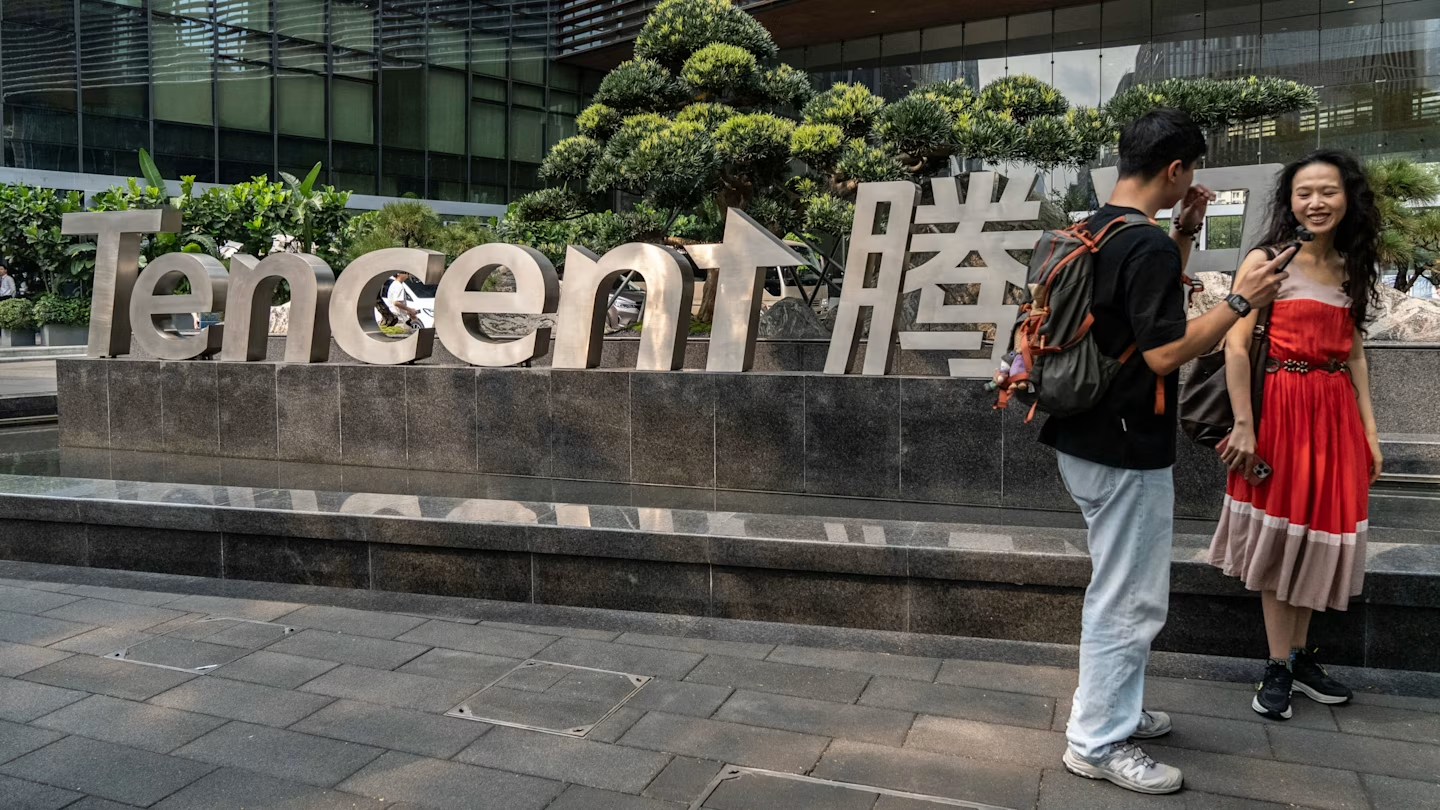
Tencent Holdings Ltd. is considering an offshore bond sale of as much as $5 billion denominated in US dollars and offshore Chinese yuan, according to people familiar with the matter, potentially coming as early as October 2026. The contemplated offering marks the second major capital raise by Tencent in four months, following a $4.7 billion bond sale in June 2026—the company’s largest debt offering since 2020. The June proceeds were directed toward debt refinancing and developing artificial intelligence products and services. Tencent’s capital intensity for AI has intensified dramatically, with capital expenditures on AI and computing surging 176 percent to 52.8 billion yuan ($7.9 billion) in the June quarter, as the company seeks to develop in-house artificial intelligence models such as Hy4, targeted for launch in late 2026, to compete with rivals including ByteDance, Alibaba, DeepSeek, and Moonshot. The company operates one of China’s largest cloud computing services, positioning it as a vertically-integrated player across model development, cloud infrastructure, and computing provision. Global artificial intelligence-related debt issuance has exceeded $575 billion in 2026 according to Goldman Sachs credit strategists, despite mounting concerns about whether the technology will deliver sufficient returns to justify the scale of investments being made. SoftBank Group Corporation raised $11.1 billion through one of the largest corporate junk-bond offerings on record in September 2026, paying record yields to complete the sale.
Why It Matters?
Tencent’s contemplated $5 billion bond sale, combined with its prior $4.7 billion raise in June, signals that Chinese technology companies are accelerating artificial intelligence capital expenditures faster than originally budgeted, driven by competitive pressure to keep pace with ByteDance, Alibaba, and emerging rivals such as DeepSeek and Moonshot. The two raises within four months totaling $9.7 billion represent a significant acceleration in capital deployment, suggesting Tencent views the competitive window for AI model development as narrowing and requires immediate capex increases to remain viable in the model layer. However, the bifurcated reception of Tencent’s potential bond offering on the same day that Firmus Grid’s Australian data center IPO collapsed illustrates an emerging structural division in capital markets: equity investors are rejecting AI infrastructure valuations as too aggressive (Firmus failed), but debt investors remain willing to finance AI capex at materially higher cost. SoftBank’s September junk-bond offering at record yields signals that credit spreads on AI-related debt are widening significantly, indicating debt markets are pricing elevated refinancing and return-realization risk. Tencent’s 176 percent year-over-year increase in AI capex ($7.9 billion in the June quarter alone) validates the competitive dynamics driving capex acceleration, but also highlights leverage risk: companies are funding accelerating capex via debt at escalating cost, compressing margins and increasing refinancing risk if AI returns disappoint in 2027-2028.
What’s Next?
Monitor Tencent bond issuance pricing and spreads closely: if spreads remain under 200bps above comparable credits (validates debt appetite), suggests credit markets still confident in AI capex returns; if spreads exceed 250bps (validates credit stress), signals debt market repricing AI risk upward. Watch Tencent’s Hy4 model performance metrics when launched in late 2026: if achieves comparable performance to DeepSeek/Moonshot benchmarks (validates competitive catch-up), supports capex spending justification; if performance lags (validates competitive maturity), suggests capex inefficiency ahead. Track Tencent leverage metrics: if debt-to-EBITDA rises above 1.5x (validates leverage cycle), positions company for refinancing risk if capex ROI disappoints. Monitor competing AI model launches: if ByteDance, Alibaba, DeepSeek, Moonshot pricing compress models aggressively (validates commoditization), margin pressure on Tencent’s capex burn rate. Most critically, watch SoftBank’s junk-bond spread trajectory: if widen beyond 300bps (validates AI credit stress), signals broader tech debt market repricing underway. Finally, track Tencent management guidance on capex trajectory: if conservative or reduced in Q4 2026 earnings (validates peak capex inflection), validates Hayes thesis; if aggressive or increased, validates capex acceleration continuing into 2027. The two raises in four months position Tencent with runway through 2027, but rising debt cost creates margin compression risk if AI model returns plateau.
Affected Tickers and Coins: TCEHY | SFTBY | BABA
Source: Bloomberg