
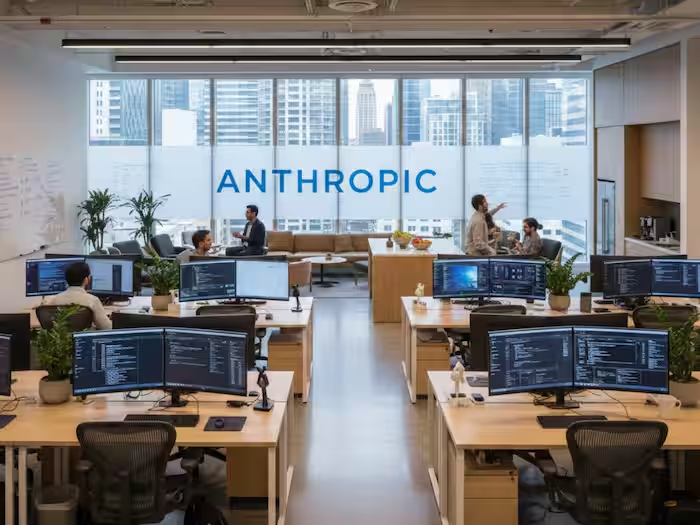
- Anthropic told a small group of backers it expects positive adjusted operating income for the second consecutive quarter, a measure that strips out costs like stock-based compensation. Gross margins are above 80% before accounting for revenue shared with distribution partners including Amazon and the cost of training models.
- Rather than publishing its IPO prospectus last week as expected, Anthropic shared documents privately with a small investor group and will take their questions before making the filing public. The company has chosen Nasdaq for a listing that could value it at $2 trillion or more.
- Revenue growth has been extreme: second-quarter revenue rose 14-fold year over year to $11.5 billion, and annualized revenue hit $65 billion at the end of July, up from $9 billion at the end of last year. Semi Analysis’s Joey Brookhart said investors are modeling $120 billion in annualized revenue by year-end and nearly triple that by the end of 2027.
- The profitability disclosure lands alongside CEO Dario Amodei’s Saturday essay calling for the AI industry to slow model development, a position echoed by OpenAI’s Sam Altman and SpaceX’s Elon Musk. Altman confirmed OpenAI will stay private this year despite having confidentially filed its own IPO paperwork in June.
What Happened?
The FT reports that the profitability and slowdown messaging are more connected than they appear on the surface. Employees at Anthropic and OpenAI have reportedly been in close, unusual communication over recent weeks about jointly managing AI development risk, driven by security breaches, growing researcher unease about model capability, and a view that the Trump administration was unlikely to impose its own constraints. One employee at a frontier lab was quoted saying “we are on our own here.” That back-channel coordination is said to have laid the groundwork for Altman and Amodei’s aligned public statements this week.
Why It Matters?
Brookhart’s framing is the sharpest read for investors: at Anthropic’s current margins and growth rate, competing against it becomes extremely difficult simply on compute resources, which is precisely the kind of moat public-market investors want to underwrite. But the slowdown proposal cuts directly against that story. Slowing model development could save Anthropic billions in training costs for next-generation models — a margin-friendly move right before an IPO — but also risks letting rivals close the capability gap that justifies the premium valuation in the first place. That is a real trade-off, not just safety positioning, and it is why coordinated public statements from competing CEOs are unusual enough to draw scrutiny on their own. The choice to brief a small investor group privately rather than file a public prospectus also suggests Anthropic wants to control the narrative around both profitability and the slowdown message before it faces broader market questions.
What’s Next?
The public S-1 filing is the next concrete step, and its timing relative to the investor briefing process will show how much pushback the company got in the private sessions. Watch whether Anthropic’s growth trajectory tracks toward the $120 billion annualized revenue figure investors are modeling for year-end, since any deviation tied to a genuine development slowdown would be the first real test of whether safety messaging and business execution can coexist. Continued coordination signals between Anthropic and OpenAI employees, and whether that extends to other frontier labs, are also worth tracking as a leading indicator of how seriously the proposed slowdown is being operationalized versus treated as a public relations position ahead of two major IPOs.
Source: Financial Times


