- Bitcoin fell as much as 2.2% to around $68,460 Tuesday, erasing Monday’s gains that had briefly pushed it above $70,000 for the first time since March — as Trump’s self-imposed Tuesday deadline for Iran to reopen the Strait of Hormuz weighed on risk sentiment
- Iran reportedly rejected a ceasefire proposal, keeping both sides on a collision course; Brent crude rose Tuesday and is now up roughly 50% since the war began February 28, while gold is down more than 10% over the same period
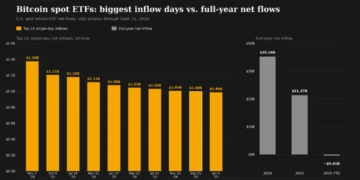
- Despite the pullback, institutional demand signals remain constructive: U.S.-listed spot Bitcoin ETFs saw $471.3 million in net inflows on Monday alone, and analysts say institutional selling pressure is easing
- Analysts identify two specific catalysts for the next Bitcoin leg higher: a confirmed U.S.-Iran ceasefire bringing oil below $100, and passage of the U.S. Clarity Act (expected late April) which institutional investors are watching as a regulatory unlock
What Happened?
Bitcoin slipped 2.2% to around $68,460 in London morning trading Tuesday, erasing gains from the prior session when it briefly cleared $70,000 — its highest level since March. Ether fell as much as 2.8%. The retreat came as markets braced for Trump’s self-imposed Tuesday deadline threatening to bomb Iranian civilian infrastructure unless the Strait of Hormuz was reopened, while reports emerged that Iran had rejected a ceasefire proposal. S&P 500 futures were down 0.4%, reflecting broad risk-off sentiment. Brent crude rose further Tuesday, now roughly 50% above its pre-war level from late February. Despite the price pullback, institutional demand signals remained surprisingly firm: U.S.-listed spot Bitcoin ETFs recorded $471.3 million in net inflows on Monday alone — the strongest single-day figure in weeks — adding to $22.3 million in net inflows the prior week. Analysts described the market as in “wait-and-see mode,” with bulls lacking conviction to sustain breakouts and bears unable to force a decisive breakdown.
Why It Matters?
Bitcoin has been one of the more resilient major assets since the Iran war began in late February, largely holding a $65,000 to $75,000 range while equities, bonds, and even gold have experienced more dramatic moves. That relative stability is increasingly being attributed to the structural change in Bitcoin’s ownership base: ETF inflows confirm that institutional investors are treating it as a genuine allocation rather than a speculation vehicle, and their longer investment horizons make them less reactive to geopolitical headlines than the retail traders who dominated prior crypto cycles. The divergence between Bitcoin (down ~45% from its October all-time high but range-bound) and gold (down 10%+ since the war started, contrary to historical precedent) is a notable market signal that warrants attention from macro investors. Bitcoin’s correlation with broader risk assets remains intact at the headline level — it falls on bad news — but its resilience relative to other risk assets is a data point that the “digital gold” narrative may be gaining some empirical traction.
What’s Next?
Analysts have identified two specific catalysts that could break Bitcoin out of its range to the upside. The first is a confirmed and sustained U.S.-Iran ceasefire that brings oil back below $100 a barrel — which would unlock a broad risk-on rally across all asset classes and remove the macro uncertainty that has kept institutional allocators cautious. The second is passage of the U.S. Clarity Act, expected in late April, which would provide the regulatory framework institutional market participants have been waiting for before making larger allocations to digital assets. On the downside, a break below $65,000 to $66,000 support is the key level analysts say would indicate demand deterioration and could trigger a more significant drawdown. The Tuesday Trump-Iran deadline is the most immediate binary: a genuine escalation to power-plant strikes would likely push Bitcoin lower along with equities; any signal of ceasefire talks resuming could produce a sharp relief rally.
Source: Bloomberg