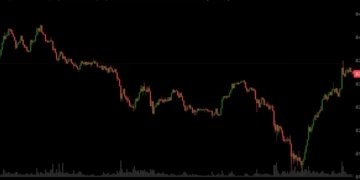
- Bitcoin whales — large holders whose accumulation behavior has historically preceded major price cycles — have added approximately 43,000 Bitcoin over the past 60 days, worth roughly $2.75 billion at current prices near $64,500, according to CryptoQuant data that excludes exchanges and mining pools; the cohort recommitted to buying after months of net selling when Bitcoin traded down toward $60,000.
- The accumulation is broad-based across holder cohorts: Glassnode data shows mid-sized holders with 100 to 1,000 Bitcoin have been on a sustained buying spree, as have “humpbacks” — the super-buyer category of investors with more than 10,000 coins — and “dolphins” with smaller but still significant holdings, suggesting coordinated institutional-level conviction rather than isolated large-holder activity.
- Bitcoin is down roughly 50% from its October 2025 highs and trading near $64,500, with the broader crypto market suffering commensurate damage: crypto-centered ETFs have seen billions of dollars flow out, and Strategy Inc. — once the market’s most reliable large-scale buyer — has shifted from accumulator to net seller, removing what had been a structural pillar of demand from the market.
- Despite the whale accumulation signal, critical warning indicators remain: August spot trading volumes are running at their lowest levels since 2021, retail investors have largely exited the space, and analysts warn that whale buying in a low-volatility environment “confirms structural accumulation” but “does not guarantee an immediate, broad-based bull run” without a supportive macro backdrop — particularly on rates and risk sentiment.
What Happened?
After months of net selling that coincided with Bitcoin’s 50% decline from its October 2025 peaks, large Bitcoin holders — the “whales” whose on-chain behavior is closely tracked as a leading indicator — have reversed course and resumed accumulation. CryptoQuant data covering the past 60 days shows approximately 43,000 Bitcoin added to whale wallets, worth roughly $2.75 billion at current prices. The buying appears to have begun in earnest when Bitcoin traded toward $60,000, suggesting that level represented a perceived value threshold for deep-pocketed long-term holders. Glassnode offers additional granularity: the accumulation spans multiple holder cohorts, including mid-sized holders (100-1,000 BTC) and “humpbacks” (10,000+ BTC), indicating this is not isolated large-holder activity but a coordinated multi-cohort shift back into accumulation mode.
Why It Matters?
Bitcoin whale behavior has historically been one of the more reliable on-chain signals for identifying market cycle turning points — whales tend to be long-term believers who accumulate during periods of price weakness and retail disillusionment, and their buying at current levels is being interpreted by some analysts as confirmation that the market is in the process of forming a cycle bottom. The context makes the signal more potent: Bitcoin is down 50% from highs, retail traders have exited en masse, ETF outflows have been persistent, and Strategy Inc. — the company that functionally institutionalized continuous Bitcoin buying — has become a net seller. Against that backdrop, the re-entry of whales is one of the few constructive signals available. The timing also matters: whales are buying into weakness, not chasing strength, which is the accumulation pattern associated with cycle bottoms rather than speculative momentum.
What’s Next?
The critical variable for translating whale accumulation into a broader market recovery is retail re-engagement, and the current data on that front is discouraging: August spot volumes are at their lowest since 2021, suggesting the retail bid that drives the high-velocity price appreciation of bull markets has not yet returned. Analysts at Nexo note that “for a true market-wide recovery, the macroeconomic backdrop must first align” — a reference to the rate environment, where 30-year Treasury yields at 19-year highs are competing with risk assets for capital and suppressing the risk appetite that typically drives retail crypto participation. The most likely catalyst for retail re-entry would be a meaningful Fed pivot signal, a de-escalation of the Iran conflict that reduces energy-driven inflation pressure, or a Bitcoin price breakout above key technical resistance levels that generates momentum-driven FOMO buying. Until one or more of those catalysts materializes, the whale accumulation story represents a structural positive without yet being a near-term price trigger.
Source: Bloomberg