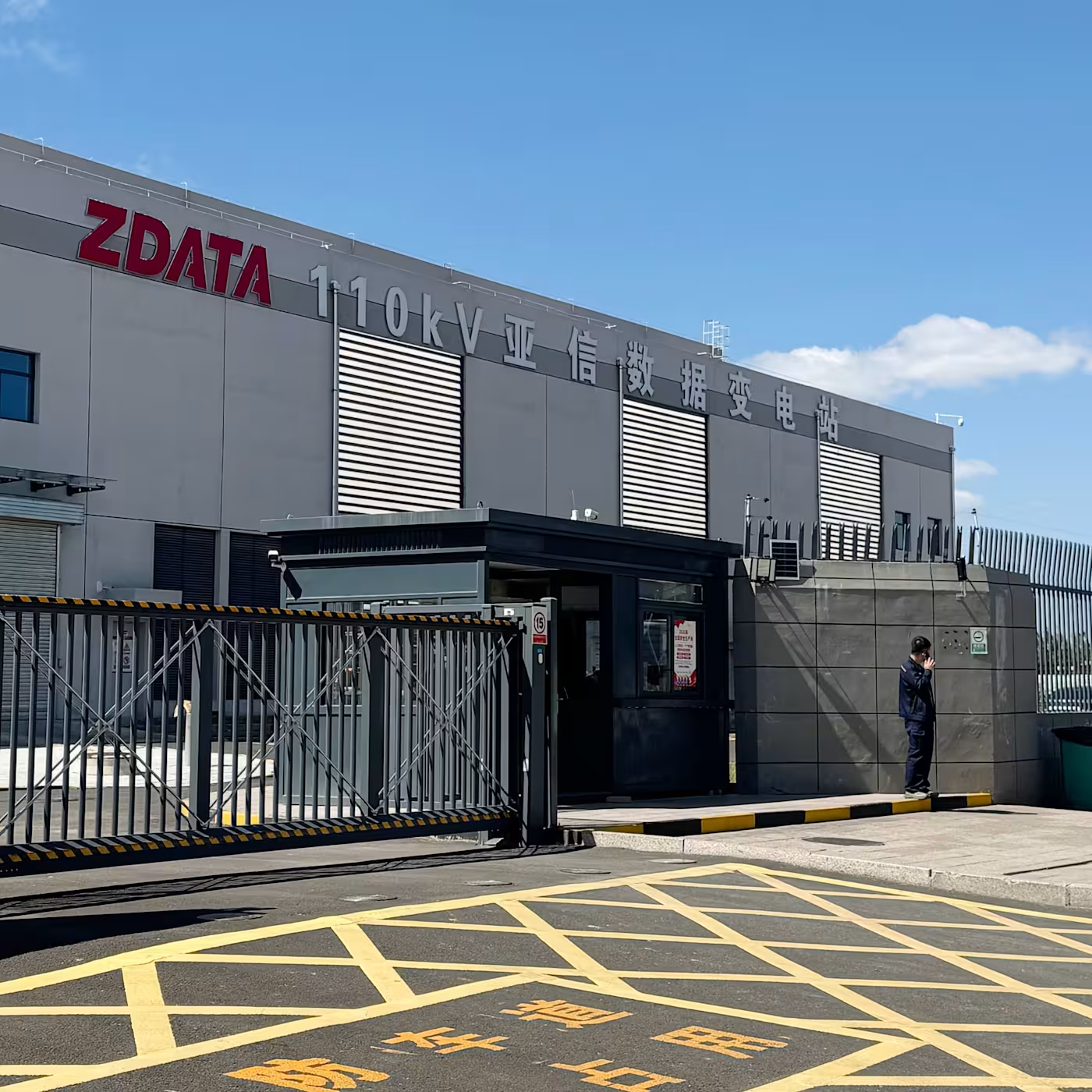
- China’s AI data center buildout reaching industrial scale proportions, validating Arthur Hayes’ “overbuilding” thesis globally. China operational capacity: 24GW (more than rest of Asia combined, but half US 56GW). Under construction/announced: 50GW+ additional. Trajectory: 74GW total by 2027-2028, converging with US 56GW to create global AI infrastructure overcapacity. Ulanqab (Inner Mongolia) emerging as fastest-growing Asian hub: 15GW committed, 89 data centers built or planned, making single city capacity rival many nations. Beijing strategic objective: reduce reliance on foreign (Nvidia) technology by incentivizing domestic processors (tax benefits, electricity/water discounts). But chip bottleneck undermines infrastructure advantage: despite massive buildout capacity, NVDA export restrictions + limited Chinese fab capacity creates “ghost capacity” problem—facilities built but underutilized due to processor shortage.
- Chinese infrastructure advantages expose Hayes “overbuilding” pattern. Construction costs 20% cheaper than larger Chinese cities (per Goldman Sachs), completion in 12-18 months vs US 18-24 months. Electricity costs critical: Ulanqab pays 0.358 RMB/kWh vs 0.60+ RMB average China vs 0.80 RMB Beijing—55% cost advantage over capital. Inner Mongolia renewable capacity: 117GW wind (largest in China, 4x UK total capacity), 130GW fossil fuel (mostly coal), creating “largest electricity local oversupply” globally per Lantau Group analyst. Cold climate (4.3C average) reduces cooling costs. Proximity to Beijing (2 hours high-speed rail) enables engineering support. Result: China can build data centers 20% cheaper, 33% faster than US. But speed/cost advantage only matters if demand justifies capacity—Hayes thesis predicts demand won’t.
- Global simultaneous overbuild validates Hayes two-geography buildup. US already 56GW operational. China trajectory 74GW by 2027-2028. Combined 130GW+ global capacity being deployed in compressed 2-3 year window. Demand forecast consensus: “no risk of overbuilding” per Jefferies analyst (“token consumption going through the roof”). But Hayes thesis: AI capex cycle peaks 2027-2028 when customers face compute commitments. If capex tightens or demand disappoints, simultaneous capacity delivery (both US and China) creates overcapacity spiral. Prefabricated “Lego data center” modules (China innovation, adopted by US hyperscalers) enable rapid deployment but also rapid obsolescence if demand doesn’t materialize. Supply chain locks in: Envision building 2GW adjacent power (1M AI accelerator card capacity), Vertiv liquid cooling positioned, equipment suppliers establishing regional manufacturing. Entire ecosystem committed to capex thesis.
- Chip constraint creates structural vulnerability and validates 2027-2028 inflection timing. NVDA restrictions + limited Chinese fab capacity means China’s 74GW capacity constrained by processor availability, not just electricity/construction. Consequence: facilities built to scale cannot be fully deployed, creating stranded asset risk. US also faces NVDA competition (hyperscalers may diversify to AMD, custom chips), reducing capex urgency. If both geographies simultaneously face constraint (chips unavailable, demand disappointing, capex cycles tightening), combined 130GW capacity becomes “white elephant” forcing write-downs and equipment liquidation. Timing convergence: Hayes predicted 2027-2028 (capex commitments due, overcapacity arrives); China/US simultaneous buildout peaks exactly then. Single catalyst (AI model training plateau, capex budget cuts, geopolitical chip restrictions) could trigger global capacity collapse.
What Happened?
China is rapidly expanding artificial intelligence data center capacity across its energy-rich interior, positioning the country for leadership in the global AI infrastructure race. China currently operates 24 gigawatts of data center computing capacity—more than the rest of Asia combined but less than half the 56 gigawatts in the United States. An additional 50 gigawatts is under construction or has been announced, positioning China for a combined 74-gigawatt capacity by 2027-2028. Ulanqab, a remote agricultural city in Inner Mongolia, has emerged as the fastest-growing data center hub in Asia, with 15 gigawatts of computing capacity committed and 89 data centers built or planned. Construction in Ulanqab proceeds at accelerated speed (12-18 months versus 18-24 months in the US) at approximately 20 percent lower cost than larger Chinese cities, according to Goldman Sachs. Electricity costs in Ulanqab average 0.358 renminbi per kilowatt-hour, approximately 55 percent cheaper than Beijing rates. Companies including Alibaba, Huawei, ByteDance, DeepSeek, and Z.ai have established operations in Ulanqab, taking advantage of abundant wind and coal power, cold climate, and rapid construction capabilities. However, China’s infrastructure buildout faces a critical constraint: Beijing and Washington export restrictions on advanced Nvidia processors have created a bottleneck limiting deployment capacity despite infrastructure readiness.
Why It Matters?
China’s AI data center expansion validates Arthur Hayes’ thesis that global AI capex involves massive simultaneous overbuilding across geographies. The combined China (74GW projected) and US (56GW) capacity buildout creates a 130-gigawatt global infrastructure race arriving simultaneously at 2027-2028—exactly matching Hayes’ predicted inflection point when AI capex peaks and customers face their compute commitments. The speed of deployment (China building 33 percent faster than US) and cost advantages (55 percent electricity discount, 20 percent construction cost savings) suggest structural capacity will exceed demand if AI capex cycles tighten. The chip constraint further highlights vulnerability: despite massive facility buildout, processor availability limitations (NVDA export restrictions, limited Chinese fab capacity) mean infrastructure built cannot be fully deployed—creating “stranded asset” risk if demand disappoints. The convergence of infrastructure overcapacity with chip supply bottlenecks positions 2027-2028 as potential crisis inflection point for AI infrastructure investments globally. For investors, the implication suggests significant write-down risk for data center operators and equipment suppliers if capex commitments compress or AI model scaling plateaus sooner than consensus forecasts.
What’s Next?
Monitor capacity additions: if China reaches 74GW by late 2027 (validates overbuilding trajectory), combined with US 56GW suggests global capacity exceeding demand forecasts; if delays beyond 2028, suggests execution constraints moderating buildout. Track utilization rates: if Ulanqab facilities achieve 70%+ utilization (validates demand thesis), supports “no overbuilding risk” narrative; if stall below 50% (validates Hayes), validates stranded asset risk. Watch chip supply dynamics: if NVDA restrictions ease or Chinese fab capacity expands dramatically (validates deployment opportunity), reduces stranded capacity risk; if tighten further, validates infrastructure/processor mismatch. Finally, monitor capex guidance from hyperscalers (Google, Meta, Microsoft, OpenAI, Anthropic): if reduce AI infrastructure commitments in 2027-2028 (validates Hayes cycle peak), positions simultaneous global deleveraging as trigger for asset write-downs and equipment liquidation cascades across both Chinese and US data center operators.
Affected Tickers and Coins: NVDA | BABA | HWT | DLR | EQIX
Source: Financial Times