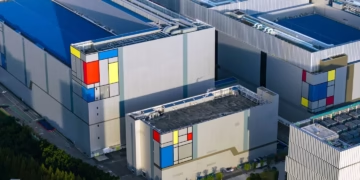
- TSMC Q3 revenue surged 51% YoY to NT$1.49 trillion ($46.7 billion), exceeding analyst consensus (NT$1.46tn expected), validating supply-side strength of AI infrastructure demand cycle despite equity market skepticism (Firmus IPO collapse same day). Advanced Micro Devices CEO Lisa Su: chip demand “sharply higher over next few years.” Samsung Electronics +9x operating profit (Article 269), Hon Hai (AI server assembler) beat estimates, TSMC stock hit record this month. Demand-side capital suppliers (Firmus) retreating on valuations, but supply-side chip makers accelerating. Contradiction validates Hayes thesis: capex commitments lock in at peak, but infrastructure buyers increasingly uncertain about returns. North American customers 75%+ TSMC sales H1 2026 (vs global 50%+ average), directly exposed to US data center buildout uncertainty. Yet TSMC doubling down on capex: considering Texas expansion on top of $265B Arizona commitment, suggesting company confident in 2027-2028 utilization rates despite demand-side hesitation signals.
- Wafer pricing increases (+3-6% 2027 expected per Taiwan media) signal peak margin cycle arriving, validating Hayes inflection timing. TSMC record profitability Q3 2026 reflects premium pricing power on constrained capacity (lead times 6+ months for leading-edge nodes). But 2027 margin trajectory faces multiple pressures: (1) competitive capacity additions (Samsung HBM4 ramp, Intel 14A production, Foundry competitors ramping), (2) customer consolidation driving pricing pressure (Google, Meta, Microsoft, Amazon collectively represent 40%+ TSMC sales, increasing negotiating power vs spot customers), (3) geography concentration risk (North America 75%, Asia 20%, rest 5% = single-region exposure to US data center capex cycle). Taiwan media 3-6% price increase guidance suggests TSMC management already modeling demand plateau 2027, attempting to lock in pricing power before competitive capacity additions pressure market. Pattern: Samsung Q3 2026 margins peak, TSMC Q3 2026 margins peak, both implementing pricing strategies to defend against 2027 compression.
- Capex acceleration (Arizona $265B + Texas expansion consideration) validates investment cycle continuation but faces 2027 monetization risk. TSMC capex implied $20-25B annual for Arizona alone (5-year build), plus Taiwan ongoing (~$15B annually), plus Texas expansion (est. $10-15B), totals ~$50-60B+ annual capex through 2028. This validates Hayes thesis: capex commitments peak 2026-2027, requiring deployment through 2028, but actual chip demand may plateau earlier. If AI model training/inference scales plateau 2027 (as Hayes predicts), excess TSMC capacity coming online 2027-2028 could trigger utilization collapse and margin compression simultaneously. Company betting on 2-3x capacity growth supporting 1.5-2x demand growth (typical for semiconductor cycles). Risk: if demand growth disappoints to 1x (flat), massive stranded capex.
- Overseas capex dilution signals and 2027 guidance critical inflection markers. TSMC added $100B to Arizona plan in July 2026 (total now $365B vs original $265B), suggesting accelerating buildout timeline. Overseas capex currently ~10-15% of total; Arizona alone could push to 20-25%. Management guidance on overseas-dilution impact (gross margins compressed by geographic concentration + manufacturing cost delta) and 2027 capex levels critical: if aggressive (validates continued buildout), suggests confidence in cycle sustaining through 2028; if conservative (validates peak cycle), positions for margin compression. CoWoS (high-margin packaging for AI chips) and A14 advanced node expansion trajectory also key indicators of demand confidence. If guidance conservative, validates Hayes thesis; if aggressive, challenges peak timing. Key risk: if demand disappoints 2027, TSMC faces $365B Arizona sunk cost against declining utilization and falling margins.
What Happened?
Taiwan Semiconductor Manufacturing Co. reported third-quarter revenue of NT$1.49 trillion ($46.7 billion), representing a 51 percent increase year-over-year and exceeding analyst consensus expectations of NT$1.46 trillion. The strong earnings report reinforced confidence in the sustainability of artificial intelligence infrastructure demand at a moment when equity investors are increasingly skeptical of premium valuations for infrastructure providers. The company is the primary supplier to Nvidia Corporation and Apple Inc., serving as a leading barometer for global AI demand trends. Advanced Micro Devices Inc. Chief Executive Officer Lisa Su stated this week that the company expects chip demand to remain significantly elevated over the next several years. Samsung Electronics Co. reported an almost nine-fold increase in operating profit, and Hon Hai Precision Industry Co., an AI server assembler, also beat quarterly sales estimates. TSMC’s stock price reached a record high this month. North American customers accounted for more than 75 percent of TSMC’s overall sales in the first half of 2026, indicating concentrated exposure to US data center demand. TSMC is considering a further expansion in Texas following its commitment of $265 billion to create a manufacturing campus in Arizona. The company added $100 billion to its Arizona plan in July 2026.
Why It Matters?
TSMC’s 51 percent revenue growth validates that the underlying demand for artificial intelligence infrastructure remains robust, providing supply-side confirmation that the capital commitments made by hyperscalers and data center operators over the past 18 months are translating into actual chip orders. However, the timing of TSMC’s strong earnings report coinciding with Firmus Grid’s Australian data center IPO collapse illustrates a critical divergence: supply-side chipmakers are thriving at peak profitability while demand-side infrastructure providers face valuation rejection. Taiwan media reports point to 3-6 percent wafer price increases expected in 2027, suggesting TSMC management is anticipating demand plateau and attempting to lock in pricing power before competitive capacity additions from Samsung, Intel, and other foundries pressure margins. The concentration of TSMC’s sales in North America (75 percent of revenue) creates significant exposure to US data center capex cycles and adds cyclical risk if American customers reduce spending in 2027-2028. Most critically, TSMC’s decision to expand its Arizona commitment from $265 billion to $365 billion and consider a Texas hub represents continued capex acceleration despite emerging demand-side hesitation signals. If artificial intelligence training and inference demand plateaus in 2027 as Arthur Hayes predicts, TSMC’s aggressive capex trajectory could result in excess capacity and margin compression precisely when the company is attempting to defend pricing power through announced price increases.
What’s Next?
Monitor TSMC’s 2027 capex guidance closely: if guidance conservative (reduces from $20-25B annual run-rate), validates cycle peak concerns and supports margin compression thesis; if aggressive or maintained, suggests company confidence in cycle sustaining. Watch wafer pricing outcomes: if 3-6 percent increases hold and customers accept (validates pricing power), supports sustained profitability through 2027; if customers push back or demand volume concessions in exchange for price (validates competitive pressure), signals early cycle deterioration. Track utilization rates and lead-time shortages: if 6+ month backlogs persist (validates capacity constraints), supports continued pricing power; if compress to 2-3 months (validates demand plateau), positions for margin compression. Monitor competitive capacity: if Samsung HBM4 production ramps successfully or Intel 14A scales faster than expected, validates competitive supply additions pressuring TSMC pricing. Watch customer concentration dynamics: if major hyperscalers (Google, Meta, Microsoft) consolidate at fewer suppliers (validates consolidation), increases pricing negotiation power against TSMC; if diversify (validates competitive entry), pressures TSMC margins. Finally, track CoWoS and A14 expansion: if demand remains strong (validates AI lead-edge focus), supports premium pricing; if softens (validates commodity pressure), signals margin compression ahead of 2027-2028. TSMC 2027 guidance and Arizona execution timeline are critical barometers for inflection confirmation.
Affected Tickers and Coins: TSM | NVDA | AMD | INTC | AAPL
Source: Bloomberg