- Sui blockchain launching Hashi institutional Bitcoin lending protocol with $500 million in capital commitments from 20+ industry partners, targeting $1 trillion in dormant Bitcoin held by institutions and public companies. Mainnet rollout in phases October 2026. Protocol allows Bitcoin collateral without moving BTC off Bitcoin network: real BTC locked in 2-of-2 multisig vault on Bitcoin blockchain; Sui mints hBTC voucher tokens backed 1:1 by deposited Bitcoin; lending/borrowing/credit markets operate on hBTC on Sui; user burns hBTC voucher to unlock and retrieve original Bitcoin. Security: Certora formal smart contract verification, CommonPrefix reviewed MPC protocol cryptography, independent guardian layer monitoring. Partners include Anchorage Digital (stablecoin liquidity provider). Use cases expanding beyond speculative trading: tuition, real estate acquisition, corporate working capital loans. Timing validates narrative inflection: Bitcoin lending infrastructure maturing (validates Article 266 mainstream adoption thesis) while Bitcoin price faces technical breakdown ($82K support, $1B liquidation cascade from Article 277). Bifurcation: infrastructure maturation validates BTC utility/adoption narrative; price weakness validates technical/leverage cycle concerns.
- $500M capital commitments validate institutional demand for Bitcoin collateral utility but reveal institutional friction friction points. Major institutions (public companies, wealth funds, corporate treasurers) hold $1T+ Bitcoin but faced constraints deploying capital without custody transfer or regulatory complexity. Hashi removes friction: native Bitcoin stays on-chain (regulatory transparency, audit clarity), institutions access lending via secondary layer (Sui) without giving up custody. Consequence: if successful, unlocks institutional utilization of dormant Bitcoin, potentially converting $200-400B of held Bitcoin into active capital markets. This validates broader Bitcoin-as-collateral narrative (Coinbase, SALT, Ledn articles in prior sessions) entering institutional/enterprise phase. Risk: if Hashi platform faces security breach, custody dispute, or regulatory challenge, could trigger institutional capital flight and undermine confidence in Bitcoin-backed finance infrastructure. But current $500M commitments suggest major institutions (Anchorage, others) confident in security model.
- $1 trillion dormant Bitcoin target validates addressable market size but reveals institutional hesitation to deploy into DeFi. Bitcoin balance sheet holdings by institutions, corporations, governments currently unproductive. $1T target represents ~5% of global institutional wealth, suggesting massive deployment opportunity if institutional adoption accelerates. But timing critical: if Hashi launches October 2026 while Bitcoin price weakening and leverage cycles unwinding (Article 277), institutional capital may prioritize risk reduction over lending deployment. Consequence: Hashi may struggle to achieve $500M deployment targets if broader crypto market turbulence (BTC technical breakdown, leverage cascade) undermines institutional confidence. Conversely, if BTC stabilizes and bounce occurs, institutional capital could rapidly deploy into Hashi given $500M pre-committed capital.
- Bitcoin lending infrastructure maturation validates crypto layer 2 applications independent of layer 1 price cycles. Hashi represents maturation of Bitcoin-collateral DeFi infrastructure: protocol security standards met (formal verification, multisig, custody), regulatory pathway emerging (institutional partnerships suggest compliance), use-case clarity (tuition, real estate, working capital). This validates broader pattern: Bitcoin infrastructure (custody, lending, collateral) maturing independent of BTC price cycles. Consequence: even if Bitcoin price declines to $70-75K (prior 2023 lows), Bitcoin lending infrastructure utility remains, supporting institutional adoption. But paradox: price weakness reduces collateral valuations, potentially triggering margin calls and forced liquidations (validates Article 277 leverage cascade concerns). Timing convergence: infrastructure maturing Q4 2026 at precise moment leverage cycles unwind and technical support breaking. Market faces dual force: positive (infrastructure maturation, institutional adoption) vs negative (leverage unwinding, technical breakdown).
What Happened?
Layer-1 blockchain Sui announced the mainnet rollout of Hashi, an institutional Bitcoin lending protocol designed to enable Bitcoin holders to utilize their assets as collateral for loans without moving Bitcoin off the Bitcoin network. The initiative has secured $500 million in pre-committed capital from a coalition of over 20 industry partners, ensuring that the ecosystem will launch with sufficient liquidity for institutional-grade lending operations. The protocol employs a custodial design: actual Bitcoin is securely locked in a 2-of-2 multisignature vault address directly on the Bitcoin blockchain, while Sui mints hBTC voucher tokens backed 1:1 by each Bitcoin deposit. These vouchers facilitate lending, borrowing, credit markets, and real-world asset transactions on the Sui layer-1 blockchain. When users wish to exit, the hBTC vouchers are permanently burned, triggering the multisig to unlock and return the original Bitcoin to the user on the Bitcoin network. Anchorage Digital, a major institutional custody provider, is a day-one launch partner and plans to supply stablecoin liquidity to the network. Hashi has undergone formal security auditing: Certora formally verified the smart contracts, and CommonPrefix reviewed the cryptography of the multi-party computation protocol. Sui estimates that approximately $1 trillion worth of Bitcoin is currently idle, representing the primary addressable market for institutional deployment.
Why It Matters?
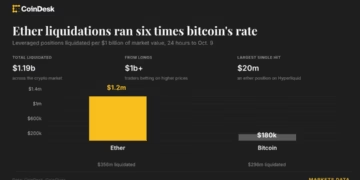
Hashi’s launch represents a critical inflection point for Bitcoin-backed finance: institutional-grade infrastructure for Bitcoin collateral lending is maturing precisely as Bitcoin prices face technical breakdown and leverage cycles unwind. The protocol’s design—keeping Bitcoin safely on-chain while enabling collateral utilization through secondary-layer vouchers—removes a critical constraint that has prevented institutional capital deployment. The $500 million in pre-committed capital from 20+ partners, including major custody providers and financial institutions, validates institutional demand for compliant Bitcoin utility infrastructure independent of speculative trading. The shift toward real-world use cases (tuition, real estate acquisition, working capital loans) demonstrates that Bitcoin collateral markets are evolving from leveraged trading vehicles toward genuine financial utilities. However, the timing of Hashi’s mainnet rollout in October 2026 coincides with significant headwinds: Bitcoin price breakdown at $82,000 support levels, $1 billion liquidation cascades, and broader institutional capital flight from cryptocurrency infrastructure assets (as documented in Article 277 on XRP/Bitcoin bifurcation). If Bitcoin technical support continues deteriorating and leverage cascades accelerate, institutional capital may prioritize risk reduction over collateral deployment, potentially limiting Hashi’s ability to mobilize its $1 trillion addressable market.
What’s Next?
Monitor Hashi capital deployment: if $500M in commitments begin flowing to Sui within first month (validates institutional adoption), supports narrative of infrastructure maturation independent of price; if deployment delays or commitments evaporate (validates institutional caution), suggests leverage cycles overriding infrastructure confidence. Watch Bitcoin price stability: if BTC stabilizes above $82,000 and bounces (validates technical floor), creates favorable environment for institutional Hashi deployment; if BTC breaks below $80,000 (validates cascade continuation), suggests margin calls could force institutional Bitcoin sales and collateral value destruction. Track institutional lending volumes on Hashi: if volumes reach $50M+ within first quarter (validates institutional adoption), positions Bitcoin lending infrastructure for rapid growth; if volumes stall at $10-20M range (validates institutional hesitation), suggests infrastructure ready but capital awaiting price stability. Monitor custody/security incidents: if Hashi suffers security breach or regulatory challenge (validates infrastructure risk), triggers institutional capital flight; if operates flawlessly (validates security model), supports continued institutional positioning. Watch competitive platforms: if other Layer-1s (Ethereum, Solana, Base) launch similar Bitcoin lending protocols (validates market opportunity), increases competition but validates broader narrative; if Hashi maintains market leadership, consolidates institutional Bitcoin lending. Finally, track institutional Bitcoin balance sheet announcements: if major corporations or institutions announce Hashi deployment (validates use-case clarity), validates momentum; if institutions pull back from Bitcoin holdings (validates macro caution), contradicts deployment narrative. Hashi infrastructure readiness at moment of Bitcoin technical weakness creates binary outcome: if price stabilizes, infrastructure maturation accelerates; if price cascades, infrastructure sits idle despite $500M capital standing ready.
Affected Tickers and Coins: BTC | SUI | Anchorage (private)
Source: CoinDesk