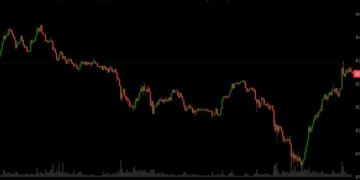
- Bitcoin bounced 1.5% to just under $83,900 in early Asian trading after New York Federal Reserve President John Williams signaled he sees no need for further interest rate increases in 2027. The comment marked a dovish pivot in Fed messaging: while Williams left open the possibility of one more rate hike before year-end, his forward guidance suggested the hiking cycle is likely exhausted. That dovish signal weakened the US dollar index, lowering the opportunity cost of holding non-yielding assets like Bitcoin. The result was a broad relief rally across crypto and equities. But the bounce should be contextualized: Bitcoin remains within its $81-84K trading range, with no clear breakout to either side. The rally reflects tactical relief from dovish Fed commentary rather than conviction that Bitcoin has found a floor. The $83,900 level is meaningful—a close above $84K and subsequent break to $85K would signal bulls are reclaiming momentum. A retreat below $82K would reset the range lower. For now, Bitcoin is range-bound and waiting for the next macro catalyst: Thursday’s US inflation data. If CPI comes in cool (disinflationary), it validates Williams’ view and gives Bitcoin room to run to $85K+. If CPI surprises hot, it muddies the Fed’s forward guidance and could snap the relief rally.
- Altcoins led the bounce, with Zcash (ZEC) jumping nearly 7% to about $1,270, outperforming the broader market. Solana (SOL) and Dogecoin (DOGE) each gained 2.5%; Ethereum (ETH) rose 2% to about $2,520. XRP, BNB, and HYPE added between 1-2%, while TRON (TRX) lagged with gains below 1%. The spread in altcoin performance reflects both risk-on appetite (ZEC, SOL, DOGE leading) and relative weakness in stablecoin-adjacent assets (TRX underperformance). ZEC’s outsized 7% gain is notable; Zcash has historically been a volatile play on privacy narratives and risk sentiment. Its outperformance in this bounce suggests traders rotated into defensive privacy plays rather than pure leverage or leverage-adjacent tokens. The altcoin moves were modest in absolute terms but significant relative to the prior session’s weakness (when many altcoins had been down 2-5% on macro uncertainty). The relief rally validates the thesis that Fed dovishness is a tail-wind for risk assets including crypto, but the magnitude (2-7% moves) suggests institutional conviction remains guarded. Larger moves (10%+ for risk assets) would indicate real momentum. For now, altcoins are bouncing off lows, not rallying on conviction.
- Asian equity markets and commodity markets also responded to Williams’ remarks. Chipmakers Samsung Electronics and SK Hynix, which had suffered a brutal five-day losing streak that wiped out leveraged crypto-exchange bets on chip stocks earlier in the week, snapped their decline and rallied. The recovery in chip stocks is material because it signals risk-off liquidations are pausing. Earlier this week, leveraged long positions on semiconductor ETFs (like SOXL) liquidated across crypto exchanges, creating cascade pressure. The reversal of that cascade—chipmakers rallying, liquidation pressure easing—suggests the macro volatility event may be running its course. The MSCI Asia Pacific equities index rose 0.7%, rebounding from two consecutive days of losses that had pushed it to its lowest close since August. Upcoming earnings from chip-equipment maker ASML (Wednesday) and Taiwan Semiconductor Manufacturing (Thursday) will be critical tests. If ASML or TSMC report disappointing guidance on AI capex or demand, it could reignite semiconductor selling. If both report strong outlooks, it would confirm that last week’s cascade was purely a leverage unwind, not a fundamental deterioration in chip demand. The stakes are high: AI infrastructure capex and chip supply remain central to this session’s macro narrative.
- Oil continued climbing, with Brent crude rising 0.7% to about $106 a barrel and US crude extending its fifth consecutive day of gains. The catalyst remains geopolitical: Middle East attacks (Iran-related) are raising doubts about energy shipment recovery from the Persian Gulf. Higher oil supports a stagflationary narrative (growth concerns + inflation concerns), which is typically a headwind for risk assets. However, in this session’s context, oil is moving mostly on geopolitical supply risk rather than demand, which mutes its macro signal. The disconnect between oil strength (supply concerns) and crypto/equities strength (Fed dovishness) highlights the competing macro narratives currently in play. Williams’ dovish signal won on Wednesday, but if oil continues climbing and Middle East tensions escalate, the inflation risk could reassert itself and undercut Fed dovishness. Thursday’s CPI print is critical to resolving that tension. If CPI is cool, oil strength reflects pure geopolitical premium and doesn’t threaten Fed complacency. If CPI is hot, oil strength signals real stagflationary risk and could force the Fed to reconsider the “no hikes in 2027” narrative. For Bitcoin, a cool CPI + strong Fed dovishness is optimal (risk-on). A hot CPI + geopolitical oil premium is worst-case (stagflation scenario). Thursday will arbitrate.
What Happened?
Bitcoin rose 1.5% to approximately $83,900 in early Asian trading on October 13 (overnight from October 14 US time) following comments from New York Federal Reserve President John Williams. Williams stated he saw no need for further interest rate increases in 2027, though he left open the possibility of one additional rate hike before the end of 2026. The dovish signal weakened the US dollar index, reducing the opportunity cost of holding non-yielding assets like Bitcoin and triggering a broad relief rally across risk assets. Altcoins participated broadly: Zcash (ZEC) led with a 7% jump to approximately $1,270; Solana (SOL) and Dogecoin (DOGE) each gained 2.5%; Ethereum (ETH) rose 2% to approximately $2,520; and XRP, BNB, and HYPE added 1-2%, while TRON (TRX) gained less than 1%. The bounce extended to Asian equities: Samsung Electronics and SK Hynix, which had suffered a brutal five-day losing streak that triggered cascading liquidations on crypto exchanges, rallied and snapped the downtrend. The MSCI Asia Pacific equities index rose 0.7%, recovering from two consecutive days of losses. Oil continued climbing: Brent crude rose 0.7% to approximately $106 per barrel, and US crude extended its fifth consecutive day of gains, driven by renewed Middle East geopolitical tensions and concerns about Persian Gulf energy shipment recovery. Upcoming catalysts include ASML earnings (Wednesday) and Taiwan Semiconductor Manufacturing earnings (Thursday). Thursday’s US inflation report for September was identified as the next major binary catalyst for both crypto and equities markets.
Why It Matters?
Fed President Williams’ dovish signal has material implications for cryptocurrency valuation and macro risk sentiment. Bitcoin and risk assets are inversely correlated to real interest rates; dovish Fed guidance that eliminates future rate hikes lowers real rates, reducing the opportunity cost of holding non-yielding assets like Bitcoin. The specific language—”no need” for rate hikes in 2027—is a pivot from the Committee’s June guidance and suggests Fed policymakers are confident that inflation is on a disinflationary trend. For Bitcoin, this is the optimal macro environment: stable, low real rates, and Fed patience. However, Williams’ dovishness is contingent on inflation data cooperating. If Thursday’s CPI surprise hot, it would force a reassessment of the “no hikes in 2027” thesis and potentially reignite stagflationary concerns. The recovery in chipmakers and Asian equities signals that Tuesday’s cascade liquidations may be exhausted, reducing downside tail risk in the near term. However, the 1.5% Bitcoin bounce and 2-7% altcoin moves remain modest in absolute terms, suggesting institutional conviction in the dovish narrative remains guarded. The disconnect between Fed dovishness and continued oil strength (Brent $106; geopolitical premium) creates binary asymmetry: if CPI is cool, oil strength is pure geopolitical noise and risk-on continues. If CPI is hot, oil strength signals stagflation risk and validates bearish macro concerns. For credit and equity markets, the key question is whether Williams’ “no hikes in 2027” thesis can survive a hot CPI print or if the Fed will be forced to walk it back, damaging credibility and triggering a risk-off rotation.
What’s Next?
Thursday’s US inflation report for September is the critical near-term catalyst. Monitor CPI headline and core readings closely. A cool print (headline <3.0%, core <3.5% YoY) would validate Williams’ dovishness, support Fed patience, and give Bitcoin room to retest $85,000 and above. A hot print (headline >3.5%, core >4.0%) would reignite stagflationary concerns and likely snap the relief rally, pushing Bitcoin back below $82,000. Watch ASML earnings (Wednesday) and TSMC earnings (Thursday) for guidance on AI capex and semiconductor demand. If both report strong outlooks, it confirms last week’s cascade was leverage unwind, not fundamental deterioration. If either reports disappointment, it could reignite chip-related cascade selling. Monitor dollar weakness following Williams’ comments. If USD index continues lower, it supports Bitcoin and emerging-market assets. If USD stabilizes or rallies (suggesting Fed pause concerns), it could headwind crypto. Track oil price action closely. If Brent breaks above $108 on escalating Middle East tensions, it increases stagflation risk and creates a headwind to the dovish narrative. If Brent stabilizes below $106, it suggests geopolitical premium is contained and dovish macro prevails. Finally, watch for Fed speaker commentary through Thursday. If other Fed officials reiterate Williams’ dovishness, it reinforces the signal. If Fed speakers sound more hawkish, it muddies the message and could trigger volatility ahead of CPI.
Affected Tickers and Coins: BTC | ETH | ZEC | SOL | DOGE | XRP | BNB | HYPE | TRX | Samsung | SK Hynix | ASML | TSM | WTI | Brent
Source: CoinDesk