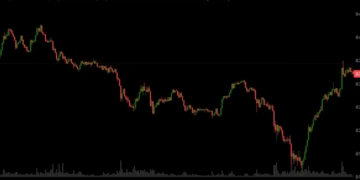
- The 13 US-listed spot Bitcoin ETFs recorded net outflows of $389.7 million in the week of August 10 — the largest weekly outflow since late June — sharply reversing the prior week’s $853.5 million in inflows, which had been the biggest weekly intake since April and were driven by the Coldcard hardware wallet hack prompting investors to seek Bitcoin exposure through traditional finance rather than self-custody.
- Bitcoin is languishing around $63,000 — down roughly 50% from its record high reached in October 2025 — with the prospect of higher interest rates keeping sentiment cautious and the implied volatility index (BVIV) sitting around 37, well below both its year average and its early-February peak of 82.2, signaling a market in wait-and-see mode rather than active positioning.
- The stalled Clarity Act — the crypto market structure bill that failed to advance before the Senate’s August recess — is adding to the malaise, with institutional buyers reluctant to make major new commitments without a clearer regulatory framework defining which digital assets are securities and which are commodities.
- ETF flows are now one of the most important barometers of institutional Bitcoin demand, and a sustained outflow trend carries real market consequences: if large-format institutional buyers withdraw while other demand sources remain subdued, there is little structural support to arrest further price weakness.
What Happened?
US spot Bitcoin ETFs bled $389.7 million in the week ending August 10, their largest net outflow since late June, according to Bloomberg data. The reversal is stark: the prior week saw $853.5 million in inflows — the biggest weekly haul since April — driven by a rush of investors seeking Bitcoin exposure through regulated ETF products after a high-profile hack of Coldcard hardware wallets shook confidence in self-custody. That inflow wave has now fully reversed, with CertiK’s Esme Pau noting that it “now appears to have been an aberration, with broader institutional sentiment remaining cautious, bordering on pessimistic.” Bitcoin itself has been nearly motionless, trading in a tight 2% range last week and sitting around $63,400.
Why It Matters?
Since their launch, US spot Bitcoin ETFs have emerged as the primary channel through which institutional and traditional-finance capital enters the Bitcoin market. Their flows are a cleaner signal of institutional appetite than retail trading activity, and a sustained period of net outflows creates a meaningful headwind for price. The current environment — with Bitcoin down 50% from its October 2025 peak, the Clarity Act stalled, and the Fed potentially still in tightening mode — gives institutional allocators few compelling reasons to increase exposure. The low implied volatility reading of 37 suggests the market isn’t expecting a near-term catalyst in either direction, which may itself suppress interest: momentum and volatility traders need movement to generate returns.
What’s Next?
The September legislative calendar is the clearest near-term potential catalyst. Senate Majority Leader Thune has filed for a procedural vote on the Clarity Act when lawmakers return mid-September, and passage would remove a major overhang on institutional sentiment. On the monetary policy side, any signal from the Fed that rate hikes are truly off the table would also improve the relative attractiveness of risk assets including Bitcoin. Absent those developments, ETF flows are likely to remain choppy and sentiment subdued. The Coldcard hack bounce has been fully given back, and the market is back to trading on macro fundamentals — none of which are particularly supportive at current levels.
Source: Bloomberg