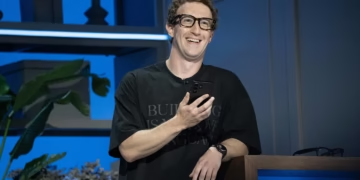
- Jensen Huang says Anthropic’s Mythos breakthrough makes it “essential” that U.S. and Chinese AI researchers talk directly about what not to use powerful AI for — an area he calls “glaringly missing” from current policy
- Huang argues export controls have not actually constrained China’s AI development: Beijing has abundant energy, empty fully-powered data centers, and the ability to bundle cheaper 7-nanometer chips to replicate compute capacity
- The training compute required for Mythos is “fairly mundane” and “abundantly available in China,” Huang said — directly undercutting the premise of the chip-restriction strategy
- Huang’s pro-dialogue stance puts him in direct conflict with Anthropic CEO Dario Amodei, who called the H200 chip export decision a “mistake” — even as Nvidia is a $10 billion investor in Anthropic
What Happened?
Nvidia CEO Jensen Huang, speaking on the Dwarkesh Podcast, called for the United States to establish a research dialogue with China on AI safety in the wake of Anthropic’s Mythos breakthrough. “We want the United States to win,” Huang said, “but I think having a dialogue and having a research dialogue is probably the safest thing to do.” He argued that the current adversarial posture between the two countries has left a dangerous gap: “It is essential that our AI researchers and their AI researchers are actually talking.” Huang also pushed back on the underlying logic of U.S. chip export controls, arguing that China has sufficient energy resources, idle data center capacity, and chip manufacturing capability to replicate the compute needed to train models like Mythos — making export restrictions less effective than their proponents believe.
Why It Matters?
Huang’s comments create an unusual and revealing fault line. Nvidia is simultaneously a $10 billion investor in Anthropic and the company most constrained by the export control regime that Anthropic’s CEO has championed. Dario Amodei called the Trump administration’s decision to allow H200 chip sales to China a “mistake” in January; Huang has lobbied persistently for exactly that kind of access. If Huang is correct that China can already train Mythos-level models using bundled 7-nanometer chips and its enormous energy surplus, then the restrictive export control strategy inflicts real costs on Nvidia’s business without delivering the intended strategic benefit. The argument is one the chip industry has long made privately; Huang is now making it explicitly in the context of the most dangerous AI capability disclosure in recent history.
What’s Next?
Huang’s call for U.S.-China AI safety dialogue faces a deeply skeptical political environment. The House is simultaneously advancing legislation to sanction Chinese firms for AI model theft, and the broader U.S.-China tech decoupling agenda has significant bipartisan support. The Mythos moment has, if anything, hardened the case for treating AI as a national security asset rather than a subject for cooperative research. Whether the administration moves toward Huang’s dialogue framework or Amodei’s containment framework will substantially shape how the next generation of AI capabilities is governed — and whether the “dark period” of offensive AI advantage the NSA’s former cybersecurity director warned about can be navigated without a major incident.
Source: Bloomberg