- Strategy Inc. sold $333.7 million of common stock in the week ended August 16, using the proceeds to repurchase $132 million of its STRC preferred shares and add $150 million to its USD cash reserve — continuing a five-week pattern of selling equity to manage liabilities rather than accumulate Bitcoin, with no Bitcoin purchased or sold since mid-June.
- Over the last five weeks, Strategy has sold approximately $2.1 billion of common stock while buying back roughly $347 million of STRC preferred shares and selling $213.3 million of Bitcoin — a wholesale reversal of the “never sell” accumulation flywheel Saylor pioneered, driven by Bitcoin’s ~50% collapse from its October 2025 peak making the original premium-arbitrage mechanism unworkable.
- Strategy now holds approximately 840,447 BTC worth about $59 billion, a $4.8 billion USD reserve, and has extended its USD duration to 2.8 years — a balance sheet configuration that prioritizes financial stability over Bitcoin accumulation and reflects Saylor’s pivot to what he’s calling a “capital management” approach announced at end of June.
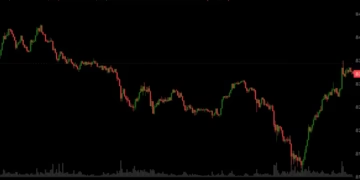
- Strategy shares rose 5% to $97.68 on Monday alongside a 2% Bitcoin bounce to ~$64,300, but the stock remains down approximately 73% over the past year — a steeper decline than Bitcoin itself (down ~45%) — reflecting the market’s reassessment of the leveraged Bitcoin accumulation thesis that made Strategy one of the most talked-about stocks of the AI and crypto bull market.
What Happened?
Strategy Inc. continued running its Bitcoin flywheel in reverse last week, selling $333.7 million of common stock to fund preferred share repurchases and cash reserve building rather than acquiring more Bitcoin. The company hasn’t purchased any Bitcoin since mid-June. Over the past five weeks, Strategy has sold approximately $2.1 billion of equity and $213 million of Bitcoin while buying back $347 million of its STRC preferred shares — a complete inversion of the playbook that made Michael Saylor famous: using capital market access to continuously accumulate Bitcoin at scale. The pivot, which Saylor announced in late June, reflects the collapse of the mechanism’s underlying logic: with Bitcoin down ~50% from its October 2025 peak, Strategy’s stock had stopped trading at the premium to book value that made selling equity to buy Bitcoin accretive.
Why It Matters?
Strategy’s accumulation flywheel was one of the most influential financial innovations of the 2024-2025 crypto bull market — a leveraged bet on Bitcoin that attracted dozens of imitators globally (including Japan’s Metaplanet) and helped establish institutional Bitcoin treasury strategies as a mainstream capital allocation option. Its reversal carries significant signaling weight. The fact that Saylor — the most committed institutional Bitcoin bull in public markets — has stopped buying and has instead been selling both stock and Bitcoin to stabilize his balance sheet reflects the severity of Bitcoin’s decline from its highs. For the broader market, Strategy’s pivot removes a consistent marginal buyer that had provided structural support for Bitcoin during the accumulation phase.
What’s Next?
The key question for Strategy investors is whether the pivot is temporary — a balance sheet stabilization before the flywheel restarts if Bitcoin recovers — or a permanent shift in business model toward capital management. Saylor’s framing suggests the latter, at least for now. With the Clarity Act stalled in Congress, Bitcoin ETF flows negative, and institutional sentiment cautious, there is no obvious near-term catalyst to revive the accumulation blueprint. Strategy’s 840,447 BTC position means it remains one of the world’s largest corporate Bitcoin holders, so a recovery in Bitcoin prices would still benefit the company significantly. But the leveraged accumulation thesis — the core of what made MSTR a cult stock — appears to be on hold indefinitely.
Source: Bloomberg