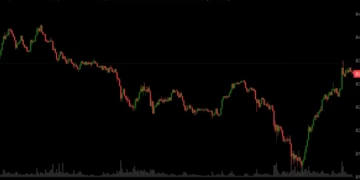
- Tether’s USDT briefly became the second-largest cryptocurrency by market cap, overtaking Ether with ~$187 billion in circulation versus Ether’s low of ~$182 billion, before Ethereum recovered.
- Ether has fallen roughly 70% from its August high, weighed down by the broader Bitcoin-led selloff, growing competition from newer blockchains, and persistent doubts about whether Ethereum’s network activity actually translates into demand for the ETH token itself.
- Stablecoins are expanding in the opposite direction: governments are advancing legislation to integrate them into the financial system, payment companies are experimenting with digital-dollar settlement, and USDT is already the most-traded cryptocurrency by daily volume.
- Retail capital has rotated toward AI, macro headwinds (inflation + potential rate hikes) are pressuring speculative assets, and AI-detected security vulnerabilities in crypto protocols have further shaken institutional confidence.
What Happened?
Early last Saturday, Ether’s market cap dropped to approximately $182 billion as the token extended a decline of roughly 70% from its August peak. At the same time, $187 billion of Tether’s USDT stablecoin was in circulation — briefly making a dollar-pegged asset worth more in aggregate than Ethereum, the second-largest blockchain and home to the majority of decentralized finance. The crossover was short-lived as markets stabilized, but it crystallized a structural divergence that crypto investors have debated for months: the “utility layer” of crypto — stablecoins used for trading, payments, and settlement — is growing steadily, while the speculative tokens that once drove the sector’s growth narrative are losing ground.
Why It Matters?
Ethereum occupies a unique and uncomfortable position in the current crypto cycle. Its loudest supporters are now pitching the network as Wall Street’s blockchain plumbing — the settlement layer for institutional DeFi — yet institutional embrace remains partial and slow. Meanwhile, newer networks like Hyperliquid are outperforming Ethereum on metrics like fees earned, and the “value paradox” has become a recurring talking point: Ethereum’s ecosystem activity keeps growing, but that growth increasingly accrues to Layer 2s and applications rather than creating direct demand for the ETH token itself. Tether, by contrast, has no such paradox — it is a utility product with a clear use case, expanding adoption, and pending US regulatory legitimization through stablecoin legislation moving through Congress.
What’s Next?
The Ethereum community is under pressure to articulate a cleaner value accrual story for the ETH token before the next bull cycle. Without one, capital may continue to rotate toward Bitcoin (the safe-haven crypto play), stablecoins (the utility play), and AI-adjacent tokens rather than back to Ethereum. Tether, meanwhile, is moving toward greater regulatory compliance even as it remains largely outside current US guidelines — passage of the stablecoin legislation working through Congress would formalize its role in the financial system and potentially accelerate adoption further. For broader crypto markets, the macro headwinds — looming inflation, potential rate hikes, and retail attention diverted toward AI stocks — suggest the speculative recovery trade remains some time away.
Source: Bloomberg