- Bitcoin fell 1.36% to $63,819 on the final day of July even as global equities staged a recovery rally — Asian stocks gained, S&P 500 futures rose 0.52%, and Nasdaq 100 futures surged 1.33% on the tailwind from Microsoft’s $450 billion single-day market cap gain following its blowout Q4 earnings — creating an unusual intraday divergence between crypto and equities that partially inverts the typical risk-on correlation that has characterized 2026 markets; Ether fell a steeper 1.97% to $1,882, and the CoinDesk 20 Index declined 0.69%, suggesting the crypto underperformance on July 31 was broad-based rather than BTC-specific; the most likely explanations for the divergence are crypto-specific: the Federal Reserve’s decision to hold rates while 30-year yields surged to 19-year highs creates a specific macro headwind for Bitcoin (which is increasingly correlated with rate-sensitive risk assets), while the equities recovery was driven primarily by the Microsoft earnings beat — a tech-specific catalyst that doesn’t directly translate to crypto demand.
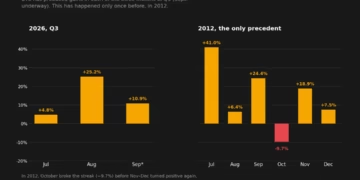
- Despite the weak final session, the broader crypto market is on track to post its best monthly performance since July 2025 — a remarkable outcome given the volatility of the month: Bitcoin surged to $66,700 in the first half before crashing to $62,400 amid South Korea’s chip stock rout and the Iran-U.S. military escalation, then partially recovered; the CoinDesk 20 index’s ability to post its best monthly gain in a year despite this intramonth volatility reflects the strength of the early-July surge driven by the U.S. regulatory environment improvements, ETF inflows, and the broader AI-narrative tailwind for crypto infrastructure plays; the July performance also reflects that altcoins materially outperformed Bitcoin on the month, with Uniswap (UNI) specifically benefiting from BlackRock’s tokenized Treasury integration and several DeFi tokens recovering from earlier lows.
- The context for Bitcoin’s July 31 weakness is a specific set of macro headwinds that are unlikely to resolve immediately: 30-year Treasury yields near 5.24% represent an elevated opportunity cost for holding non-yielding assets like Bitcoin; the Fed’s credibility crisis (Warsh’s hold without rate guidance) has created uncertainty about the trajectory of real rates that historically weighs on BTC; the Iran conflict’s geopolitical risk premium has been partially absorbed by markets but remains a vol-elevating factor; and the AI stock narrative — which had provided a positive “AI infrastructure” halo to crypto — has been disrupted by the Situational Awareness fund collapse and the broader “circular AI financing” concern that hit the semiconductor sector in late July; these headwinds are macro in nature and would need either Fed action (rate hike that removes the uncertainty) or a genuine de-escalation in the Iran conflict to materially shift.
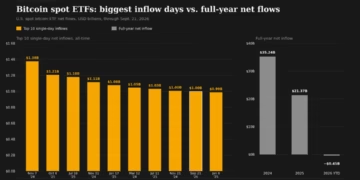
- The structural positive for crypto entering August is the monthly performance signal: institutional investors and portfolio allocators who benchmark performance monthly will see the CoinDesk 20’s best monthly gain in a year as evidence that the crypto asset class remains capable of generating alpha relative to traditional risk assets even in a volatile macro environment; this may support continued institutional inflow into crypto ETFs and structured products in August, providing a flow-based offset to the macro headwinds; watch whether Bitcoin can hold the $62,400 recent low — the level established during the South Korean chip crash — as the key technical support that would confirm the July recovery as a higher low rather than a dead-cat bounce in a longer-term corrective trend.
What Happened?
Bitcoin fell 1.36% to $63,819 and Ether dropped 1.97% on July 31 even as equities rallied globally on Microsoft’s earnings tailwind, with Nasdaq futures up 1.33%. The final-day crypto weakness stands in contrast to the broader July picture: the CoinDesk 20 index is on track for its best monthly gain since July 2025, with the broader crypto market outperforming BTC on a monthly basis despite the final-session sell-off. VIX fell 1.81% to 16.80, suggesting the equities recovery is not being read as a risk-off reversal.
Why It Matters?
The July 31 crypto/equity divergence — stocks up strongly on Microsoft, crypto down — illustrates how Bitcoin’s macro sensitivity has shifted: it’s now more responsive to Fed rate path uncertainty and yield-based opportunity cost than to broad risk-on/risk-off signals. The 30-year yield near 5.24% and Warsh credibility concerns are specific headwinds for non-yielding assets. The monthly performance signal (best CoinDesk 20 month in a year) provides institutional flow support entering August, but the macro headwinds from rates and geopolitics need resolution before Bitcoin can reclaim its July highs.
What’s Next?
Watch Bitcoin’s $62,400 support level — the recent low from the South Korean chip crash — as the key downside reference; watch August ETF flow data for whether the strong July monthly return is attracting institutional allocators back into crypto products; watch the Fed’s next inflation data prints for any signal that eases the rate path uncertainty weighing on BTC; and watch Uniswap and DeFi token performance for whether the BlackRock tokenized Treasury integration narrative sustains into August or was a one-week catalyst that has already been fully priced.
Source: CoinDesk