- Bitcoin climbed above $80,000 for the first time since mid-May, touching $81,257 on Tuesday before settling around $79,300 in New York morning trading — approaching but not yet closing above its 50-week moving average near $81,000, a technical threshold that Wave Digital Assets’ Rajiv Sawhney said would be “further constructive on a continuing bull rally” that has been building since Bessent’s bond buyback announcement last week reignited the debasement narrative.
- The structural supply constraint amplifying the ETF-driven demand surge: approximately 60% of Bitcoin in circulation hasn’t moved for more than a year, per Venn Link Partners’ Cici Lu McCalman, meaning “a lot of Bitcoin effectively isn’t available to trade” — so “when ETF demand suddenly accelerates, the marginal available supply can be quite tight,” creating an asymmetric price response to inflows that would produce a smaller move in a more liquid market.
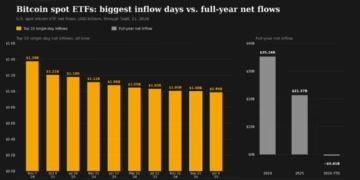
- Institutional participation has resumed forcefully: spot Bitcoin ETFs drew $337 million in net inflows on Monday alone after the record $1.92 billion weekly inflow last week (most since October 2025), with BlackRock’s IBIT dominating, while the broader crypto rally forced the liquidation of approximately $7.2 billion in leveraged bearish bets across all cryptoassets last week per Coinglass data — one of the largest short squeeze events on record.
- The bull-versus-skeptic debate turns on whether the debasement trade and regulatory tailwinds are durable: Trump met with crypto industry leaders the day of Bessent’s announcement, reviving optimism about the administration’s commitment, and the Clarity Act market structure bill — which failed to reach a Senate vote before August recess — is expected to be taken up again in mid-September; but Bitfire Research Director Allen Ding cautioned that a bull market “should not yet be treated as a confirmed trend.”
What Happened?
Bitcoin crossed $80,000 for the first time since mid-May, topping out at $81,257 intraday on Tuesday before giving back some gains to trade around $79,300. The move extends a remarkable week in which Bitcoin gained 23% — its largest weekly jump in about three years — following Treasury Secretary Bessent’s announcement of expanded long-dated bond buybacks, which traders interpreted as a debasement signal for the dollar and sparked buying in Bitcoin, gold, and other “hard assets.” The crypto market got an additional boost from a White House meeting between Trump and crypto industry leaders on the day of Bessent’s announcement, which revived optimism about the administration’s commitment to pro-crypto legislation including the stalled Clarity Act. Gold also advanced, confirming the debasement trade dynamic rather than a pure crypto-specific move.
Why It Matters?
The $80,000 level matters technically and psychologically: it’s near Bitcoin’s 50-week moving average (~$81,000), which has acted as resistance since the crypto winter began after Bitcoin’s October 2025 peak above $126,000. A sustained close above this level would signal to technical traders that the multi-month downtrend has definitively reversed. More broadly, the interplay between the debasement trade, ETF inflows, and the structural supply constraint (60% of BTC unmoved for 1+ years) creates a market structure where demand shocks produce amplified price responses — both to the upside and, eventually, to the downside. Bitcoin miners, who face an average mining cost of ~$80,000 per coin, represent a near-term supply overhang: at current prices they are incentivized to sell to de-risk their exposure, and McCalman noted this cohort could “prompt supply to sell” if prices rise further.
What’s Next?
The September Senate return is the next legislative catalyst: the Clarity Act is expected to come up for a vote in mid-September, and passage would be the most significant regulatory tailwind for US crypto markets in years. On the macro side, any shift in the debasement narrative — a hawkish Warsh speech at Jackson Hole, a reversal in dollar weakness, or evidence that Bessent’s buyback program is being scaled back — could remove the primary catalyst that triggered Bitcoin’s surge. Miners selling near the $80,000 cost-of-production level represent the most concrete near-term supply headwind. Bitfire’s Ding’s framework captures the key condition for a true bull market confirmation: “institutional participation, regulatory progress and capital rotation” must “continue to reinforce one another” — currently two of three are in place, with regulatory progress the outstanding variable.
Source: Bloomberg