- Bitcoin shrugged off the weekend and climbed back above $84,000 Monday, trading near $84,050 after dipping to $83,500 earlier in the session. The recovery follows Trump’s Friday announcement that Russia will supply 300,000 metric tons of diesel fuel to international and domestic markets as part of a partial easing of U.S. oil sanctions. Trump also claimed Russia and Ukraine agreed to an “energy ceasefire” to halt infrastructure attacks, which if credible would ease geopolitical risk premium from oil prices. Oil futures fell 1.8% to $90.28 Monday, reversing Thursday’s spike. When oil falls, it typically reduces macroeconomic uncertainty and eases pressure on growth expectations, which makes risk assets like Bitcoin more attractive. The geopolitical repricing gave Bitcoin room to recover from its Friday lows.
- The broader crypto market is advancing. Nine of the top ten cryptocurrencies moved higher Monday. Avalanche led with a 5.1% jump to $10.91, Chainlink rose 2.4% to $13.35, and Solana added 1.2%. Ether and XRP were also bid, suggesting investor interest is rotating beyond Bitcoin into altcoins. That’s a bullish signal—when money starts chasing secondary assets, it typically indicates institutional capital is comfortable with the broader risk-on environment. Bitcoin at $84,050 is holding Sunday’s high near $84,145, and analysts cite $82,000 as the key support level. If Bitcoin holds $82,000 and the rally extends, it suggests the worst of the October liquidation cascade has passed.
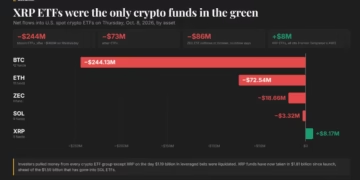
- But ETF data tells a different story. Last week, U.S. spot Bitcoin ETFs saw $681 million in outflows, the highest since June. Most happened Wednesday and Thursday during the height of the Treasury yield spike and inflation concerns. That outflow is large enough to signal cautious institutional sentiment. Analysts worry that despite Bitcoin’s Monday bounce, the macro backdrop remains challenging. Treasury yields hit 24-year highs last week, and that’s still a headwind for risk assets if yields stay elevated. The volatility between institutional outflows and price recovery suggests the market doesn’t yet believe the rally has staying power.
- The next catalyst is October 14 U.S. inflation data. If inflation comes in hot, Treasury yields will spike again and likely push Bitcoin lower. If inflation moderates, that could free up capital for risk assets and extend the rally. Until then, Bitcoin is caught between geopolitical easing (supportive) and macro uncertainty (difficult). The $82,000 support level is the line in the sand. If Bitcoin closes below that, analysts warn of deeper losses. If it holds and breaks above $85,000, that signals the recent selling was overdone and institutional confidence is rebuilding.
What Happened?
Bitcoin rebounded to near $84,050 Monday, recovering from an intraday low of $83,500 and holding close to Sunday’s high of $84,145. The bounce followed President Trump’s Friday announcement that Russia will supply 300,000 metric tons of diesel fuel to international and domestic markets, effectively easing U.S. sanctions on Russian oil. Trump also claimed that Russia and Ukraine agreed to an “energy ceasefire” to halt infrastructure strikes, though Ukrainian officials disputed this claim and reported continued Russian military strikes on Ukraine’s energy grid. WTI crude futures fell 1.8% to $90.28 Monday, reversing Thursday’s spike driven by geopolitical uncertainty. Ether and XRP advanced alongside Bitcoin, with nine of the top ten cryptocurrencies moving higher. Avalanche led gains with a 5.1% jump to $10.91, Chainlink rose 2.4% to $13.35, and Solana added 1.2%. However, U.S. spot Bitcoin ETFs registered outflows of $681 million last week, the highest since June, with most outflows occurring Wednesday and Thursday during heightened macroeconomic concerns over Treasury yields reaching 24-year highs.
Why It Matters?
Bitcoin’s ability to hold $84,000 despite significant institutional ETF outflows suggests the recent panic selling may be exhausted. When ETFs show outflows but price holds steady or rises, it indicates spot market buyers (potentially retail or international investors) are absorbing the institutional exits. That’s healthier than cascading liquidations where every seller triggers more selling. The geopolitical repricing also matters. Oil fell because Trump’s announcement reduced immediate war risk, which eases one of the macro headwinds that pushed yields up. If the “energy ceasefire” holds (even partially), that removes a shock to inflation expectations and could stabilize Treasury yields near current levels rather than driving them higher. The altcoin strength is also significant. When Bitcoin rallies but altcoins outperform, it signals broad-based confidence returning to the sector rather than flight to quality into Bitcoin alone. For institutional investors, Bitcoin at $84K with altcoins rising suggests the market is repricing from panic to opportunism.
What’s Next?
The October 14 U.S. inflation data is the next major catalyst. If inflation comes in above expectations (CPI hotter than forecast), Treasury yields will likely spike and Bitcoin could break below $82,000. If inflation moderates or meets expectations, Bitcoin could extend the rally toward $85,000+. Monitor Bitcoin’s hold of $82,000 as a line in the sand. If it closes below that level with conviction, expect continuation lower toward $80,000. If Bitcoin bounces at $82,000, that validates the recent low and gives bulls confidence to push higher. Watch ETF flows this week. If outflows slow or reverse to inflows, that signals institutional confidence is rebuilding and the rally has room to run. If outflows accelerate despite the price bounce, that warns of fresh selling pressure coming. Track oil prices closely. If oil stabilizes below $91 (or continues falling), that confirms the geopolitical easing narrative is holding. If oil spikes back above $93, that suggests the Trump ceasefire claim wasn’t credible and macro uncertainty is rising again. Finally, monitor whether Ukraine-Russia developments change the energy ceasefire narrative. Any major energy infrastructure strike would invalidate Trump’s claim and likely spike oil back toward $95+.
Affected Tickers and Coins: BTC | ETH | XRP | SOL | AVAX
Source: CoinDesk