Powered by LumidaWealth.com
Lumida News
  • Home
  • EarningsNEW
  • News
    • Alt Assets
    • Crypto
    • Equities
    • Macro
    • Markets
    • Real Estate
  • Lifestyle
    • Family Office
    • Health and Longevity
  • Themes
    • Aging & Longevity
    • AI
    • CRE
    • Digital Assets
    • Legacy Brands
    • Nuclear Renaissance
    • Private Credit
  • About Us
No Result
View All Result
Lumida News
  • Home
  • EarningsNEW
  • News
    • Alt Assets
    • Crypto
    • Equities
    • Macro
    • Markets
    • Real Estate
  • Lifestyle
    • Family Office
    • Health and Longevity
  • Themes
    • Aging & Longevity
    • AI
    • CRE
    • Digital Assets
    • Legacy Brands
    • Nuclear Renaissance
    • Private Credit
  • About Us
No Result
View All Result
Lumida News
No Result
View All Result
  • Lumida Wealth
  • Lumida Ledger
  • LUMIDA ETF
  • About Us
Home News Crypto

One Year After $19 Billion October Crash, Crypto Market Transforms; Leverage Lower But Perpetual Futures Spread Beyond Bitcoin to Stocks, Commodities, and Real-World Assets—Creating New Systemic Risks

by Team Lumida
October 12, 2026
in Crypto
Reading Time: 7 mins read
A A
0
Global Stocks Slide as AI Slowdown Calls Meet Saudi Pipeline Closure, With Chip ETF Down 4.7%
Share on TelegramShare on TwitterShare on FacebookShare on LinkedinShare on Whatsapp
  • Exactly one year ago, crypto experienced a cataclysm. On October 10, 2025, the market experienced a single-day liquidation cascade that wiped out $19 billion in leveraged bets. It was a record for a single day. That crash exposed something terrifying: when volatility spiked, liquidity didn’t just decline—it vanished. Traders who thought they could exit positions found themselves unable to do so. The market structure was fragile, and everyone knew it after that day. Bitcoin remains more than 30% below its all-time record high even after recent rallies back above $80,000. Open interest in Bitcoin perpetual futures halved in the six months after the crash, falling from $45 billion to roughly $22.5 billion. A year later, that leverage hasn’t fully returned. Traders learned their lesson: rebuilding leveraged positions slowly is safer than crashing spectacularly.
  • But systemic risk didn’t disappear—it just migrated. Here’s the dangerous part: perpetual futures (leveraged contracts that let traders place bets without expiration dates) have exploded as a product class for real-world assets. Twelve months ago, open interest in perpetual futures for stocks, commodities, bonds, and other traditional assets stood at virtually zero. Today, it exceeds $17 billion. Almost all of that growth happened in the last six months. Who’s driving it? Hyperliquid, an offshore crypto exchange that was an early mover in offering perps on stocks and commodities. The implicit trade: if you want 24/7 trading, instant settlement, and no closing time, you go to Hyperliquid or similar venues. You trade perps on Apple, gold, oil, Treasury bonds. And you use leverage. The same machinery that created the $19 billion crash in crypto is now being deployed on traditional financial assets. That should concern regulators.
  • The market has become more sophisticated and more institutional, but also more dangerous in new ways. Banks and major trading firms are now experimenting with digital assets, stablecoins, and tokenization. The Fed is moving ahead with plans to strengthen trading with guidelines on collateral and margin usage, despite failed crypto regulation in September. But here’s the trap: regulators are building rules for crypto and traditional finance separately. If a major crash in offshore perp markets (Hyperliquid trades on stocks/commodities) cascades back into traditional securities markets, regulators won’t have coordinated playbooks. The never-ending quest for yield is pushing traders toward instruments and venues that aren’t yet fully integrated into the regulatory framework. That’s how you create the next crisis.
  • Crypto itself is now integrated with Wall Street rather than opposing it. The industry was born as a rebellion against financial institutions. Today, it’s becoming another corner of Wall Street. Prediction markets are drawing crowds (another leveraged betting mechanism). Sports betting venues are experimenting with crypto. The structural case for Bitcoin remains intact (limited supply, narrative about inflation hedge, institutional adoption). But the industry has stopped asking whether crypto will disrupt finance. Instead, it’s asking how to integrate it. Lucas Tcheyan from Galaxy Digital summed it up: “The market that crashed on 10/10 doesn’t really exist anymore. The one that replaced it is just starting to get priced in.” That new market is simultaneously more resilient (lower leverage, better exchange safeguards, less correlation) and more dangerous (leverage migrated to unregulated offshore venues offering perps on real-world assets, systemic integration with traditional finance).

What Happened?

On October 10, 2025, cryptocurrency markets experienced a historic liquidation cascade that wiped out $19 billion in leveraged bets in a single day, exposing structural fragility and sparking an industry-wide retrenchment. One year later, Bitcoin remains approximately 30 percent below its all-time high despite a recent rally above $80,000. Total open interest in Bitcoin perpetual futures halved in the six months following the crash, from approximately $45 billion to roughly $22.5 billion, and remains well below its prior peak. Traders have been slow to rebuild leveraged positions. However, the crypto market has undergone a fundamental structural transformation. The most significant new development is the rapid expansion of perpetual futures contracts for real-world assets—stocks, commodities, bonds, and currencies. Open interest in perpetual futures for traditional assets stood at virtually zero one year ago and now exceeds $17 billion, driven primarily by offshore crypto exchanges like Hyperliquid that offer 24/7 trading with instant settlement. The shift reflects migration of the speculative and leverage-dependent market infrastructure from purely crypto assets to real-world financial assets. Meanwhile, banks and major trading firms are accelerating experimentation with digital assets, stablecoins, and blockchain-based financial infrastructure. Federal regulators, despite failed comprehensive crypto regulation in September, are moving forward with guidelines on collateral usage and margin requirements for digital asset trading.

Why It Matters?

The October 2025 crash served a pedagogical function: traders and market participants learned that leverage in fragmented, 24/7 markets can evaporate liquidity faster than in regulated traditional exchanges. The response—reducing leverage in crypto perpetual futures—appears rational. But the broader shift toward perpetual futures for real-world assets exposes a dangerous regulatory gap. If traders can access 24/7 leveraged bets on Apple, gold, oil, and Treasury yields through offshore venues, they are trading instruments that are functionally identical to their crypto counterparts but outside traditional regulatory frameworks. The risk profile is identical: when volatility spikes and liquidity disappears, traders face cascading liquidations. The difference is that these positions are now linked to traditional financial assets. If a flash crash in offshore perp markets cascades into stock markets, commodity markets, and fixed income markets, the fallout will be systemic. The Fed is building margin and collateral rules, but those rules are being designed for crypto assets and traditional finance separately. Coordinated execution will be difficult. Additionally, the observation that crypto is becoming integrated with Wall Street rather than disrupting it is strategically significant. The early narrative was that blockchain and crypto would displace traditional finance. The reality is that Wall Street has absorbed the technological and structural innovations while maintaining its dominance. Perps, tokenization, stablecoins, and 24/7 settlement are now just new tools within the traditional financial system. That integration provides stability but also means that crypto volatility and leverage cycles now directly affect traditional markets.

What’s Next?

Monitor open interest in real-world asset perpetual futures, particularly on Hyperliquid and similar venues. If that $17 billion grows to $50 billion or $100 billion, it represents significant leverage concentrated in instruments outside traditional regulatory oversight. A volatility spike that cascades through those markets could create forced deleveraging that reverberates into stock and commodity exchanges. Watch for regulatory coordination between the Fed, SEC, and CFTC on perpetual futures for traditional assets. If regulators create margin and collateral rules for crypto perps but not for real-world asset perps, the arbitrage becomes obvious: traders migrate to real-world asset perps to avoid regulation. That would be dangerous. Track Bitcoin and crypto volatility regimes closely. QCP Capital forecast Bitcoin in a $80,000–$90,000 range for Q4 2026. If Bitcoin breaks above $90,000, it could reignite retail interest and leverage rebuilding in crypto. If Bitcoin falls below $80,000, it tests whether the market has genuinely rebuilt confidence or just consolidated at lower leverage levels. Monitor prediction market growth. Prediction markets are another leveraged betting mechanism that could concentrate tail risk. If prediction markets on political events or economic outcomes grow to systemic scale, they become another liquidity risk vector. Finally, watch bank and Wall Street commentary on stablecoins and tokenization. If major banks begin rolling out stablecoin platforms and tokenized securities trading, that accelerates integration between crypto infrastructure and traditional finance—which provides stability but also means contagion runs in both directions.

Affected Tickers and Coins: BTC | ETH | GLXY

Source: Bloomberg

Previous Post

Prime Broking Becomes Wall Street’s Cash Cow as Banks Lend Trillions to Hedge Funds; Regulatory Concerns Mount as Lock-Up Periods Stretch to Six Months

Next Post

HSBC Switches to Wall Street Bonus Model, Phases Out Fixed-Pay Allowances; UK Banks Align Compensation Structure as Regulatory Change Unleashes Bonus-Heavy Pay Starting 2028

Recommended For You

Bitcoin Rebounds Above $84,000 as Oil Falls and Trump Signals Russia-Ukraine Energy Ceasefire; Crypto Broadly Advances Despite $681 Million ETF Outflows Last Week

by Team Lumida
3 hours ago
Bitcoin Could Drop to $50K Before a Potential Fed-Driven Rally

Bitcoin trading near $84,050 after bouncing from $83,500. Oil fell 1.8% to $90.28 on Trump's announcement of Russia diesel supply deal and claimed energy ceasefire. ETF outflows of...

Read more

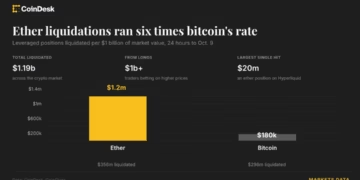
Ether Traders Crushed at Six Times Bitcoin’s Rate as $1 Billion Cascade Wipes Out Leveraged Bets Ahead of Liquidation Anniversary

by Team Lumida
3 days ago
Ether Traders Crushed at Six Times Bitcoin’s Rate as $1 Billion Cascade Wipes Out Leveraged Bets Ahead of Liquidation Anniversary

$356 million in ETH positions liquidated in 24 hours, outpacing Bitcoin despite Ether's smaller market cap. Fed minutes, Iran geopolitics, and AI security warnings triggered the flush. Short...

Read more

XRP Ledger Enables Banks to Split Payment and Compliance Work — $4.26B Tokenized Assets Now Protected by New Permissions Feature as Technical Bugs Complicate Rollout

by Team Lumida
3 days ago
XRP Ledger Activates PermissionDelegationV1_1 — Institutional Compliance Features Mature While Technical Bugs Emerge, Validating Infrastructure Complexity as $4.26B Tokenized Assets Layer Demands Operational Rigor

XRP Ledger activated PermissionDelegationV1_1 on Oct 8, letting banks authorize compliance accounts without exposing master keys. Feature addresses institutional need for operational separation. But bugs in voting mechanism...

Read more

Solana Completes Block-Time Halving to 200ms Friday — Infrastructure Optimization Validates Network Maturation but Rising Validator Costs Signal Centralization Pressure as Performance Gains Trade Off Operational Economics

by Team Lumida
3 days ago
Solana Completes Block-Time Halving to 200ms Friday — Infrastructure Optimization Validates Network Maturation but Rising Validator Costs Signal Centralization Pressure as Performance Gains Trade Off Operational Economics

Solana reducing block time 250ms → 200ms Oct 9 at epoch 1053. Completes 7-week cycle from 400ms. Block frequency 2.5 → 5/second. Validator window 1.6s → 800ms. Higher...

Read more

Sui Launches Hashi Bitcoin Lending With $500M Commitments — Institutional Protocol Targets $1T Dormant Wealth as BTC Infrastructure Matures Despite Technical Breakdown, Validating Narrative/Price Divergence

by Team Lumida
3 days ago
Sui Launches Hashi Bitcoin Lending With $500M Commitments — Institutional Protocol Targets $1T Dormant Wealth as BTC Infrastructure Matures Despite Technical Breakdown, Validating Narrative/Price Divergence

Sui launching Hashi institutional Bitcoin lending protocol with $500M commitments from 20+ partners. $1T dormant Bitcoin target. Bitcoin stays on-chain, hBTC vouchers on Sui enable lending. Mainnet rollout...

Read more

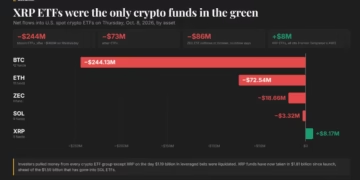
XRP ETFs Only Green as Bitcoin, Ethereum, Zcash Funds Post Massive Outflows — Crypto Capital Bifurcation Validates Selective Risk Rotation as $1B Liquidation Cascade Pressures BTC Below $82K Resistance

by Team Lumida
3 days ago
XRP ETFs Only Green as Bitcoin, Ethereum, Zcash Funds Post Massive Outflows — Crypto Capital Bifurcation Validates Selective Risk Rotation as $1B Liquidation Cascade Pressures BTC Below $82K Resistance

XRP ETFs sole crypto fund gainers Thursday. Bitcoin ETFs -$244M outflows. Ethereum, Zcash also bleeding capital. Bitcoin $82K after $1B liquidation. October pattern validates crypto asset rotation amid...

Read more

Crypto Returned 52.7% in Q3 Against 2.03% for the S&P, With a 160-Point Spread Between the Best and Worst of 20 Assets

by Team Lumida
4 days ago
Crypto Returned 52.7% in Q3 Against 2.03% for the S&P, With a 160-Point Spread Between the Best and Worst of 20 Assets

Bitcoin ETFs swung $11 billion from outflow to inflow. Bitcoin has since fallen below where the quarter ended.

Read more

Bitcoin Loans Go Mainstream — Collateral-Backed Credit Now Funding Tuition, Business Cash Flow, and Real-World Expenses, Not Just Trades

by Team Lumida
4 days ago
Bitcoin Loans Go Mainstream — Collateral-Backed Credit Now Funding Tuition, Business Cash Flow, and Real-World Expenses, Not Just Trades

SALT Lending, Ledn report BTC-backed loans increasingly for tuition, emergency expenses, working capital (not trades). Ledn: $11B+ loans, targeting $1T. Coinbase added fixed-rate loans Sept 22 via Morpho....

Read more

Deus X Capital Liquidates — $1B Crypto Investment Firm Pivots to AI, Signals Broader Capital Flight From Digital Assets

by Team Lumida
4 days ago
Deus X Capital Liquidates — $1B Crypto Investment Firm Pivots to AI, Signals Broader Capital Flight From Digital Assets

Deus X Capital shutting down Jan 31, 2027. CEO Tim Grant leading TensorX AI venture. Family office splitting: Shane Morton→Darius (AI), Owen/Jason Morton→95 (fintech/markets). 36.5% annual returns insufficient...

Read more

Cardano Unlocks Regulated Finance — CIP-0113 Token Standard Lets Issuers Freeze, Seize, and Restrict Assets On-Chain

by Team Lumida
5 days ago
Cardano Unlocks Regulated Finance — CIP-0113 Token Standard Lets Issuers Freeze, Seize, and Restrict Assets On-Chain

Cardano Foundation launches CIP-0113 standard live on mainnet. Allows regulated stablecoins, funds, bonds to freeze/seize/restrict transfers. Identity checks, sanctions controls built into assets. No hard fork needed.

Read more
Next Post
HSBC Switches to Wall Street Bonus Model, Phases Out Fixed-Pay Allowances; UK Banks Align Compensation Structure as Regulatory Change Unleashes Bonus-Heavy Pay Starting 2028

HSBC Switches to Wall Street Bonus Model, Phases Out Fixed-Pay Allowances; UK Banks Align Compensation Structure as Regulatory Change Unleashes Bonus-Heavy Pay Starting 2028

Goldman Sachs Strategists Upgrade Global Stocks to Overweight; Barbell Strategy Balances Tech Upside with Rate-Sensitive Defensives as Q3 Earnings Season Crucial to Year-End Rally

Goldman Sachs Strategists Upgrade Global Stocks to Overweight; Barbell Strategy Balances Tech Upside with Rate-Sensitive Defensives as Q3 Earnings Season Crucial to Year-End Rally

Leave a Reply Cancel reply

Your email address will not be published. Required fields are marked *

Related News

a street corner with a store lit up at night

7-Eleven: The Next Target for Circle K’s Owner?”

August 27, 2024

Alibaba Group Earnings Highlights: Steady Growth and Strategic Realignment

August 15, 2024
How Nvidia’s AI Chips are Secretly Making Their Way to China

Nvidia to Resume H20 AI Chip Sales to China Following US Reversal

July 15, 2025

Subscribe to Lumida Ledger

Browse by Category

  • Lifestyle
    • Family Office
    • Health and Longevity
    • Legacy
    • Next Gen Wealth
    • Trust, Tax, and Estate
  • News
    • Alt Assets
    • Crypto
    • Equities
    • Latest
    • Macro
    • Markets
    • Real Estate
  • Opinions
    • Investing Philosophy
    • Op-Ed
  • Research
    • Trackers
  • Themes
    • Aging & Longevity
    • AI
    • Biotech
    • CRE
    • Cybersecurity
    • Digital Assets
    • Legacy Brands
    • Nuclear Renaissance
    • Private Credit
    • Software
Facebook Twitter Instagram Youtube TikTok LinkedIn
Lumida News

Premium insights to help you invest beyond the ordinary. Lumida Wealth Management LLC (‘Lumida”) is an SEC registered investment adviser

CATEGORIES

  • Aging & Longevity
  • AI
  • Alt Assets
  • Biotech
  • CRE
  • Crypto
  • Cybersecurity
  • Digital Assets
  • Equities
  • Family Office
  • Health and Longevity
  • Investing Philosophy
  • Latest
  • Legacy
  • Legacy Brands
  • Lifestyle
  • Macro
  • Markets
  • News
  • Next Gen Wealth
  • Nuclear Renaissance
  • Op-Ed
  • Private Credit
  • Real Estate
  • Software
  • Themes
  • Trackers
  • Trust, Tax, and Estate

BROWSE BY TAG

AI AI chips Amazon Apple Artificial Intelligence Banking Bitcoin China Commercial Real Estate CPI Crypto data centers Donald Trump EARNINGS ELON MUSK ETF Ethereum Federal Reserve financial services generative AI Goldman Sachs Google India Inflation Intel Interest Rates Investment Strategy Japan Jerome Powell JPMorgan Markets Meta Microsoft Nasdaq Nvidia OpenAI private equity S&P 500 SEC stock market Tech Stocks tesla Trump Wells Fargo Whale Watch

© 2025 Lumida Wealth Management LLC is an SEC registered investment adviser. Privacy Policy. Cookies Policy.
Disclaimer Important Information This site is for informational purposes only. Information presented on this site does not constitute as investment advice.

Lumida Wealth Management LLC (‘Lumida”) is an SEC registered investment adviser. SEC registration does not constitute an endorsement of the firm by the Commission nor does it indicate that the adviser has attained a particular level of skill or ability.

Lumida's website (referred to herein as the "Website") is limited to the dissemination of general information pertaining to its advisory services, together with access to additional investment-related information, publications, and links. Accordingly, the publication of the Website on the Internet should not be construed by any client and/or prospective client Lumida’s solicitation to effect, or attempt to effect transactions in securities, or the rendering of personalized investment advice for compensation, over the Internet.

Any subsequent, direct communication by Lumida with a prospective client will be conducted by a representative that is either registered or qualifies for an exemption or exclusion from registration in the state where the prospective client resides.

‍Lead Capture Forms: By submitting your contact information in the forms on this site, you are not obligated to invest in Lumida's product or services.
‍Address: Lumida Wealth Management, 25 W 39th Street Suite 700, New York, NY 10018

No Result
View All Result
  • Home
  • Earnings
  • News
    • Alt Assets
    • Crypto
    • Equities
    • Macro
    • Markets
    • Real Estate
  • Lifestyle
    • Family Office
    • Health and Longevity
  • Themes
    • Aging & Longevity
    • AI
    • CRE
    • Digital Assets
    • Legacy Brands
    • Nuclear Renaissance
    • Private Credit
  • About Us

© 2025 Lumida Wealth Management LLC is an SEC registered investment adviser. Privacy Policy. Cookies Policy.
Disclaimer Important Information This site is for informational purposes only. Information presented on this site does not constitute as investment advice.

Lumida Wealth Management LLC (‘Lumida”) is an SEC registered investment adviser. SEC registration does not constitute an endorsement of the firm by the Commission nor does it indicate that the adviser has attained a particular level of skill or ability.

Lumida's website (referred to herein as the "Website") is limited to the dissemination of general information pertaining to its advisory services, together with access to additional investment-related information, publications, and links. Accordingly, the publication of the Website on the Internet should not be construed by any client and/or prospective client Lumida’s solicitation to effect, or attempt to effect transactions in securities, or the rendering of personalized investment advice for compensation, over the Internet.

Any subsequent, direct communication by Lumida with a prospective client will be conducted by a representative that is either registered or qualifies for an exemption or exclusion from registration in the state where the prospective client resides.

‍Lead Capture Forms: By submitting your contact information in the forms on this site, you are not obligated to invest in Lumida's product or services.
‍Address: Lumida Wealth Management, 25 W 39th Street Suite 700, New York, NY 10018