Powered by LumidaWealth.com
Lumida News
  • Home
  • EarningsNEW
  • News
    • Alt Assets
    • Crypto
    • Equities
    • Macro
    • Markets
    • Real Estate
  • Lifestyle
    • Family Office
    • Health and Longevity
  • Themes
    • Aging & Longevity
    • AI
    • CRE
    • Digital Assets
    • Legacy Brands
    • Nuclear Renaissance
    • Private Credit
  • About Us
No Result
View All Result
Lumida News
  • Home
  • EarningsNEW
  • News
    • Alt Assets
    • Crypto
    • Equities
    • Macro
    • Markets
    • Real Estate
  • Lifestyle
    • Family Office
    • Health and Longevity
  • Themes
    • Aging & Longevity
    • AI
    • CRE
    • Digital Assets
    • Legacy Brands
    • Nuclear Renaissance
    • Private Credit
  • About Us
No Result
View All Result
Lumida News
No Result
View All Result
  • Lumida Wealth
  • Lumida Ledger
  • LUMIDA ETF
  • About Us
Home Themes AI

China’s AI Chip Self-Sufficiency Dream Derailed; 1 Million+ Nvidia Workaround Purchases Expose Supply Shortfall as Domestic Demand Outpaces Output Through 2030

by Team Lumida
October 13, 2026
in AI
Reading Time: 8 mins read
A A
0
Apollo’s Torsten Slok Warns AI Agents Could Trigger Slow-Motion Bank Run; Muse + Agentic AI Auto-Sweeping Deposits 0.1% → 5%; $7.78B Market 2026, $43.52B By 2031; x402 Protocol 188M+ Transactions
Share on TelegramShare on TwitterShare on FacebookShare on LinkedinShare on Whatsapp
  • China’s national strategic plan to achieve AI chip self-sufficiency is hitting a brutal reality: the country’s tech giants bought more than 1 million Nvidia gaming and workstation chips this year as a desperate workaround to a worsening supply shortage. The irony is visceral. Four years after the US began restricting advanced AI processor sales to China, and two years after Beijing told Chinese tech companies to reduce their reliance on Nvidia, the country is buying Nvidia chips—just older models (RTX Pro 6000D, 5000, 5090) that technically comply with export controls but aren’t designed for AI. The chips are inferior to Huawei’s Ascend 910C for most workloads, but they’re good enough for simpler tasks like the prefilling phase of inference. Chinese companies are using them because they have no other choice: domestic supply can’t match demand. This year, China will produce about 3.5 million AI chips. Total demand exceeds 5 million. By 2027, demand could double to 10 million+, while domestic production rises to maybe 5-6 million. That’s a structural deficit that will persist for years.
  • The supply shortage exposes a fundamental tension in China’s strategy: the country is trying to build AI infrastructure at a pace that domestic chip production simply cannot support. Alibaba, ByteDance, and Tencent combined are spending upwards of 700 billion yuan ($104 billion) on AI capex this year alone. China’s total AI compute spending is $193 billion—about 21% of US spending. That’s massive. And the intensity keeps accelerating. These companies are racing to build foundation models, deploy agentic systems, and secure computing infrastructure. They need chips now, not in 2028 when Huawei production scales. Alibaba CEO Eddie Wu said on an earnings call that industry consensus is the shortage won’t resolve until 2030. That statement is a strategic admission: China is going to be compute-constrained for years. And the constraint is becoming a competitive disadvantage because the US isn’t facing it. US companies have access to Nvidia’s best chips. Chinese companies have access to workarounds and the hope that Huawei chips improve.
  • The CUDA lock-in is real and underestimated. Nvidia’s CUDA software system is the standard programming interface for GPU computing. Most Chinese tech companies cut their teeth on CUDA before being forced to transition to Huawei’s alternative, CANN. But CANN is “not as easy to work with,” which means training costs are higher, debugging is harder, and time-to-market for new models is longer. DeepSeek is working closely with Huawei to accelerate the CUDA-to-CANN transition using AI tools. But that’s an extra engineering cost and timeline stretch that US companies (using CUDA natively) don’t face. The fact that 2 million+ pre-orders already exist for Nvidia’s new RTX Pro 5500 workstation chip tells you how desperate Chinese tech companies are to avoid the CANN integration cost. They want to keep using CUDA-based development, even if it means buying Nvidia workaround products that comply with export controls. That’s a strategic win for Nvidia and a strategic loss for China’s AI independence goal.
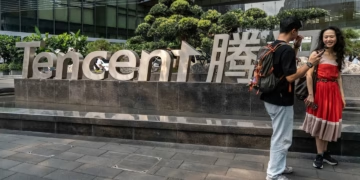
  • The overseas leasing strategy reveals strategic vulnerability. Unable to source sufficient compute domestically, Chinese tech companies are leasing GPU capacity from overseas data centers. Tencent signed an Oracle deal to lease 100,000 GPUs across Southeast Asia data centers. ByteDance and Alibaba are pursuing similar massive leases. Most of these overseas data centers are filled with Nvidia’s cutting-edge B300 chips—the kind of advanced compute that Chinese companies can’t access domestically due to export controls but can access through offshore leasing. This workaround is clever but strategically pathetic: China is spending billions on domestic chip production to build self-sufficiency, then turning around and renting advanced Nvidia chips overseas to actually train its foundation models. That means the frontier models being built by Chinese companies (Alibaba, ByteDance, Tencent, DeepSeek, Zhipu) are running on Nvidia infrastructure, not Chinese infrastructure. That’s not self-sufficiency. That’s strategic dependence hiding behind geographic arbitrage. If the US wanted to tighten controls, it could pressure cloud providers to restrict access. That would instantly cripple Chinese AI model development.

What Happened?

Chinese technology companies purchased more than 1 million Nvidia gaming and workstation chips in 2026, revealing a worsening supply deficit in China’s domestic AI chip production and exposing the limits of Beijing’s strategy to achieve semiconductor self-sufficiency. The workaround purchases of Nvidia RTX Pro products (6000D, 5000, 5090 models) occur despite four years of US export controls restricting advanced AI processor sales to China and a two-year-old Chinese government directive instructing domestic tech companies to reduce reliance on Nvidia. China’s domestic AI chip production is forecast to reach approximately 3.5 million units this year, including about 1 million chips manufactured overseas, while total demand exceeds 5 million units. By 2027, demand could double to exceed 10 million units while domestic production rises to only 5-6 million, according to industry insiders. Domestic chipmakers including Huawei (targeting 1.6 million chips), Alibaba and Baidu combined (1 million), and Cambricon (300,000) are expanding production, but the growth rate lags demand acceleration. Chinese tech companies’ combined artificial intelligence capital expenditure from Alibaba, ByteDance, and Tencent could exceed 700 billion yuan ($104 billion) this year, driving soaring computing demand. Alibaba CEO Eddie Wu stated on an earnings call that industry consensus holds the supply shortage will not resolve until 2030. Chinese tech companies are compensating by leasing compute capacity from overseas data centers, with Tencent securing 100,000 GPUs through an Oracle deal in Southeast Asia, while ByteDance and Alibaba pursue similar large-scale overseas lease arrangements, predominantly using Nvidia’s cutting-edge B300 chips. Nvidia is introducing a new RTX Pro 5500 workstation processor with more than 2 million pre-orders from Chinese companies already placed, expected to ship late 2026.

Why It Matters?

China’s forced reliance on Nvidia workaround chips and overseas GPU leasing reveals a critical vulnerability in Beijing’s AI strategy: the country is attempting to build computing infrastructure faster than it can develop domestic semiconductor alternatives. This constraint has three major strategic implications. First, it undermines China’s self-sufficiency objective. Beijing has made AI development a national strategic priority and instructed tech companies to reduce Nvidia reliance. Instead, companies are buying 1 million+ Nvidia chips annually and leasing cutting-edge Nvidia compute overseas. That’s not self-sufficiency; it’s strategic dependence masked by geographic arbitrage. Second, the CUDA software lock-in disadvantages Chinese companies. Forced to migrate from Nvidia’s CUDA to Huawei’s CANN, Chinese tech companies face higher engineering costs, slower development cycles, and time-to-market delays. US companies using CUDA natively have no such friction. This creates a persistent productivity gap that favors US AI development. Third, the shortage through 2030 means Chinese frontier models (built by Alibaba, ByteDance, Tencent, DeepSeek, Zhipu) will continue relying on US infrastructure. The models being trained on overseas Nvidia clusters are dependent on US supply chains. If the US decided to pressure cloud providers or restrict offshore access, it could instantly impair Chinese AI development. That asymmetric vulnerability is a geopolitical liability. Finally, the surge in Nvidia’s business is a strategic win for the US. Despite export controls, Nvidia’s market share in China remains dominant through workaround products, and 2+ million pre-orders for the RTX 5500 suggest that dominance will persist. Nvidia has effectively circumvented export controls through product categorization.

What’s Next?

Monitor US export control policy closely. If the US tightens restrictions on workstation chips or high-volume consumer GPU products, it directly impacts the RTX 5500 pre-orders and forces Chinese companies back to pure domestic alternatives that are less capable. If restrictions remain unchanged, Nvidia’s dominance persists through the workaround strategy. Track Huawei chip production ramp-ups. If Huawei and other domestic chipmakers accelerate timelines and achieve better-than-expected performance, it could reduce Nvidia dependency. If they slip or disappoint on performance, the supply gap widens further. Monitor Chinese government regulatory responses. The article mentions regulators asking tech companies whether RTX 5500 demand is “necessary” and companies answering “yes.” If regulators decide that necessity doesn’t override strategic independence goals, they could impose restrictions or quotas on Nvidia purchases. Such action would be economically painful but politically significant. Watch overseas lease agreements announcements. If major Chinese tech companies publicly disclose large-scale Tencent-Oracle-style arrangements with US cloud providers, it signals that offshore compute reliance is becoming structural. If companies instead announce domestic-centric infrastructure plans, it signals commitment to reducing offshore dependence. Track Chinese frontier AI lab funding and capex. DeepSeek and Zhipu are raising massive capital for data center buildouts with Huawei chips. If these buildouts succeed and models trained on Huawei infrastructure match or exceed US-trained models, it validates the path forward. If results disappoint, it validates concerns that Huawei chips can’t compete. Finally, monitor Alibaba, ByteDance, and Tencent earnings guidance on capex and AI model development. If they moderate capex due to supply constraints, it suggests they’ve accepted the shortage and are building within constraints. If they maintain aggressive capex, they’re betting on continued offshore leases and Nvidia workarounds.

Affected Tickers and Coins: NVDA | TCEHY | BABA

Source: Financial Times

Previous Post

Investors Lock In Record Treasury Yields Amid Rout; $73 Billion in Bond Fund Inflows Signal Capitulation as 10-Year Yields Hit 24-Year Peak, Real Returns Near 3%

Next Post

Meta’s Muse Wonder Reaches AI Frontier, Zuckerberg Commits to Further Vast Spending; Stock Up 10% Since Muse Launch Despite Amazon Throttling Agents and Privacy Concerns

Recommended For You

SpaceX Agrees to NYC Council AI Safety Testimony After Subpoena Threat; Musk-Backed Grok Testifies Friday as Deepfake Porn Lawsuits Mount and Federal Agencies Question Pentagon Usage

by Team Lumida
44 minutes ago
SpaceX Agrees to NYC Council AI Safety Testimony After Subpoena Threat; Musk-Backed Grok Testifies Friday as Deepfake Porn Lawsuits Mount and Federal Agencies Question Pentagon Usage

SpaceX testifying Fri (Oct 18) 10 AM to NYC Council tech committee. Originally subpoenaed Sept 28 for Oct 5 hearing; skipped. Anthropic, OpenAI, Google, Meta testified Oct 5....

Read more

Meta’s Muse Wonder Reaches AI Frontier, Zuckerberg Commits to Further Vast Spending; Stock Up 10% Since Muse Launch Despite Amazon Throttling Agents and Privacy Concerns

by Team Lumida
1 hour ago
Meta’s Muse Wonder Reaches AI Frontier, Zuckerberg Commits to Further Vast Spending; Stock Up 10% Since Muse Launch Despite Amazon Throttling Agents and Privacy Concerns

Meta released Muse Wonder; Zuckerberg: at AI 'frontier.' Outperforms Claude Opus 5.5, GPT-6 Astra on benchmarks. Muse app most-downloaded US both platforms. Stock +10% since Sept. $1.8T company....

Read more

Tencent Raises $5 Billion in Bonds for AI Capex as Chinese Tech Giants Fund Competitive Arms Race; Annual Spending to Exceed 200 Billion Yuan Through 2027

by Team Lumida
1 day ago
Tencent Raises $5 Billion in Bonds for AI Capex as Chinese Tech Giants Fund Competitive Arms Race; Annual Spending to Exceed 200 Billion Yuan Through 2027

Tencent raising $5B bonds ($1.5-2B USD + 20-25B yuan offshore). Proceeds for AI capex (bulk for chip purchases). Q2 capex 52.8B yuan (176% YoY growth). Annual spending >200B...

Read more

Intel and Broadcom CEOs Warn Capital Crunch Could Surpass Chip Shortages as AI’s Biggest Constraint; Rising Bond Yields Threaten Data Center Economics

by Team Lumida
1 day ago
Intel Surges 5%, SK Hynix Up 3% on Reports of U.S. Memory Chip Manufacturing Deal to Serve Nvidia and AI Demand

Broadcom CEO Hock Tan says capital access may be bigger constraint than chip/memory shortages. Intel CEO Lip-Bu Tan cites rising cost of capital and ROI questions. Supply bottlenecks...

Read more

SoftBank’s Masayoshi Son Hunts $100 Billion from Gulf Investors to Scale AI Bets as OpenAI IPO Delays and Valuation Concerns Mount

by Team Lumida
4 days ago
SoftBank Bets Big on AI: Ditches $15bn Buyback Plan Despite Investor Pressure

SoftBank founder seeks up to $100B from UAE and Saudi Arabia to fund AI expansion. Son would use capital to acquire companies and improve them with AI. Comes...

Read more

Isomorphic Labs Series C at $40-50B Valuation — Alphabet’s AI Drug Discovery Spinoff Attracts International Capital as Application Layer Commands Premium While Infrastructure Investors Retreat

by Team Lumida
5 days ago
Isomorphic Labs Series C at $40-50B Valuation — Alphabet’s AI Drug Discovery Spinoff Attracts International Capital as Application Layer Commands Premium While Infrastructure Investors Retreat

Isomorphic Labs (Google DeepMind spinoff) raising Series C at $40-50B valuation (vs $2.1B Series B 5mo ago). Eli Lilly, Novartis partnerships. Demis Hassabis: cut drug discovery years to...

Read more

Tencent Mulls $5B Offshore Bond as AI Capex Accelerates — Global AI Debt $575B YTD Masks Credit Stress as SoftBank Pays Record Yields, Signaling Debt Market Bifurcation from Equity Rejection

by Team Lumida
5 days ago
Tencent Mulls $5B Offshore Bond as AI Capex Accelerates — Global AI Debt $575B YTD Masks Credit Stress as SoftBank Pays Record Yields, Signaling Debt Market Bifurcation from Equity Rejection

Tencent considering $5B offshore bond (dollar/yuan) in Oct 2026. Prior $4.7B June raise. Global AI debt $575B+ YTD per Goldman. SoftBank $11.1B junk bonds Sept at record yields....

Read more

Firmus Grid IPO Collapses as Investors Balk at $30.4B Valuation — Nvidia-Backed Data Center Listing Fails to Find Support, Validating Hayes AI Capex Skepticism Inflection

by Team Lumida
5 days ago
Nvidia’s AI Demand Surge: Hon Hai Ramps Up Server Production

Firmus closed books on $5.5B Australian IPO Thursday at A$11 target price amid inadequate demand. A$43.7B ($30.4B) valuation rejected by investors citing aggressive pricing, AI capex caution. Backer...

Read more

Manus Raises $500M After Meta Forced Breakup — Beijing’s AI Export Ban Fails to Deter Investors as China Agent Market Consolidates Around Domestic Capital

by Team Lumida
5 days ago
Manus Raises $500M After Meta Forced Breakup — Beijing’s AI Export Ban Fails to Deter Investors as China Agent Market Consolidates Around Domestic Capital

Manus raised $500M led by Boyu Capital, IDG Capital; existing shareholders Tencent, HSG, ZhenFund participate. Valuation ~$4B (most valuable China AI agent). Meta forced to abandon $2B acquisition...

Read more

China’s AI Data Center Blitz Validates Hayes Bubble Thesis — Global Capacity Race Creates 130GW Overbuilding Risk as Chip Constraints Limit Deployment

by Team Lumida
5 days ago
China’s AI Data Center Blitz Validates Hayes Bubble Thesis — Global Capacity Race Creates 130GW Overbuilding Risk as Chip Constraints Limit Deployment

China: 24GW operational + 50GW planned (74GW total). Ulanqab: 15GW hub, 89 data centers. Build speed: 12-18 months (vs US 18-24mo), cost 20% cheaper, electricity 55% cheaper. NVDA...

Read more
Next Post
Meta’s Muse Wonder Reaches AI Frontier, Zuckerberg Commits to Further Vast Spending; Stock Up 10% Since Muse Launch Despite Amazon Throttling Agents and Privacy Concerns

Meta's Muse Wonder Reaches AI Frontier, Zuckerberg Commits to Further Vast Spending; Stock Up 10% Since Muse Launch Despite Amazon Throttling Agents and Privacy Concerns

Accenture’s AI Paradox: $130 Billion Valuation Hinges on Survival Question as Organic Growth Faces Deflationary Pressure; Investor Day Must Prove Consulting Model Survives

Accenture's AI Paradox: $130 Billion Valuation Hinges on Survival Question as Organic Growth Faces Deflationary Pressure; Investor Day Must Prove Consulting Model Survives

Leave a Reply Cancel reply

Your email address will not be published. Required fields are marked *

Related News

AstraZeneca Reports Strong Q2 Sales and Profit Boosted by Cancer Drugs

AstraZeneca Reports Strong Q2 Sales and Profit Boosted by Cancer Drugs

July 29, 2025
Trump Tariffs Leave Key Questions on China Supply Chain Rules Unanswered

Trump Turns All Stimulus Levers On, Setting Up a Hot Economy in 2026

January 15, 2026
Omnicom Veteran Alex Lubar Leaves DDB to Lead Fundamentalco’s PE-Focused Brand Consultancy

Omnicom Veteran Alex Lubar Leaves DDB to Lead Fundamentalco’s PE-Focused Brand Consultancy

November 17, 2025

Subscribe to Lumida Ledger

Browse by Category

  • Lifestyle
    • Family Office
    • Health and Longevity
    • Legacy
    • Next Gen Wealth
    • Trust, Tax, and Estate
  • News
    • Alt Assets
    • Crypto
    • Equities
    • Latest
    • Macro
    • Markets
    • Real Estate
  • Opinions
    • Investing Philosophy
    • Op-Ed
  • Research
    • Trackers
  • Themes
    • Aging & Longevity
    • AI
    • Biotech
    • CRE
    • Cybersecurity
    • Digital Assets
    • Legacy Brands
    • Nuclear Renaissance
    • Private Credit
    • Software
Facebook Twitter Instagram Youtube TikTok LinkedIn
Lumida News

Premium insights to help you invest beyond the ordinary. Lumida Wealth Management LLC (‘Lumida”) is an SEC registered investment adviser

CATEGORIES

  • Aging & Longevity
  • AI
  • Alt Assets
  • Biotech
  • CRE
  • Crypto
  • Cybersecurity
  • Digital Assets
  • Equities
  • Family Office
  • Health and Longevity
  • Investing Philosophy
  • Latest
  • Legacy
  • Legacy Brands
  • Lifestyle
  • Macro
  • Markets
  • News
  • Next Gen Wealth
  • Nuclear Renaissance
  • Op-Ed
  • Private Credit
  • Real Estate
  • Software
  • Themes
  • Trackers
  • Trust, Tax, and Estate

BROWSE BY TAG

AI AI chips Amazon Apple Artificial Intelligence Banking Bitcoin China Commercial Real Estate CPI Crypto data centers Donald Trump EARNINGS ELON MUSK ETF Ethereum Federal Reserve financial services generative AI Goldman Sachs Google India Inflation Intel Interest Rates Investment Strategy Japan Jerome Powell JPMorgan Markets Meta Microsoft Nasdaq Nvidia OpenAI private equity S&P 500 SEC stock market Tech Stocks tesla Trump Wells Fargo Whale Watch

© 2025 Lumida Wealth Management LLC is an SEC registered investment adviser. Privacy Policy. Cookies Policy.
Disclaimer Important Information This site is for informational purposes only. Information presented on this site does not constitute as investment advice.

Lumida Wealth Management LLC (‘Lumida”) is an SEC registered investment adviser. SEC registration does not constitute an endorsement of the firm by the Commission nor does it indicate that the adviser has attained a particular level of skill or ability.

Lumida's website (referred to herein as the "Website") is limited to the dissemination of general information pertaining to its advisory services, together with access to additional investment-related information, publications, and links. Accordingly, the publication of the Website on the Internet should not be construed by any client and/or prospective client Lumida’s solicitation to effect, or attempt to effect transactions in securities, or the rendering of personalized investment advice for compensation, over the Internet.

Any subsequent, direct communication by Lumida with a prospective client will be conducted by a representative that is either registered or qualifies for an exemption or exclusion from registration in the state where the prospective client resides.

‍Lead Capture Forms: By submitting your contact information in the forms on this site, you are not obligated to invest in Lumida's product or services.
‍Address: Lumida Wealth Management, 25 W 39th Street Suite 700, New York, NY 10018

No Result
View All Result
  • Home
  • Earnings
  • News
    • Alt Assets
    • Crypto
    • Equities
    • Macro
    • Markets
    • Real Estate
  • Lifestyle
    • Family Office
    • Health and Longevity
  • Themes
    • Aging & Longevity
    • AI
    • CRE
    • Digital Assets
    • Legacy Brands
    • Nuclear Renaissance
    • Private Credit
  • About Us

© 2025 Lumida Wealth Management LLC is an SEC registered investment adviser. Privacy Policy. Cookies Policy.
Disclaimer Important Information This site is for informational purposes only. Information presented on this site does not constitute as investment advice.

Lumida Wealth Management LLC (‘Lumida”) is an SEC registered investment adviser. SEC registration does not constitute an endorsement of the firm by the Commission nor does it indicate that the adviser has attained a particular level of skill or ability.

Lumida's website (referred to herein as the "Website") is limited to the dissemination of general information pertaining to its advisory services, together with access to additional investment-related information, publications, and links. Accordingly, the publication of the Website on the Internet should not be construed by any client and/or prospective client Lumida’s solicitation to effect, or attempt to effect transactions in securities, or the rendering of personalized investment advice for compensation, over the Internet.

Any subsequent, direct communication by Lumida with a prospective client will be conducted by a representative that is either registered or qualifies for an exemption or exclusion from registration in the state where the prospective client resides.

‍Lead Capture Forms: By submitting your contact information in the forms on this site, you are not obligated to invest in Lumida's product or services.
‍Address: Lumida Wealth Management, 25 W 39th Street Suite 700, New York, NY 10018