- Bitcoin fell 3.1% to $65,391 Wednesday, deepening a rout that has erased roughly $160 billion in total crypto market cap this week; the Nasdaq 100 simultaneously hit a record high — the widest Bitcoin-tech divergence in the current cycle
- Strategy’s sale of just 32 Bitcoin ($2.5M) from its 843,706-coin, $62B hoard shattered chairman Michael Saylor’s “never sell” brand identity — what was financially trivial proved psychologically catastrophic for market sentiment
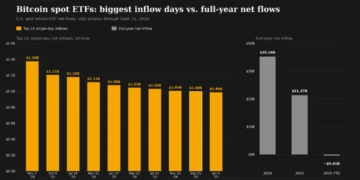
- US spot-Bitcoin ETFs have now seen a record 12 consecutive days of net outflows, with nearly $4 billion redeemed; $1.6 billion in bullish perpetual futures positions were wiped out in the past 24 hours alone
- Capital is explicitly rotating from Bitcoin into AI: K Wave Media abandoned $500M in planned Bitcoin purchases to redirect into AI data centers and GPU infrastructure; crypto miner Bitdeer liquidated its entire Bitcoin treasury to fund AI/HPC expansion
What Happened?
Bitcoin’s rout accelerated into Wednesday, with the largest cryptocurrency falling to $65,391 in Asian trading — its lowest level since early spring and 48% below the October 2025 peak. The psychological trigger was Strategy’s disclosure that it sold 32 Bitcoin for $2.5 million — a rounding error against a $62 billion position, but a direct violation of the “never sell” ethos that Saylor has preached publicly since 2020. The market interpreted it as a crack in the most important Bitcoin support narrative: that the world’s largest corporate holder would accumulate indefinitely. Meanwhile, the Nasdaq 100 hit a record high Tuesday, powered by AI stocks, crystallizing what fund managers are now describing openly as a rotation trade — selling Bitcoin and crypto to buy AI equities.
Why It Matters?
Bitcoin was once treated as high-beta tech — a leveraged bet on risk appetite that moved with the Nasdaq. That relationship broke decisively in October 2025 and has widened ever since. The Nasdaq 100 is up 41.5% over the past 12 months; Bitcoin is down 37%. The divergence is not random: it reflects a conscious capital allocation decision by institutional managers who see AI equities as offering a more compelling risk-reward profile. Wave Digital Assets’ Rajiv Sawhney captured the dynamic precisely: “Strategy selling 32 BTC for $2.5 million is financially trivial. What it signals to the market, given Bitcoin’s underperformance in recent weeks, matters more.” The leveraged MSTR fund complex — MSTU, MSTY, MSTX — adds systemic risk: as Strategy’s stock falls (down 14% this week, 70%+ from peak), these products amplify losses and force rebalancing, feeding a vicious downward loop in MSTR itself.
What’s Next?
The $65,000 level is now critical support; a weekly close below it would confirm the structural breakdown that technicians warned about at $70,000. Watch Strategy’s next disclosure: if Saylor sells again — even trivially — the narrative damage compounds. The ETF outflow streak ending is the clearest potential reversal signal; 12 consecutive days of outflows has no historical precedent in the post-ETF era. An Iran ceasefire deal reopening Hormuz and easing macro risk-off sentiment would likely provide the strongest Bitcoin catalyst, as geopolitical risk aversion has been the other major headwind alongside the rotation narrative. Longer term, the explicit capital shift from Bitcoin treasuries to AI infrastructure (K Wave, Bitdeer) signals a potential structural re-rating: if Bitcoin is no longer the preferred vehicle for corporate capital deployment into “transformative technology,” its institutional demand story requires a new thesis.
Source: Bloomberg