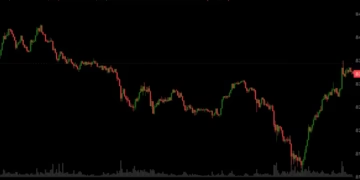
- Bitcoin dropped as much as 3.3% to $72,643 on Thursday — a six-week low — while Ether fell more than 4.6% to $1,965, its weakest in nearly two months, as renewed US-Iran military exchanges crushed risk appetite across asset classes.
- US spot-Bitcoin ETFs have recorded net outflows of approximately $2.1 billion so far in May — the largest monthly retreat since November — with reports of a large block sale in the iShares Bitcoin Trust (the biggest Bitcoin ETF) amplifying the selling pressure.
- Roughly $870 million in bullish crypto bets were unwound in the 24 hours ending Thursday morning, per CoinGlass data — a leveraged long liquidation cascade triggered by the combination of geopolitical shock and over-extended positioning.
- Analysts warn that a clean break below $70,000 could trigger a self-reinforcing wave of stop-losses and forced liquidations; higher US yields, a firmer dollar, and tightening financial conditions are all working against crypto in the near term.
What Happened?
Fresh US airstrikes on an Iranian military site near Hormuz and Kuwait’s interception of hostile Iranian drones and missiles on Wednesday renewed fears that the Iran conflict will continue driving energy prices higher, keeping inflation elevated, and pushing the Federal Reserve toward rate hikes rather than cuts. That macro backdrop — higher yields, stronger dollar, tighter financial conditions — proved toxic for leveraged crypto positions. Bitcoin fell to $72,643, its lowest since April 13, erasing weeks of gains. Ether dropped below $2,000 for the first time in nearly two months. Spot-Bitcoin ETF outflows of $2.1 billion for May mark the worst institutional retreat from the product since November, and a reported large block sale in the iShares Bitcoin Trust accelerated the move. Over $870 million in bullish derivatives bets were liquidated in a single 24-hour period.
Why It Matters?
This is a stress test of Bitcoin’s dual identity problem. Bitcoin advocates argue it is digital gold — an inflation hedge that should rally when war drives prices higher. But in practice, Bitcoin behaves as a risk asset when leverage is high and financial conditions tighten: it sells off alongside equities and bonds when the macro shock is acute enough. The $2.1 billion in May ETF outflows is particularly significant because it shows institutional holders — the investors who drove the ETF inflow boom in 2024 and 2025 — are reducing exposure, not adding to it. That is a different kind of selling pressure than retail capitulation. The $70,000 level flagged by analysts as a potential liquidation trigger is worth monitoring closely: the options and futures market has significant open interest clustered around that level.
What’s Next?
The near-term path for Bitcoin depends heavily on whether the Iran situation stabilizes. A ceasefire extension or credible diplomatic progress would likely release risk-on pressure across assets including crypto. But the ETF outflow trend and the rate-hike repricing are independent headwinds that do not resolve quickly — even if Hormuz reopens, a Fed that drops its easing bias at the June meeting is a persistent drag on speculative assets. Watch the $70,000 level on Bitcoin and the $1,900 level on Ether as potential liquidation tripwires. The PCE inflation print due Thursday could also be a catalyst: a reading at or above the expected 3.8% would reinforce rate-hike fears and extend crypto’s rough week.
Source: Bloomberg