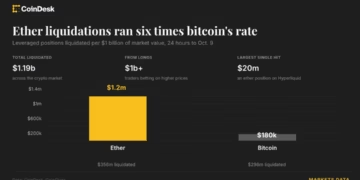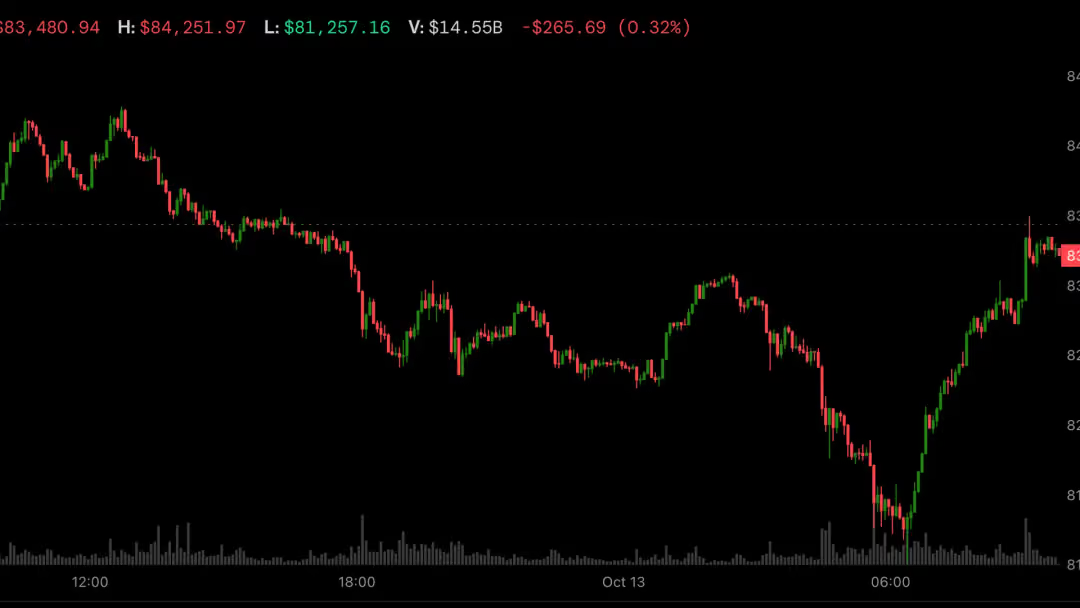
- Bitcoin demonstrated resilience on Tuesday, rebounding above $83,000 after briefly dipping below $81,000 as a severe selloff in Asian technology stocks tested crypto risk appetite. The intraday range ($81K-$83K) is tighter than the volatility seen in broader equity and commodity markets, suggesting that institutional crypto players are holding ground despite geopolitical uncertainty and macroeconomic headwinds. Ether bounced from five-day lows, XRP and Solana recovered from multi-week lows, and other major tokens followed the same pattern. The key insight is what did NOT happen: mass liquidation. In past market shocks (like the October 10, 2025 $19 billion crypto liquidation event), dips in equity markets triggered cascading crypto losses. This time, Bitcoin’s modest intraday dip and quick recovery suggest that the worst-case scenario (panic selling) is not manifesting. That restraint reflects two things: (1) retail crypto positions have probably stabilized at much lower leverage after last year’s crash, and (2) institutional holders are positioned defensively but not capitulating. A crypto trader at a major market-making firm told CoinDesk: “With US inflation data approaching, I expect institutional investors to focus on adding protection through derivatives and hedging strategies rather than materially reducing their underlying exposure.” In other words, institutions are buying downside options (puts), not selling crypto. They’re maintaining core positions while protecting against tail risk. That’s a strong signal about institutional conviction in crypto’s medium-term value proposition.
- The Asian tech selloff was severe and specifically targeted semiconductor and AI-related equities, which is the third or fourth time this pattern has repeated in the past month (see: October 15 Broadcom “casino” comment that crashed Nasdaq). South Korea’s KOSPI index plunged more than 6% intraday, falling below 6,000 for the lowest level since late July. Samsung Electronics and SK Hynix each dropped roughly 8%, extending five-session losing streaks. The fear: AI valuations are decoupling from fundamentals, and Chinese memory-chip producers (CXMT, others) are developing competing architectures that threaten Korea’s historical pricing power in DRAM. The sell-off is material because South Korea is a bellwether for global semiconductor health. If Korea is panicking on Chinese competition, it signals that semiconductor leadership is fragmenting. But crypto, historically a risk-on proxy, barely moved. Bitcoin’s $2K intraday range pales compared to Samsung’s 8% drop. That decoupling suggests either (A) crypto is less sensitive to semiconductor sentiment than in prior cycles, or (B) crypto investors have already priced in semiconductor weakness and don’t believe it threatens crypto mining profitability or AI chip demand dynamics. The latter is more plausible: Bitcoin mining profitability is driven by hash rate difficulty and energy costs, not semiconductor valuations. AI chip shortages don’t threaten Bitcoin. So Korean semiconductor panic doesn’t mechanically transmit to crypto.
- Oil prices remained elevated, with WTI crude holding near $92.67 (up from Monday recovery below $90) and Brent hovering around $106 after a three-day rally. The culprits are fresh attacks on Saudi Arabia and continued Houthi threats to shipping through the Strait of Hormuz. Elevated oil raises inflation expectations, which typically leads to Fed rate-hike calls, a known headwind for crypto (higher rates reduce the discount value of future crypto cash flows). Additionally, the US Dollar Index held near 102.50, its highest level since April 2025. A stronger dollar is another crypto headwind because most crypto trading is priced in dollars; when the dollar strengthens, it makes crypto expensive for foreign buyers and reduces international demand. Both oil elevation and dollar strength are working against crypto. But Bitcoin still bounced to $83K. That suggests that oil and dollar headwinds are already in the market’s collective expectation. The real catalyst is Thursday’s US CPI report. If CPI comes in hotter than expected, it confirms inflation persistence, which could trigger another Fed hike or signal higher-for-longer rates. That would hit crypto. If CPI comes in cool, it opens the door to rate-cut expectations, which would be bullish for crypto. The CPI print is a binary event that could easily move Bitcoin by $2K-$3K.
- Institutional positioning ahead of CPI is revealing. Rather than liquidating crypto holdings out of fear, major players are buying hedges (derivatives, options) to protect downside while maintaining core exposure. This is the classic institutional playbook: “Hold your position, protect your tail risk.” The strategy signals confidence in crypto’s medium-term value (otherwise, why hold?) but caution about near-term volatility (hence the hedging). The fact that a major market-making firm is explicitly stating this positioning to the media (CoinDesk) suggests it’s become consensus among institutional players. That consensus could support the $81K-$84K range through CPI. If CPI surprises bullish, expect a sharp rally (Bitcoin could test $85K-$87K quickly if Fed rate-cut expectations suddenly emerge). If CPI surprises bearish, expect a test of $80K-$81K support, but institutions will likely buy the dip (hence why some traders are expecting “large investors to increase hedging rather than reduce their underlying exposure”). The key risk: if CPI triggers a major Fed policy shift signal (surprise hawkishness), then institutional hedges might not be sufficient, and Bitcoin could break down to $78K-$79K. But that would require CPI to be drastically worse than expectations.
What Happened?
Bitcoin rebounded above $83,000 on Tuesday after an early intraday dip to just below $81,000, demonstrating resilience amid a sharp selloff in Asian semiconductor stocks and elevated macroeconomic uncertainty. Ether recovered from five-day lows, while XRP, Solana, and other major tokens bounced from recent weakness. The cryptocurrency price action contrasted sharply with severe declines in Asian equities, particularly South Korea’s KOSPI index, which plunged more than 6% intraday and fell below 6,000 for its lowest level since late July. Samsung Electronics and SK Hynix each dropped approximately 8%, extending five-session losing streaks, as investors worried about artificial intelligence-related valuation corrections and rising competition from Chinese memory-chip producers. Hong Kong’s Hang Seng index slipped 0.4%, and Nasdaq futures fell 0.6%, extending Monday’s 0.78% decline. Oil markets remained elevated, with WTI crude trading near $92.67 and Brent hovering around $106 per barrel, sustained by reports of fresh attacks on Saudi Arabia and continued Houthi threats to shipping through the Strait of Hormuz. The US Dollar Index held near 102.50, its highest level since April 2025. Institutional crypto traders indicated that major investors are focused on adding protective hedges through derivatives strategies rather than liquidating underlying crypto positions ahead of Thursday’s US consumer price index report, the next significant catalyst for cryptocurrency price direction.
Why It Matters?
Bitcoin’s decoupling from the Asian technology selloff and its ability to maintain a relatively tight trading range despite multiple macroeconomic headwinds (oil elevation, strong dollar, geopolitical tension) signals that institutional crypto investors have shifted from panic-sale positioning to defensive-positioning strategies. The institutional focus on hedging rather than liquidation suggests underlying confidence in crypto’s medium-term value proposition, even as near-term catalysts (US CPI data, potential Fed policy signals) create elevated volatility risk. The contrast between crypto’s modest intraday moves and equity markets’ sharp declines indicates that leverage and forced liquidations—which triggered the October 10, 2025 $19 billion crypto crash—are currently lower, reducing systemic tail risk in crypto markets. However, Thursday’s CPI report represents a binary catalyst that could significantly move Bitcoin valuations: a hotter-than-expected print would confirm inflation persistence and support higher-for-longer rate expectations, a headwind for crypto; a cooler-than-expected print would open the door to rate-cut expectations, supportive for crypto prices. The institutional hedging positioning implies that the $81K-$84K range will likely hold through CPI, but a significant surprise in either direction could trigger rapid volatility.
What’s Next?
Monitor Thursday’s US CPI report closely as the primary catalyst for Bitcoin price direction. A hotter-than-expected print (>0.3% month-over-month core CPI, or >3.0% year-over-year) would likely trigger Bitcoin weakness toward $80K-$81K support, though institutional hedging may limit the downside. A cooler-than-expected print would open the door to rate-cut expectations and could trigger a rapid rally toward $85K-$87K. Watch for any Fed communication or policy signals following the CPI data, as unexpected hawkishness could trigger institutional hedge liquidation and a breakdown toward $78K-$79K. Monitor oil prices and geopolitical developments in the Middle East. If Saudi attacks intensify or Houthi strikes disrupt shipping significantly, oil could spike above $100 WTI, which would reinforce inflation expectations and create a headwind for crypto. Conversely, if tensions ease, oil weakness would support crypto. Track the US Dollar Index. A break above 103.00 would represent fresh strength and additional headwind for crypto. A move below 102.00 would relieve dollar strength and support crypto prices. Monitor institutional positioning through derivative data (open interest in Bitcoin futures, put/call ratios). If institutional hedging intensity rises significantly, it could signal increasing concerns about downside risk. If hedging falls, it could signal growing confidence. Watch for repeat patterns of Asian semiconductor weakness and whether it begins to transmit to crypto through indirect channels (mining cost inflation, chip-related supply chain issues). Finally, track the $83K level as resistance and $81K as support. A break above $83K on strong volume would suggest momentum to test $85K+. A break below $81K would confirm bearish momentum toward the $78K-$80K zone.
Affected Tickers and Coins: BTC | ETH | XRP | SOL | ZEC | Samsung | SK Hynix | KOSPI
Source: CoinDesk