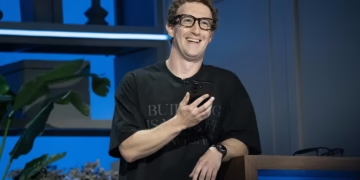
- Microsoft co-founder Bill Gates said in an interview excerpt with NBC Meet the Press, airing this weekend, that AI is powerful enough to drive events causing a billion deaths, describing the combination of people with malicious intent and current AI tools as more powerful than any weapon that has existed.
- Gates argued that self-regulation by the industry is insufficient and that law enforcement and politicians must be involved in determining what safeguards and monitoring look like, adding that such measures have to be mandatory rather than optional.
- His warning follows escalating concern inside the industry. Jacob Coxon, a staffer at Anthropic, resigned this month accusing both Anthropic and OpenAI of gambling with lives by racing toward super-intelligent AI, and another Anthropic employee has said he believes there is a greater than 10% chance AI eliminates all humans within the next decade.
- Markets registered none of it. Microsoft rose 3.48% to 515.26 and Meta gained 3.70% to 748.83 on the day the remarks were published.
What Happened?
Anthropic chief executive Dario Amodei has since urged a slowdown in AI development, a proposal supported by OpenAI chief executive Sam Altman and Elon Musk. In an essay published in August, Gates set out more specific scenarios, arguing that bad actors could use increasingly capable AI for cyberattacks, fraud and disinformation directed at hospitals, financial institutions, power grids and government systems.
Why It Matters?
Gates is making a different claim from the one dominating this debate, and the distinction matters. He is describing people using AI to cause harm, not an autonomous system acting on its own, which is a nearer-term and more tractable problem than the extinction scenarios circulating from inside the labs. It is also the version supported by evidence, since AI-enabled fraud and intrusion are already occurring. Conflating the two muddles what regulation would actually need to address. His position on enforcement puts him directly at odds with the industry framework. OpenAI published a proposal this week asking Washington to lead international standards through the Commerce Department, while specifying those standards would not be licences, mandatory prerelease review or approval requirements, and leaving adoption to national governments. Gates is arguing for precisely what that proposal rules out. The most prominent independent voice in technology and the leading AI developer are therefore proposing opposite regulatory architectures in the same week, which suggests the shape of any eventual framework is far from settled. For investors the market reaction is the most informative data point. The best-known figure in the industry described a billion-death scenario and AI-exposed shares rose more than 3%. Either investors regard these warnings as noise, or they have concluded that regulation sufficient to constrain the technology is not coming. The second reading is the more consequential, because it means any genuine move toward mandatory monitoring would be unpriced. The practical exposure worth examining is the one in Gates August essay: attacks on hospitals, financial institutions, power grids and government systems are insurable, measurable risks affecting utilities, healthcare operators and banks, and that tail is more assessable than any extinction estimate.
What Next?
The full interview airs this weekend and may contain more specific regulatory proposals than the excerpt. The live policy question is whether Congress or the administration moves toward the mandatory monitoring Gates describes or the voluntary standards the industry prefers, and the Commerce Department response to the OpenAI proposal is the first place that will show. Watch whether other figures outside the AI labs align with Gates, since an independent coalition calling for binding rules would carry different weight than warnings from companies with commercial interests in the outcome. On the cyber side, any significant AI-enabled attack on critical infrastructure would move this debate faster than any essay, and that is the scenario with direct portfolio consequences. Also track whether AI-exposed equities ever react to safety news, because so far they have moved higher through every escalation.
Affected Tickers and Coins: MSFT, META, GOOGL, NVDA
Source: Bloomberg